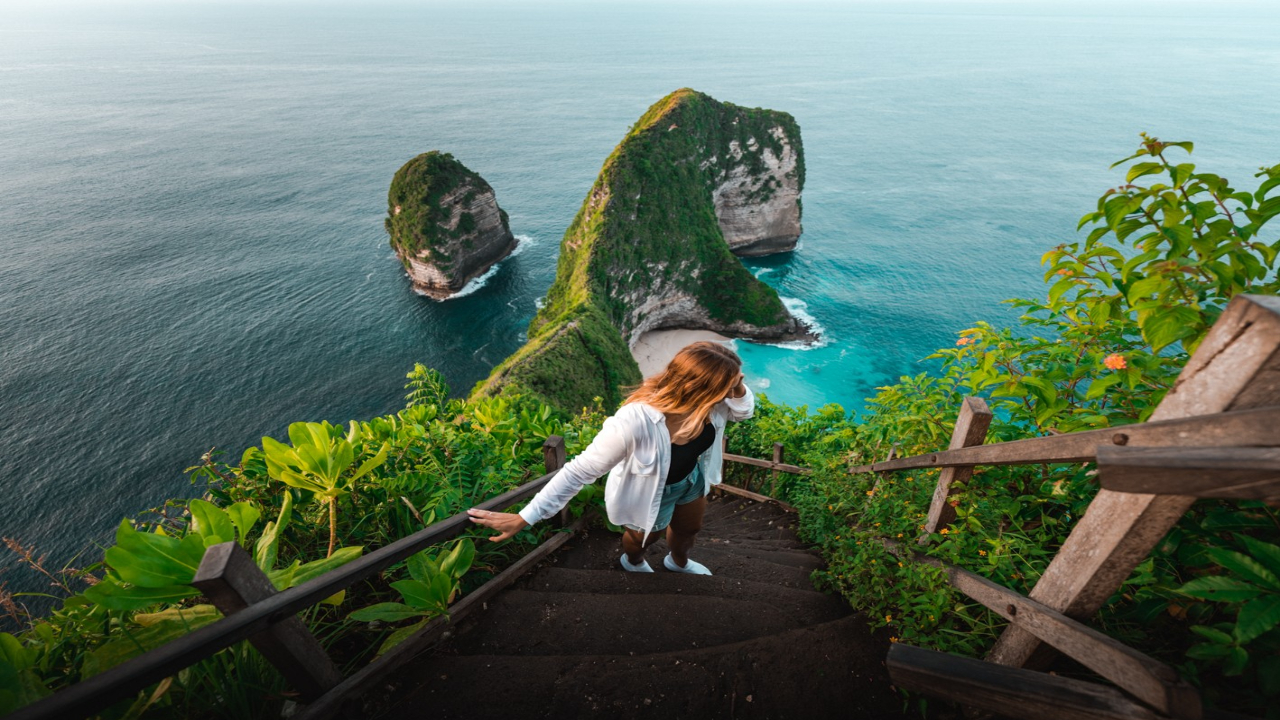
Nusa Penida Island is one of the most spectacular destinations in Bali, Indonesia. Just across the water from mainland Bali, this rugged island is famous for towering limestone cliffs, turquoise bays, white-sand beaches, dramatic coastal viewpoints and some of the most exciting marine life in the region.
From the iconic T-Rex-shaped headland at Kelingking Beach to the bright sand and rock formations at Diamond Beach, Nusa Penida offers landscapes that look almost unreal. Yet the island is more than a collection of Instagram viewpoints. Its villages, temples, marine ecosystems and quiet interior hills reveal a side of Bali that feels very different from the busy resort towns of the mainland.
This complete Nusa Penida Island travel guide covers how to get there from Bali, ferry routes, island transportation, the best beaches and attractions, snorkeling with manta rays, a practical three-day itinerary, entrance fees, where to stay, hotel room options, local culture, food, weather, travel costs and important safety precautions.

Wikimedia Commons,
CC BY-SA 4.0.

Wikimedia Commons,
CC BY-SA 4.0.

Wikimedia Commons,
CC BY-SA 4.0.
Nusa Penida Island At A Glance
| Detail | Information |
|---|---|
| Location | Southeast of mainland Bali, Indonesia |
| Regency | Klungkung, Bali |
| Main gateway | Sanur, Bali |
| Typical fast boat | 30–45 minutes, weather dependent |
| Popular arrival ports | Banjar Nyuh, Toyapakeh area and Sampalan |
| Best trip length | 3 days / 2 nights |
| Best general travel season | April–October, subject to marine conditions |
| Foreign adult island fee | IDR 25,000 |
| Separate attraction levy | IDR 25,000 per adult at applicable attractions |
| Currency | Indonesian Rupiah (IDR) |
| Time zone | WITA / UTC+8 |
Where Is Nusa Penida?
Nusa Penida is located southeast of mainland Bali, separated from the main island by the Badung Strait.
It is the largest of the three neighboring islands commonly associated with this part of Bali. The other two are Nusa Lembongan and Nusa Ceningan.
Although it is administratively part of Bali Province, Nusa Penida feels noticeably different from popular mainland destinations such as Kuta, Seminyak, Canggu and Ubud.
The coastline is dominated by large limestone cliffs, while the interior contains villages, temples, farmland and rolling hills. Roads have improved in recent years, but steep terrain and winding routes still make short distances surprisingly slow.
For travelers exploring more of Indonesia, Aoqira also covers the unusual coastal scenery of the Komodo Pink Beaches, another extraordinary Indonesian island destination.
Nusa Penida Island Map
Use the map below to understand the island’s overall position and plan your journey between the western and eastern attractions.
How To Get To Nusa Penida From Bali
There is no road bridge connecting Nusa Penida to mainland Bali. Visitors must cross by boat.
Sanur To Nusa Penida Fast Boat
Sanur is the main departure hub for travelers staying in southern Bali.
Numerous operators provide fast boat services to ports on Nusa Penida, with typical crossings taking about 30–45 minutes in suitable conditions.
Travel time can become longer during rough weather, and departures may be delayed or cancelled when the crossing is considered unsafe.
The main steps are straightforward:
- Book a fast boat to the correct Nusa Penida arrival port.
- Travel to Sanur Harbour well before check-in closes.
- Keep your ticket confirmation and identification accessible.
- Follow the operator’s baggage and boarding instructions.
- Meet your pre-arranged driver or accommodation transfer after arrival.
Important: Check the destination port before purchasing a ticket. Banjar Nyuh/Toyapakeh and Sampalan are different arrival areas, and choosing the wrong port can add unnecessary driving time.
Other Boat Routes
Boat services may also operate from Kusamba, Padang Bai and neighboring islands, depending on operator, route and season.
Travelers already staying on Nusa Lembongan should check the current local boat connections rather than returning to Sanur unnecessarily.
How Much Is The Ferry?
Ticket prices vary according to boat company, travel date, passenger category, service level and booking channel.
When comparing fares, check whether the price is one-way or return and whether it includes hotel pickup, harbor transfers or local tourism fees.
Buy from an established operator and give yourself plenty of flexibility if connecting to an international flight. A delayed boat should never force you to miss a flight from Bali.
How To Get Around Nusa Penida
Getting around the island deserves as much planning as the ferry journey.
Nusa Penida is larger than many first-time visitors expect. Famous viewpoints sit on different sides of the island and are connected by hilly roads.
Private Car With Driver
For most visitors, a private car with a local driver is the best combination of convenience and safety.
A driver can organize attractions in a sensible order, navigate steep roads and help avoid spending too much time searching for parking or entrances.
This is especially useful if you have only two or three days and want to cover both coastal regions.
Scooter Rental
Scooters offer flexibility, but they are not a good choice for inexperienced riders.
Some access roads are narrow, steep, broken or slippery after rain. Busy viewpoints can also involve unexpected traffic and difficult parking.
Only consider a scooter if you have appropriate riding experience, a valid motorcycle licence accepted in Indonesia, suitable insurance and a properly fitted helmet.
Public Transportation
Nusa Penida does not have the kind of convenient scheduled public transport network visitors may expect in large cities.
Do not build a detailed sightseeing itinerary assuming you can simply summon a conventional metered taxi or app-based car at every remote viewpoint.
Pre-arranging transport is generally much easier.
Best Things To Do On Nusa Penida Island
1. Kelingking Beach
Kelingking Beach is the island’s most famous landmark and one of Indonesia’s most recognizable coastal viewpoints.
From the top of the cliff, a long limestone headland curves into the ocean above a white-sand beach. Its silhouette is popularly compared with a Tyrannosaurus rex, giving it the nickname T-Rex Bay.
The upper viewpoint provides the classic panoramic photograph. You do not need to descend the cliff to appreciate it.
The route toward the beach is extremely steep, involves exposed sections and can become slippery. Anyone considering the descent should evaluate current access, footwear, fitness and weather conditions carefully.
Swimming warning: Kelingking faces powerful open-ocean surf. Dangerous currents and breaking waves make swimming extremely risky. Treat the beach primarily as a scenic destination rather than a swimming location.
The unfinished glass-lift structure at the cliff is not an operational visitor transport service.

Wikimedia Commons, CC BY-SA 4.0.
2. Broken Beach (Pasih Uug)
Broken Beach is one of Nusa Penida’s most unusual geological formations.
Here, the sea enters an almost circular coastal basin through a natural limestone arch, creating a remarkable view of turquoise water enclosed by high cliffs.
You can walk around the upper coastal viewpoint and admire the arch from several positions.
Broken Beach is not a normal swimming beach. The main attraction is the rock formation and the view from above.
Stay away from unprotected cliff edges, especially when taking photographs.

Wikimedia Commons, CC BY-SA 4.0.
3. Angel’s Billabong
Angel’s Billabong is a natural coastal rock pool located near Broken Beach.
When conditions are calm, the water and surrounding rock create an impressive natural infinity-pool effect against the ocean.
However, this is one of the places where appearances can be dangerously misleading.
Large waves can suddenly wash over the rocks, and the force of moving water can be enough to sweep visitors into the sea.
Enjoy the view from a safe position. Do not enter the water or approach the outer ledges when surf conditions are uncertain.

Wikimedia Commons, CC BY-SA 4.0.
4. Crystal Bay
Crystal Bay is one of the most accessible beaches on Nusa Penida and a popular place to end a western-island sightseeing day.
The bay has a sandy shoreline, palm trees and views toward a small offshore island.
It is popular for snorkeling, diving and sunset views, although water conditions vary and strong currents can develop.
For a relaxing afternoon, choose a shaded place to sit, enjoy the scenery and stay out of the water if surf, currents or visibility look unsafe.

Wikimedia Commons, CC BY-SA 4.0.
5. Diamond Beach
Diamond Beach is among the most beautiful locations on the eastern coastline of Nusa Penida.
The white-sand beach lies beneath spectacular limestone cliffs, with isolated pointed rock formations rising from the bright blue water.
Its carved staircase has become one of the island’s iconic photographs.
The descent is exposed and steep, and some sections can be crowded or slippery. Access conditions may change, so follow local instructions.
Many visitors find the upper viewpoint more than rewarding enough without descending to the sand.
The waves can be powerful, so do not assume the beach is safe for swimming simply because the water looks inviting.

Wikimedia Commons, CC BY-SA 4.0.
6. Atuh Beach
Atuh Beach sits near Diamond Beach on the eastern side of the island.
Its crescent of sand is surrounded by limestone headlands and distinctive offshore rock formations.
The descent to the beach involves steps, and conditions can be hot during the middle of the day.
Atuh is particularly scenic in the morning, when the light illuminates the eastern coastline.
Diamond and Atuh Beaches can comfortably form the main focus of one eastern-island sightseeing morning.

Wikimedia Commons, CC BY-SA 4.0.
7. Thousand Islands Viewpoint
The Thousand Islands Viewpoint offers one of the most dramatic panoramic views on the eastern coast.
Rather than overlooking a traditional beach, the viewpoint looks across steep cliffs, isolated limestone formations and deep blue water.
It pairs naturally with Diamond Beach, Atuh Beach and the nearby tree-house viewpoint area.
Keep a safe distance from cliff edges and avoid crossing barriers for photographs.
8. Rumah Pohon Tree House
Rumah Pohon is a famous tree-house viewpoint overlooking the rugged eastern coastline.
It is best treated as a photo attraction rather than assuming that accommodation or tree-house access will always be available.
Photography rules, access arrangements and any applicable fees can change.
Check locally before visiting and respect other guests or visitors who may have reserved access.
9. Teletubbies Hill
Teletubbies Hill is a quieter alternative to the island’s dramatic coastal viewpoints.
Rolling green hills cover this part of the interior, creating a landscape that looks particularly lush during and after the rainy season.
During drier periods, the grasses may turn yellow or brown.
The hills are worth visiting if you enjoy natural scenery and want a break from crowds at the island’s famous beaches.
10. Goa Giri Putri Temple
Goa Giri Putri is one of Nusa Penida’s important spiritual attractions.
The Hindu temple complex is located inside a large limestone cave reached through a narrow entrance.
Visitors should dress respectfully, follow local guidance, and avoid disturbing religious ceremonies.
This is an active sacred place, not simply a tourist cave.
The experience helps visitors understand the island’s culture beyond its beaches and viewpoints.
11. Tembeling Forest And Natural Pools
Tembeling is a more adventurous destination involving forest scenery, natural pools and a secluded coastal setting.
The access route can be steep and rough, particularly after rain.
Visitors should confirm current access conditions and avoid forcing a vehicle along a road that feels unsafe.
Follow local rules around the pools and do not enter water when conditions are uncertain.
12. Peguyangan Waterfall
Peguyangan, also called Guyangan, is known for a striking blue staircase descending along a tall coastal cliff.
The attraction is as much about the exposed staircase and ocean scenery as it is about the spring and temple area below.
This is not a suitable excursion for travelers with serious fear of heights, limited mobility or discomfort with steep stairways.
Use appropriate footwear, follow local temple requirements and avoid visiting when rain or strong winds make the descent unsafe.
Snorkeling And Diving With Manta Rays
Nusa Penida is one of Bali’s most famous destinations for marine life.
Its surrounding waters are known for coral reefs, sea turtles, reef fish, manta rays and seasonal encounters with ocean sunfish, also called mola.
Manta Point is a particularly well-known dive destination, while other snorkeling and diving itineraries may visit Manta Bay, Gamat Bay, Crystal Bay or nearby sites depending on conditions.
Manta rays may be encountered throughout the year, but sightings are never guaranteed.
Ocean sunfish are more commonly associated with the cooler-water period around July to October.

Wikimedia Commons, CC BY-SA 4.0.
Choosing A Safe Snorkeling Tour
Do not select a snorkeling tour based only on the cheapest price or the promise of manta-ray sightings.
Look for a licensed, safety-focused marine operator with suitable equipment, appropriate group size and clear weather-cancellation procedures.
Ask whether the tour includes:
- properly fitted life jackets;
- a snorkeling guide;
- appropriate boat safety equipment;
- insurance information;
- reef-safe environmental practices;
- clear procedures when currents are too strong.
Some areas around Nusa Penida experience powerful and unpredictable currents. Beginners should never feel pressured to enter the water just because a tour boat has reached a snorkeling location.
Never touch, chase, block or feed manta rays. Maintain a respectful distance and allow the animals to control encounters.
Nusa Penida Entrance Fees In 2026
Visitors should distinguish between three different payment categories.
| Fee | Amount | Applies To |
|---|---|---|
| Bali foreign tourist levy | IDR 150,000 | Eligible international tourists visiting Bali |
| Nusa Penida area entry | IDR 25,000 adult / IDR 15,000 child aged 4–13 | Foreign visitors entering the tourism area |
| Applicable attraction entry | IDR 25,000 adult / IDR 15,000 child aged 4–13 | Visitors to participating attractions under the local ticketing system |
The Klungkung Regency government introduced its revised tourism collection system effective 1 September 2026. The Nusa Penida arrival charge and individual attraction charges are separate, rather than one universal ticket for the whole island.
Some tours include certain local charges; others do not. Confirm what your booking actually covers and keep payment receipts.
The separate Bali provincial foreign tourist levy can be paid using the official Love Bali website.
Always use official payment channels rather than unsolicited payment requests.
Where To Stay On Nusa Penida Island
Staying overnight is one of the best ways to enjoy Nusa Penida because the island’s beaches and viewpoints are spread out.
For most visitors, the northwest side around Toyapakeh, Ped and the surrounding hillside accommodation is practical for ferry connections, restaurants and exploring the west coast.
The three accommodations below cover a comfortable hillside hotel, an ocean-view resort and a luxury private-pool villa option.
| Hotel | Accommodation | Best For |
|---|---|---|
| Semabu Hills Hotel & Villa | Ocean-view suites, double rooms and villa | Convenient hillside base |
| Adiwana Warnakali | Ocean-view rooms, suites and pool villas | Couples, diving and ocean views |
| MĀUA Nusa Penida | Deluxe rooms and private-pool villas | Luxury and privacy |
1. Semabu Hills Hotel & Villa
Location: Toyapakeh–Ped hillside area.
Semabu Hills is a practical option for visitors wanting attractive island views while remaining relatively close to the northwest transportation area.
Its official accommodation listings include standard double rooms, larger suites and a two-bedroom villa.
Selected room categories include:
- Deluxe Double Room: approximately 60 m² with a king bed.
- Deluxe Twin Room: approximately 60 m² with twin-bed accommodation.
- Ocean View Suite: approximately 100 m² with separate living and bedroom areas.
- Suite Pool Access: approximately 100 m² with terrace and sea views.
- Two-Bedroom Villa: approximately 300 m², private pool and room for a family or group.
The hotel also offers a swimming pool, restaurant and island-trip packages.
Semabu Hills works well if you want to spend busy days exploring and return to a larger, more relaxing room in the evening.
Official room photos:
View actual hotel, pool, room and villa photographs on the Semabu Hills website.
Official villa gallery:
View Two-Bedroom Villa photographs and facilities.
2. Adiwana Warnakali
Location: Sakti, Nusa Penida.
Adiwana Warnakali is an ocean-facing resort constructed along a coastal slope with views toward the surrounding sea and neighboring islands.
The resort offers a more intimate and scenic accommodation experience, making it attractive for couples, divers and travelers who want a relaxing stay between excursions.
Its official accommodation categories include:
- Grand Deluxe Ocean View;
- Ocean View Suite;
- Premier Ocean Suite;
- One-Bedroom Pool Villa with Ocean View;
- Two-Bedroom Pool Villa with Ocean View.
Facilities listed by the resort include an ocean-view swimming pool, spa and access to diving services through the on-site dive center.
Choose this property if you want a scenic stay where relaxing at the hotel is an important part of your island experience.
Official hotel photographs:
View Adiwana Warnakali’s real room, pool, ocean-view and facilities photo gallery.
Official website:
Adiwana Warnakali Resort.
3. MĀUA Nusa Penida
Location: Gamat Bay area, Nusa Penida.
MĀUA Nusa Penida is a luxury-oriented resort offering contemporary rooms and private-pool villas in a hillside setting.
It is particularly appealing to couples and families looking for more privacy and a quieter resort experience.
Accommodation options listed on the official website include:
- Deluxe Room with Valley View: approximately 47 m², with balcony options.
- One-Bedroom Pool Villa: approximately 75 m², with a private pool.
- One-Bedroom Deluxe Pool Villa: approximately 94 m², with sea-view options.
- Two-Bedroom Pool Villa: approximately 110 m², suitable for families and groups.
- Two-Bedroom Duplex Pool Villa: approximately 140 m², featuring a private pool and spacious living areas.
Depending on the category, rooms may include air conditioning, Wi-Fi, minibar, safe, coffee facilities and private outdoor living spaces.
MĀUA is a good choice if you prefer spending part of the trip at your accommodation rather than rushing between sightseeing stops every day.
Official hotel photographs:
View actual MĀUA Nusa Penida resort, villas and room photographs.
Room and villa gallery:
Explore the official room and private-pool villa categories.
Best Area To Stay On Nusa Penida
Toyapakeh and Ped: A good first-time base for ferry access, accommodation choices, restaurants and western-island travel.
Crystal Bay area: Attractive if beach scenery and sunsets are your priorities, although you should check the exact location of each hotel and road access.
Gamat Bay and surrounding hills: Suitable for quieter boutique and resort-style accommodation.
Eastern Nusa Penida: Useful if you want to spend substantial time around Diamond Beach, Atuh Beach and the eastern villages, but less convenient for some western highlights.
For only two nights, staying at one well-located hotel is usually simpler than moving luggage between different properties.
Best Nusa Penida 3-Day Itinerary
Three days and two nights offer an excellent introduction without making every day feel rushed.
Day 1 — West Nusa Penida
Take a morning fast boat from Sanur and meet your pre-arranged driver at the arrival port.
Spend the day exploring:
- Kelingking Beach viewpoint.
- Broken Beach.
- Angel’s Billabong.
- Crystal Bay if there is sufficient time.
Check into your hotel afterward and enjoy a relaxed dinner.
If you plan to descend the Kelingking cliff, do not attempt all these stops on a tight schedule. In many cases, simply viewing Kelingking from above is the more practical and safer choice.
Day 2 — East Nusa Penida
Leave your accommodation early and focus on the eastern coastline.
A practical route includes:
- Diamond Beach viewpoint.
- Atuh Beach.
- Thousand Islands Viewpoint.
- Rumah Pohon tree-house area.
- Teletubbies Hill if time and road conditions allow.
Take breaks and carry water. The eastern side is beautiful, but viewpoint stairs and exposed paths can become exhausting in the heat.
Day 3 — Snorkeling Or Relaxation
Use the final morning for a marine excursion with a reputable operator, a cultural visit or simply relaxing at the hotel.
If you go snorkeling, choose an excursion that finishes with enough time to reach your ferry departure port comfortably.
Return to mainland Bali later in the day, allowing flexibility for sea conditions.
Can You Visit Nusa Penida In One Day?
Yes, but it is important to be realistic.
A one-day tour from Bali normally includes the journey to Sanur, ferry check-in, boat crossing, island sightseeing, return to the port and crossing back to the mainland.
That leaves less time at the actual attractions than many travelers expect.
For one day, choose either:
- West Nusa Penida: Kelingking, Broken Beach, Angel’s Billabong and possibly Crystal Bay.
- East Nusa Penida: Diamond Beach, Atuh Beach and the nearby viewpoints.
Trying to see every famous location in a single day usually means spending much of the trip in a vehicle.
Best Time To Visit Nusa Penida
April To October
This is broadly Bali’s drier period and often provides more favorable conditions for sightseeing and outdoor travel.
Clearer weather can make cliff viewpoints and beach visits particularly rewarding.
However, dry-season winds and ocean swell can still affect boat trips and snorkeling conditions.
November To March
The wetter period brings greener hills, higher humidity and more frequent rainfall.
Rain can make steep trails and some roads slippery. Sea conditions can also change quickly.
Trips remain possible, but build more flexibility into your plans.
Best Time For Manta Rays And Ocean Sunfish
Manta rays may be seen throughout the year, although encounters always depend on conditions and animal behavior.
The cooler-water period around July to October is often associated with increased chances of ocean sunfish sightings for experienced divers.
Cold water, stronger currents and deep diving conditions make some of these sites unsuitable for beginner divers.
How Much Does A Nusa Penida Trip Cost?
The total cost depends heavily on travel style, season and whether you arrange a driver or book a package.
Budget separately for:
- fast boat tickets;
- tourism levies and attraction fees;
- car with driver or scooter rental;
- accommodation;
- meals and drinks;
- snorkeling or diving trips;
- travel insurance and any personal extras.
For accurate planning, request a written quote from your driver or tour company explaining exactly which fees, meals and transfers are included.
Do not assume that a cheap advertised tour includes every attraction levy or harbor charge.
Food And Restaurants
Visitors can find Indonesian dishes, fresh seafood, international café food and hotel restaurants around populated parts of Nusa Penida.
Useful local food options to look for include:
- Nasi goreng: Indonesian fried rice.
- Mie goreng: Fried noodles with vegetables and optional protein.
- Satay: Grilled skewers commonly served with sauce.
- Nasi campur: Rice with a selection of side dishes.
- Fresh fish: Available at some coastal restaurants, depending on the day’s catch.
Choose clean, busy eateries, drink safe bottled or properly filtered water and be cautious with food that has been left unrefrigerated in the heat.
Nusa Penida Culture And Local Etiquette
Nusa Penida is home to Balinese communities with active Hindu religious traditions.
Its temples, villages and sacred sites are important parts of everyday local life.
When visiting a temple:
- follow posted dress requirements;
- wear a sarong or sash where required;
- respect active worship and ceremonies;
- ask permission before photographing people;
- avoid stepping on offerings;
- follow instructions from temple caretakers.
Travelers should remember that local communities live here year-round. Respect for residents matters just as much as protecting the landscape.
Safety And Travel Precautions
Nusa Penida’s landscapes are spectacular, but some of its most famous attractions carry serious risks.
1. Cliff Safety
Many coastal viewpoints have sheer drops, loose rock and limited protective barriers.
Stay back from edges, avoid unstable overhangs and never cross safety barriers for photographs.
Strong winds and wet ground can make exposed viewpoints more dangerous.
2. Dangerous Surf And Currents
Kelingking, Diamond Beach and exposed coastal locations can experience powerful waves and rip currents.
Some beaches have limited rescue facilities, and emergency access may be difficult.
Do not enter the water merely because other visitors are doing so.
3. Steep Stairways
Kelingking, Diamond Beach and Peguyangan involve potentially demanding descents.
Footwear, fitness and current conditions matter. Always remember that you must climb back up after descending.
4. Road Safety
Some roads are steep, narrow or uneven. Construction and rainy conditions may alter driving routes.
Choose a competent local driver unless you are genuinely comfortable riding a motorcycle on difficult roads.
5. Boat Safety
Fast boats may be delayed or cancelled because of rough sea conditions.
Follow crew instructions, wear safety equipment when directed and avoid overloaded or poorly maintained boats.
6. Snorkeling And Diving
Currents can change quickly around reefs, headlands and channels.
Use professional operators, stay within your ability, avoid touching coral and never chase wildlife.
7. Heat And Dehydration
Exposed viewpoints can be very hot in the middle of the day.
Carry water, take shade breaks and use sun protection.
8. Emergency Planning
Some remote beaches and cliffs have poor mobile coverage and limited emergency access.
Share your route with your accommodation or driver and avoid exploring hazardous trails alone.
Travel insurance should cover your intended activities, including snorkeling or diving if relevant.
What To Pack For Nusa Penida
- comfortable walking shoes with grip;
- lightweight, breathable clothing;
- sun hat and sunglasses;
- sunscreen;
- reusable water bottle;
- swimwear and towel;
- waterproof bag for boat travel;
- phone and power bank;
- offline map;
- light rain jacket;
- sarong for temple visits;
- small cash reserve and a working payment card.
Nusa Penida Vs Nusa Lembongan
These islands are close together but offer different experiences.
Nusa Penida is larger, more dramatic and generally better for travelers seeking iconic cliffs, long scenic drives and major coastal viewpoints.
Nusa Lembongan is smaller and often easier for a slower island stay with cafés, beaches and shorter sightseeing journeys.
If you have enough time, combining both islands can be worthwhile, but do not underestimate the travel involved in moving between accommodation and attractions.
More Indonesia Travel Guides From Aoqira
If you enjoy Nusa Penida’s cliffs and extraordinary beaches, continue exploring Indonesia with these related Aoqira guides.
The Pink Beaches in Komodo guide explores another beautiful Indonesian island region known for snorkeling and unusual coastlines.
For a more adventurous side of Indonesia, read Aoqira’s Inerie Volcano Hike guide, covering a demanding volcanic mountain trek on Flores.
Another interesting island destination is covered in the Ternate Island travel guide, with volcano scenery and historic attractions in North Maluku.
Frequently Asked Questions
Where is Nusa Penida Island?
Nusa Penida is southeast of mainland Bali, Indonesia, across the Badung Strait. It is part of Klungkung Regency, Bali Province.
How do you get from Bali to Nusa Penida?
The most common option is a fast boat from Sanur to one of Nusa Penida’s harbors, followed by local road transportation.
How long is the ferry?
Fast boat journeys commonly take about 30–45 minutes in suitable conditions, although sea state and operator schedules can change travel time.
How many days should I stay?
Three days and two nights is a good starting point. It allows separate days for the western and eastern attractions and leaves some time for snorkeling or relaxation.
Is Nusa Penida worth visiting?
Yes, especially if dramatic coastal scenery, snorkeling and nature are priorities. Its rugged character is also why transportation and safety planning matter.
Can I swim at Kelingking Beach?
Swimming is strongly discouraged because of powerful surf and dangerous currents. The upper viewpoint is the safer way to appreciate Kelingking’s famous scenery.
Can I see manta rays?
Yes, Nusa Penida is known for manta-ray encounters. Sightings are possible year-round, but wildlife encounters cannot be guaranteed and ocean conditions determine whether tours can operate safely.
Where is the best place to stay?
The Toyapakeh–Ped area is convenient for ferry access and sightseeing. Semabu Hills, Adiwana Warnakali and MĀUA Nusa Penida offer different levels of comfort and resort-style accommodation.
Do I need to rent a scooter?
No. A private driver is often the easier and safer option, especially if you are unfamiliar with steep roads or motorcycle riding.
How much is the Nusa Penida entry fee?
Under Klungkung’s September 2026 tourism collection system, foreign adults pay IDR 25,000 to enter the Nusa Penida tourism area. Applicable attraction fees are separate.
Is Diamond Beach easy to reach?
The upper viewpoint is comparatively straightforward, but the staircase toward the beach is steep and exposed. Visitors should evaluate current access and conditions before descending.
Can I visit Nusa Penida and Nusa Lembongan together?
Yes. Boat connections operate between the island areas, depending on route and conditions. Allow enough time rather than trying to explore both islands in a rushed day trip.
Final Thoughts
Nusa Penida is one of Bali’s most visually impressive destinations, but the best experience comes from exploring it at a realistic pace.
Kelingking Beach, Broken Beach, Angel’s Billabong and Crystal Bay make a memorable western route, while Diamond Beach, Atuh Beach and the Thousand Islands Viewpoint reveal a completely different coastal landscape on the east.
Staying overnight gives you time to see both sides and experience more of the island beyond hurried sightseeing stops.
Choose accommodation that fits your travel style, arrange safe transport and leave flexibility for weather or sea conditions.
Above all, respect the cliffs, strong currents and local communities that make Nusa Penida such a remarkable place to visit.
Sources And Official Travel Information
Indonesia Travel — Nusa Penida Travel Guide
Official Indonesian tourism information covering the island, attractions, transportation and cultural sites.
Indonesia Travel — Kelingking Beach
Official destination information and cliff safety guidance.
Klungkung Regency Government — September 2026 Tourism Fees
Official announcement of revised visitor and attraction fees.
Klungkung Tourism Department — Fee Collection Rules
Official explanation of area charges and separate attraction tickets.
Love Bali — Foreign Tourist Levy
Official Bali government information about the IDR 150,000 levy.
PADI — Diving In Nusa Penida
Marine life, manta rays, ocean sunfish and diving information.
Semabu Hills — Official Hotel Website
Rooms, villas, facilities and official property photographs.
Adiwana Warnakali — Official Resort Website
Accommodation, resort facilities and official image galleries.
MĀUA Nusa Penida — Official Rooms And Villas
Room dimensions, villa categories, amenities and gallery photographs.
Wikimedia Commons — Nusa Penida Photographs
Original image pages and reuse licences. Each embedded image is also individually credited next to its caption.
Information checked: October 2026. Ferry schedules, local fees, hotel facilities, room availability, attraction access and marine conditions may change. Confirm essential details with official authorities and service operators shortly before travel.