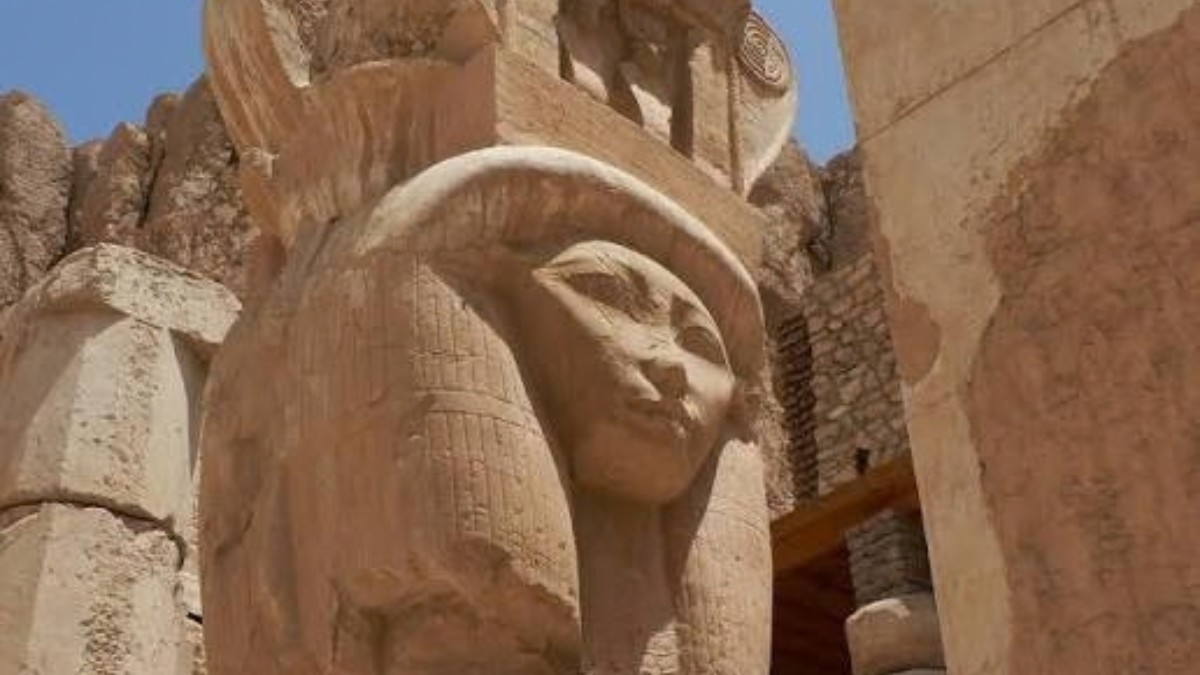
Queen Hatshepsut’s Temple is one of the most distinctive ancient monuments in Egypt. Built into the dramatic limestone cliffs of Deir el-Bahari on Luxor’s West Bank, the temple rises in three broad terraces connected by long ramps and framed by rows of columns.
Its setting alone makes it extraordinary, but the temple is much more than an impressive façade. Its walls preserve scenes of Hatshepsut’s famous expedition to Punt, stories supporting her divine right to rule, religious ceremonies, processions, gods, royal statues and some of the most important surviving evidence from the reign of one of ancient Egypt’s best-known female pharaohs.
This complete Queen Hatshepsut Temple guide explains the history of the monument, how the temple was designed, what to see on each terrace, how to get there from Luxor, current ticket prices and opening hours, how long to spend, the best time to visit and how to combine Deir el-Bahari with the Valley of the Kings and other West Bank sites.


Queen Hatshepsut Temple At A Glance
| Detail | Information |
|---|---|
| Official name | Temple of Hatshepsut / Djeser-djeseru |
| Meaning of Djeser-djeseru | “Holy of Holies” |
| Location | Deir el-Bahari, Luxor West Bank, Egypt |
| Period | New Kingdom, 18th Dynasty |
| Pharaoh | Hatshepsut |
| Hatshepsut’s reign | Approximately 1473–1458 BC |
| Associated architect | Senenmut, Hatshepsut’s chief steward |
| Temple layout | Three main terraces linked by ramps |
| Foreign adult ticket | EGP 440 on dedicated official booking portal |
| Foreign student ticket | EGP 220 |
| Suggested visit | 1.5–2 hours |
| UNESCO status | Part of Ancient Thebes and its Necropolis World Heritage Site |
Where Is Queen Hatshepsut Temple?
The temple is located at Deir el-Bahari on the western side of the Nile opposite modern Luxor.
This side of ancient Thebes was heavily associated with death, burial and royal mortuary cults. The Valley of the Kings lies behind the cliffs, while many royal temples, noble tombs and necropolises spread across the surrounding desert.
Hatshepsut’s temple sits directly beneath an enormous semicircular limestone cliff that rises dramatically behind the upper terrace.
Across the Nile to the east is Karnak, the principal sanctuary of Amun at Thebes.
The relationship was intentional. Hatshepsut’s mortuary temple was closely connected with the cult of Amun, one of the most important deities of the New Kingdom.
Map Of Hatshepsut Temple & Luxor West Bank
The temple sits close to several of Luxor’s most important archaeological sites, making it easy to include in a West Bank sightseeing day.
Who Was Queen Hatshepsut?
Hatshepsut was the daughter of Pharaoh Thutmose I and later married her half-brother Thutmose II.
After Thutmose II’s death, the young Thutmose III inherited the throne. Because he was still a child, Hatshepsut initially acted as regent.
She later adopted full royal status and ruled as pharaoh.
This was highly unusual but not entirely without precedent in Egyptian history.
Hatshepsut used traditional royal titles, clothing and imagery associated with male kingship while still retaining aspects of her female identity in other representations.
Her reign was associated with major construction projects, religious activity, long-distance trade and renewed prosperity.
One of her greatest architectural statements was her mortuary temple at Deir el-Bahari.
Why Was Hatshepsut Temple Built?
The building is a mortuary temple, not simply a palace or conventional place of worship.
Ancient Egyptian royal mortuary temples were built to maintain the cult of the deceased king and ensure the ruler’s continued existence in the afterlife.
Hatshepsut’s temple therefore had a strong funerary purpose, but it was not dedicated only to Hatshepsut.
The complex also contained spaces devoted to:
- Amun-Re;
- Hathor;
- Anubis;
- Ra-Horakhty and the solar cult;
- Hatshepsut’s father, Thutmose I;
- Hatshepsut’s own royal mortuary cult.
The central sanctuary of Amun was especially important.
Is Hatshepsut Temple Her Tomb?
No.
This is one of the most common misunderstandings about Deir el-Bahari.
The temple was designed for religious ceremonies and Hatshepsut’s posthumous royal cult.
Her royal tomb was separate, in the Valley of the Kings. Archaeological evidence identifies KV20 as Hatshepsut’s royal tomb.
Egypt’s Ministry of Tourism and Antiquities states that the mummy associated with Hatshepsut was discovered in KV60 in the Valley of the Kings.
Separating a royal tomb from a mortuary temple became an important feature of New Kingdom royal funerary planning.
Djeser-Djeseru: The “Holy Of Holies”
Hatshepsut’s temple was known as Djeser-djeseru, commonly translated as “Holy of Holies.”
The complex uses the natural landscape with exceptional skill.
Rather than competing with the enormous cliffs behind it, the terraces visually extend the horizontal lines of the surrounding rock.
The temple rises upward in stages until the final sanctuary appears to disappear directly into the mountain.
This close relationship between architecture and landscape is one reason the building looks so different from many later Egyptian temples dominated by enormous pylons.
Who Designed Hatshepsut Temple?
The Egyptian Ministry of Tourism and Antiquities associates the temple’s design with Senenmut, Hatshepsut’s powerful chief steward of Amun.
Senenmut was one of the most important officials of Hatshepsut’s reign and was closely connected with major royal building projects.
The Metropolitan Museum of Art notes that construction of Djeser-djeseru took roughly 14–16 years during the joint reign of Hatshepsut and Thutmose III.
The scale of the project becomes even more remarkable when you remember that Hatshepsut was simultaneously commissioning major works elsewhere, including at Karnak.
The Three Terraces Of Hatshepsut Temple
The basic design is easy to understand once you stand in front of the monument.
Three broad levels rise one above another, linked by central ramps.
Each stage gradually draws the visitor toward the cliff and deeper into increasingly sacred spaces.
First Terrace
The lowest level originally formed part of a much larger processional landscape.
In antiquity, the temple was approached from the Nile through a valley temple and a long causeway.
The lower area was once landscaped with vegetation, including trees and gardens, creating a much greener appearance than the modern desert environment suggests.
Second Terrace
The middle level contains some of the most historically important reliefs in the temple.
These include:
- the Expedition to Punt scenes;
- the Divine Birth narrative;
- the Chapel of Hathor;
- the Chapel of Anubis.
If you are visiting without a guide, do not rush directly up the next ramp. Some of the temple’s most interesting storytelling survives here.
Third Terrace
The upper terrace represents the ceremonial and religious climax of the complex.
The façade is famous for its Osiride figures of Hatshepsut, portraying the pharaoh in the form of Osiris.
Beyond the portico lies the upper courtyard and several highly important religious spaces, including the sanctuary of Amun-Re and complexes associated with royal and solar worship.

Expedition To Punt Reliefs
The Punt reliefs are among the most famous scenes in the entire temple.
Hatshepsut sent an expedition to a region the Egyptians called Punt.
Its exact location remains debated, but it is generally associated with the Red Sea region of northeastern Africa, with modern Eritrea and surrounding regions frequently discussed.
The reliefs show:
- the people of Punt;
- their houses;
- local vegetation;
- exotic animals;
- goods being exchanged;
- valuable products being transported back to Egypt.
The expedition brought luxury commodities and other resources to Egypt.
The scenes are valuable not only as royal propaganda but also because they preserve visual information about Egyptian long-distance trade and how Egyptians imagined a distant foreign land.
The Divine Birth Of Hatshepsut
Another important group of reliefs explains Hatshepsut’s right to rule through a divine story.
Her legitimacy was politically important because she had moved from queen and regent to full pharaoh.
In the temple narrative, the god Amun is presented as Hatshepsut’s divine father.
The story therefore supports the idea that her kingship was not simply a political decision but part of a divine plan.
Ancient Egyptian royal monuments regularly used religion, genealogy and mythology to communicate authority, and Hatshepsut’s temple is an outstanding example.
Chapel Of Anubis
Anubis was strongly associated with embalming, cemeteries and the protection of the dead.
The Chapel of Anubis therefore fits naturally within a royal mortuary temple.
Look carefully at the surviving painted decoration. Despite more than three thousand years of history, traces of ancient color remain visible in parts of the complex.

Chapel Of Hathor
Hathor had an especially important connection with Deir el-Bahari.
Egypt’s Ministry of Tourism and Antiquities explains that the wider Deir el-Bahari landscape was sacred to Hathor.
Hathor could be represented in many forms and had associations with motherhood, kingship, music, joy and the western necropolis.
In religious imagery connected with this area, Hathor could appear as a cow emerging from the western mountain.
The Chapel of Hathor therefore belongs to a much wider sacred landscape rather than being an isolated shrine added for decoration.

Sanctuary Of Amun-Re
The Sanctuary of Amun-Re lies on the central axis of the temple and represents one of its most sacred spaces.
A passage extends into the living rock of the cliff.
The connection with Amun helps explain why the temple was positioned directly across the Nile from Karnak, the main Theban sanctuary of the god.
The sanctuary included space connected with Amun’s sacred bark, which played an important role in religious processions.
The Polish-Egyptian conservation mission restored the sanctuary over many years, and it was opened to visitors after the completion of major conservation work.
Solar Cult Complex
The upper terrace also includes an area connected with solar worship.
An altar open to the sky was associated with Ra-Horakhty.
This reflects the importance of solar theology to Egyptian kingship.
The Solar Cult Complex was restored by the Polish Centre of Mediterranean Archaeology and opened to visitors in 2015.
Osiride Statues Of Hatshepsut
The upper terrace is lined with monumental figures depicting Hatshepsut in the form of Osiris.
These mummiform royal statues visually connected the deceased king with Osiris, the god closely associated with death, resurrection and the afterlife.
Several original statues were deliberately destroyed in antiquity.
Fragments recovered by archaeologists have helped scholars reconstruct how the upper terrace originally appeared.
Why Were Hatshepsut’s Images Destroyed?
Roughly two decades after Hatshepsut’s death, many of her statues and images were deliberately attacked.
Her name and royal representations were removed from monuments, and numerous statues from Deir el-Bahari were broken.
The destruction is associated with the reign of Thutmose III, but the precise motivation remains debated.
Older explanations sometimes presented the act simply as personal revenge.
Modern scholarship is more cautious because the campaign occurred many years after Hatshepsut’s death and appears to have been selective.
What is clear is that the destruction severely damaged parts of Hatshepsut’s temple and royal image.
Later Damage To The Temple
Thutmose III’s actions were not the only source of destruction.
During the Amarna Period, representations of certain deities were also attacked.
Over later centuries the temple suffered from:
- rockfalls;
- earth and debris accumulation;
- stone removal;
- natural weathering;
- reuse of parts of the site;
- conversion of sections into a Christian monastery.
The Arabic name Deir el-Bahari means roughly “Northern Monastery,” reflecting the later Christian presence in the area.
Restoration Of Hatshepsut Temple
Much of what visitors see today is the result of generations of excavation, archaeological research and conservation.
The Polish-Egyptian Archaeological and Conservation Expedition to the temple was established in 1961.
Archaeologists, Egyptologists, architects, engineers and conservators have worked for decades to document and reconstruct the monument.
The project has restored damaged architectural elements, protected surviving reliefs and made additional spaces accessible to visitors.
The work continues to improve our understanding of how the temple originally functioned and appeared.
Hatshepsut Temple & Mentuhotep II
Hatshepsut was not the first ruler to recognize the power of the Deir el-Bahari landscape.
Approximately 600 years earlier, Middle Kingdom ruler Mentuhotep II built his mortuary complex beside the same cliffs.
His temple used terraces and a central rising approach.
The earlier monument appears to have influenced Hatshepsut’s architects, although Djeser-djeseru developed the idea on a much larger and more refined scale.
Remains of other temples, including that of Thutmose III, also form part of the archaeological landscape at Deir el-Bahari.
UNESCO World Heritage Status
Hatshepsut’s Temple forms part of the UNESCO World Heritage property Ancient Thebes with its Necropolis, inscribed in 1979.
The World Heritage area includes major monuments on both sides of the Nile.
Important East Bank sites include Karnak and Luxor Temple.
The West Bank includes the Valley of the Kings, Valley of the Queens, Deir el-Bahari, Medinet Habu and other temples and necropolises.
UNESCO specifically highlights Hatshepsut’s enormous porticoes, superimposed terraces and Punt reliefs as significant features of the Theban necropolis.
How To Get To Queen Hatshepsut Temple
The temple is on Luxor’s West Bank, while many hotels, restaurants and major city facilities are on the East Bank.
There are several practical ways to reach it.
Private Driver
A private driver is the easiest option if you plan to visit several West Bank attractions on the same day.
You can arrange a car through your hotel, travel company or local driver.
This is especially convenient for a route combining the Valley of the Kings, Hatshepsut Temple, Colossi of Memnon and Medinet Habu.
Taxi
A taxi from the East Bank can travel to the West Bank using the road bridge across the Nile.
If the driver is not using an app or transparent meter, agree on the fare and whether waiting time is included before departure.
Public Ferry + West Bank Taxi
Independent travelers can cross the Nile using the local passenger ferry and arrange a taxi or other local transport after reaching the West Bank.
This can be an enjoyable and inexpensive way to divide the journey into two parts.
For multiple archaeological stops, negotiate clearly whether your West Bank driver is taking you only to Hatshepsut Temple or waiting for a complete sightseeing circuit.
Organized Tour
Many Luxor West Bank tours include Hatshepsut Temple together with the Valley of the Kings and Colossi of Memnon.
This is a convenient option if you want an Egyptologist guide and do not want to arrange transportation independently.
Getting There From Luxor Airport
From Luxor International Airport, a taxi or pre-arranged private transfer is the simplest choice.
The airport is on the eastern side of the Nile, so the road journey to Deir el-Bahari requires crossing to the West Bank.
If you have luggage, it usually makes more sense to go to your hotel first rather than visit the archaeological site directly.
Queen Hatshepsut Temple Ticket Price
The dedicated official Egyptian e-ticket system currently lists:
| Visitor | Current Listed Price |
|---|---|
| Foreign adult | EGP 440 |
| Foreign student | EGP 220 |
| Egyptian adult | EGP 40 |
| Egyptian student | EGP 20 |
The official online system also states that student visitors need valid identification and must be no older than 24 to qualify for the student rate.
Children below six are listed as eligible for free entry.
Queen Hatshepsut Temple Opening Hours
The dedicated ticketing portal currently lists:
- Summer: from 6:00 AM, last entry 5:00 PM.
- Winter: from 6:00 AM, last entry 4:00 PM.
The separate Ministry monument page currently shows 6:00 AM–5:00 PM daily.
Because seasonal information differs slightly between official pages, check the booking portal shortly before your travel date.
The official ticket platform recommends arriving at least one hour before closing.
Best Time Of Day To Visit
Early morning is usually the best choice.
The West Bank is extremely exposed to the sun and the limestone cliffs around Deir el-Bahari can make the area feel very hot later in the day.
Visiting close to opening time gives you:
- cooler temperatures;
- softer morning light;
- fewer large tour groups;
- more time to study the reliefs;
- enough time to continue toward the Valley of the Kings.
For photography, the relationship between the pale temple and the huge cliffs becomes particularly impressive when the light is less harsh.
Best Time Of Year
Luxor is a desert destination and summers can be extremely hot.
The cooler part of the year is generally more comfortable for archaeological sightseeing because West Bank sites involve substantial outdoor walking with relatively little shade.
If visiting during hotter months:
- start as early as possible;
- carry water;
- wear sun protection;
- use a hat;
- avoid unnecessary midday walking.
How Long Do You Need At Hatshepsut Temple?
45–60 Minutes
Enough for a quick visit focused on the terraces, façade and major highlights.
1.5–2 Hours
The better choice for most independent travelers.
This gives you time to study the Punt scenes, Hathor and Anubis areas, upper terrace and sanctuary spaces without constantly rushing.
2+ Hours
Worth considering if you are especially interested in archaeology, Egyptian art or photography.
Suggested Route Through The Temple
A simple first-time route is:
- Stop for the wide frontal view. Take in the entire relationship between the terraces and cliffs before approaching.
- Walk across the lower court. Imagine the much greener processional landscape that once existed here.
- Climb to the middle terrace.
- Study the Punt reliefs.
- Look for the Divine Birth scenes.
- Visit the Anubis Chapel.
- Explore the Hathor Chapel.
- Continue up the main ramp.
- Examine the Osiride figures on the upper terrace.
- Continue into the upper religious complexes and Amun sanctuary where visitor access permits.
Photography At Hatshepsut Temple
The official Egyptian e-ticket portal currently states that mobile-phone photography is free.
For larger camera equipment, tripods, commercial photography or filming, rules can be different and may change, so follow current site signage and staff instructions.
Good photo locations include:
- the long frontal approach;
- the bottom of the central ramp;
- the middle terrace looking toward the cliff;
- upper terrace colonnades;
- views outward from the higher levels across the West Bank.
What To Wear
There is no need for hiking equipment, but the site is large, sunny and uneven in places.
Useful items include:
- comfortable walking shoes;
- lightweight clothing;
- sun hat;
- sunglasses;
- sunscreen;
- drinking water;
- a light extra layer during cooler winter mornings.
Respectful clothing is also appropriate when visiting Egypt’s cultural and religious heritage sites.
Accessibility
The temple’s famous ramps make the overall layout easier to understand than many rock-cut archaeological sites, but this should not be mistaken for fully modern accessibility.
Ancient surfaces can be uneven, inclines are long and access to some interior sections may involve thresholds, steps or narrower spaces.
Visitors with significant mobility requirements should confirm current arrangements with site staff or a tour operator before arrival.
Do You Need A Guide?
No guide is required simply to visit Hatshepsut Temple.
However, this is one Luxor site where a knowledgeable Egyptologist can add substantial value.
Without context, the building is visually impressive.
With context, the same walls tell stories about:
- Hatshepsut’s claim to the throne;
- Egyptian religion;
- trade with Punt;
- the cult of Amun;
- royal funerary practices;
- ancient political propaganda;
- later destruction and restoration.
If you prefer exploring independently, read about the major relief programs before arriving so you know where to slow down.
Hatshepsut Temple & Valley Of The Kings
These two sites are naturally paired because they lie on opposite sides of the same Theban mountain system.
The Valley of the Kings is immediately behind the cliffs from Deir el-Bahari, although the normal road route goes around the mountain rather than directly through it.
A good West Bank morning can include:
- Valley of the Kings
- Queen Hatshepsut Temple
- Colossi of Memnon
Add Medinet Habu if you have more time.
Other Places To Visit Nearby
Valley Of The Kings
Royal necropolis containing the tombs of New Kingdom kings including Tutankhamun and several Ramesside rulers.
Colossi Of Memnon
Two enormous seated statues that once stood at the entrance to Amenhotep III’s vast mortuary temple.
Medinet Habu
The mortuary temple of Ramesses III is one of the most impressive and extensively decorated temples on Luxor’s West Bank.
Valley Of The Queens
Another important Theban necropolis, particularly famous for the tomb of Queen Nefertari.
Deir El-Medina
The settlement and tombs of the skilled workers responsible for constructing royal tombs in the nearby valleys.
Suggested Luxor West Bank Itinerary
6:00–6:30 AM: Start early and travel to the West Bank.
Morning: Visit the Valley of the Kings before temperatures rise.
Late morning: Explore Queen Hatshepsut Temple at Deir el-Bahari.
Next stop: Short photo stop at the Colossi of Memnon.
Afternoon: Visit Medinet Habu or Deir el-Medina if energy and time allow.
Evening: Return to the East Bank for Luxor Temple or dinner near the Nile.
Is Queen Hatshepsut Temple Worth Visiting?
Yes.
Even in Luxor, where extraordinary monuments are everywhere, Deir el-Bahari looks unlike almost anything else.
The combination of huge natural cliffs, symmetrical terraces, long ramps and reconstructed colonnades makes the temple visually memorable even before you understand its history.
Once you add the Punt expedition, Hatshepsut’s divine-birth narrative, Osiride statues and connection with Karnak and the Valley of the Kings, the temple becomes one of the most informative places for understanding the New Kingdom.
Frequently Asked Questions
Where is Queen Hatshepsut Temple?
It is at Deir el-Bahari on the West Bank of Luxor, Egypt, beneath the cliffs close to the Valley of the Kings.
What is the real name of Hatshepsut Temple?
The ancient temple is commonly called Djeser-djeseru, meaning “Holy of Holies.”
How old is Hatshepsut Temple?
It was constructed during Hatshepsut’s reign in the 15th century BC, making it roughly 3,500 years old.
Who designed Hatshepsut Temple?
The temple’s design is associated with Senenmut, Hatshepsut’s chief steward and an important official of her reign.
How much is the Hatshepsut Temple ticket?
The dedicated official booking portal currently lists EGP 440 for foreign adults and EGP 220 for foreign students. Recheck the official booking system because prices can change.
What time does Hatshepsut Temple open?
The current official ticket system lists opening from 6:00 AM. Summer last entry is shown as 5:00 PM and winter last entry as 4:00 PM.
How long should I spend there?
Allow around 1.5 to 2 hours if you want to study the main reliefs and religious areas without rushing.
Is Hatshepsut buried inside the temple?
No. The temple was her mortuary cult complex. Her royal tomb was separate in the Valley of the Kings.
What is special about the Punt reliefs?
They document Hatshepsut’s expedition to Punt and depict foreign people, houses, animals, vegetation and valuable goods transported back to Egypt.
Why were Hatshepsut’s statues destroyed?
Many of her royal images and statues were deliberately destroyed during the reign of Thutmose III roughly two decades after her death. The exact motivation remains debated by scholars.
Can I photograph Hatshepsut Temple?
The official ticketing portal currently states that mobile-phone photography is free. Follow current site rules for other equipment or commercial filming.
Can I visit Hatshepsut Temple and Valley of the Kings together?
Yes. They are among the easiest Luxor West Bank sites to combine during the same morning or half-day tour.
Final Thoughts
Queen Hatshepsut’s Temple is much more than one of Egypt’s most photogenic ancient monuments.
Its terraces were designed as part of a carefully planned religious landscape connecting the western necropolis, the sacred Theban mountain and the cult of Amun across the Nile at Karnak.
The surviving reliefs reveal how Hatshepsut presented her kingship, celebrated international trade and placed herself within Egypt’s divine order.
At the same time, broken statues and damaged inscriptions preserve evidence of the political and religious changes that followed her reign.
Visit early, allow enough time for the middle and upper terraces and do not treat Deir el-Bahari as only a quick photo stop between Valley of the Kings tombs.
Understanding the stories carved into the walls turns Hatshepsut Temple from an impressive building into one of the most fascinating historical sites in Luxor.
Sources
Egypt Ministry of Tourism & Antiquities — Hatshepsut Temple
Official history, architecture, opening hours and current admission information.
Official EgyMonuments Ticket Portal — Hatshepsut Temple
Current online ticket prices, student policy, seasonal hours and photography information.
Egypt Ministry of Tourism & Antiquities — Deir al-Bahari
Background on the sacred landscape, Mentuhotep II and the wider archaeological site.
UNESCO World Heritage Centre — Ancient Thebes with its Necropolis
World Heritage context for Deir el-Bahari and other monuments of ancient Thebes.
Polish-Egyptian Archaeological & Conservation Expedition
Information about the long-term excavation, reconstruction and conservation of Hatshepsut Temple.
The Metropolitan Museum of Art — Hatshepsut & Deir el-Bahri
Research on Hatshepsut’s reign, temple architecture, royal statues and later destruction.
Wikimedia Commons — Mortuary Temple of Hatshepsut
Original image pages and licensing information for the photographs used above.
Information checked: September 2026. Admission prices, student eligibility, seasonal opening times, accessible areas and photography rules can change. Check the dedicated official Egyptian ticket portal shortly before your visit.