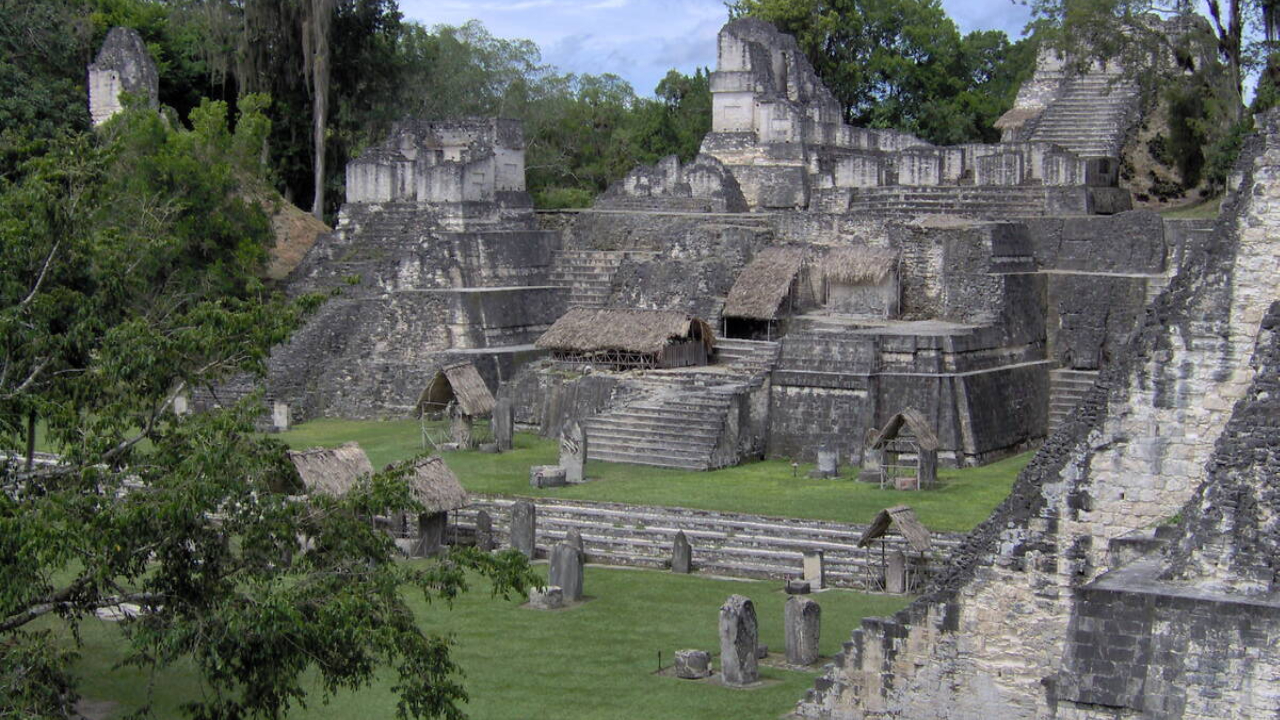
Tikal is one of the most extraordinary ancient Maya cities in Central America. Hidden deep within the tropical rainforest of northern Guatemala, its towering limestone pyramids rise above a sea of green jungle, while ancient palaces, ceremonial plazas, carved monuments and elevated stone causeways reveal the remains of a civilization that flourished more than a thousand years ago. Walking through Tikal is not simply a visit to an archaeological site; it is an opportunity to understand the political, religious and architectural achievements of one of the Maya world’s most powerful ancient cities.
The most memorable sights include Temple I, also called the Temple of the Great Jaguar, the vast Great Plaza, Temple II and the immense Temple IV rising above the forest canopy. Yet Tikal’s atmosphere comes from more than its monuments. Howler monkeys call from the trees, spider monkeys move through the branches, toucans and other birds inhabit the forest, and the paths between temples pass through a remarkably rich tropical ecosystem. The combination of history and wilderness makes Tikal different from many archaeological destinations where monuments stand in open or heavily developed surroundings.
Planning a visit requires attention to several practical details. Tikal is located in Guatemala’s Petén region, well away from Guatemala City. Most independent travelers stay in Flores or near the archaeological park, arrange road transport and choose between normal daytime entry and special sunrise or sunset access. Entrance tickets, guide requirements, seasonal weather and the distance between the major temple complexes all affect the experience.
This complete Tikal Ruins travel guide explains the history of the ancient city, its most important pyramids, how to get there from Flores and other destinations, official entrance fees, opening hours, sunrise tours, accommodation options, genuine hotel photography, a practical sightseeing itinerary, wildlife, accessibility, safety precautions, estimated travel expenses and frequently asked questions.


Photographs are licensed through Wikimedia Commons. The images in this row are displayed with square corners and cropped for layout; individual source pages provide the original files, creators and reuse requirements.
Tikal Ruins at a Glance
| Detail | Information |
|---|---|
| Location | Flores Municipality, Petén, Guatemala |
| Country | Guatemala |
| UNESCO status | World Heritage Site since 1979 |
| National park established | 1955 |
| Protected area | Approximately 57,600 hectares |
| Regular opening hours | 6:00 AM–6:00 PM daily |
| Foreign admission | Q150 per person |
| Sunrise add-on | Q100 plus regular admission and an authorized guide |
| Sunset add-on | Q100 plus regular admission and an authorized guide |
| Nearest major tourist base | Flores and Santa Elena |
| Nearest commercial airport | Mundo Maya International Airport (FRS) |
| Recommended ruins visit | 4–6 hours minimum; a full day is better |
| Currency | Guatemalan Quetzal (GTQ / Q) |
| Best for | Archaeology, Maya history, rainforest, wildlife and photography |
Where Are the Tikal Ruins?
Tikal National Park is located in northern Guatemala’s Petén Department, within the extensive lowland forests of the Maya Biosphere Reserve.
The archaeological site lies approximately 60–65 kilometers by road from the Flores and Santa Elena area, depending on the departure point. It is usually reached via the road passing through the El Remate area.
The nearest commonly used accommodation base is Flores, a small historic island town in Lake Petén Itzá, connected by a causeway to Santa Elena on the mainland.
Flores is popular because it combines restaurants, hotels, travel agencies and convenient connections to Mundo Maya International Airport. Visitors can book a day trip to Tikal and return to Flores the same afternoon.
Another option is to stay at accommodation located within Tikal National Park’s visitor accommodation area. This minimizes early-morning transfer time and is especially convenient for a sunrise tour.
Tikal is not in Guatemala City, Antigua or Lake Atitlán. Travelers coming from those destinations need to plan a separate journey to Petén before visiting the ruins.
Tikal National Park Map
The map below shows the location of Tikal National Park in northern Guatemala.
Before leaving Flores, save your accommodation location, the Tikal National Park entrance and the visitor facilities area. Mobile coverage may be inconsistent inside the forest, so an offline map is useful.
The History of Tikal: One of the Great Maya Cities
Tikal was one of the principal urban and political centers of the ancient Maya civilization.
Archaeological evidence indicates that the wider settlement developed during the Preclassic period. UNESCO describes the site’s occupation as extending from approximately the sixth century BC through the tenth century AD, with monumental architecture and urban development evolving over many centuries.
During the Classic Maya period, particularly between approximately AD 250 and 900, Tikal became a major political, military, religious and economic center.
The city was connected through diplomacy, conflict and trade with other important Maya and Mesoamerican cities, including Calakmul and the distant metropolis of Teotihuacan.
Its rulers commissioned monumental pyramids, decorated buildings, carved stone monuments and ceremonial complexes to express their political power and religious authority.
The Rise of Tikal’s Royal Dynasty
Maya inscriptions preserve the names and achievements of numerous rulers associated with Tikal.
UNESCO notes that the city’s dynastic record spans more than 1,100 years, with inscriptions and monumental evidence documenting a long sequence of royal power.
One particularly important ruler was Jasaw Chan K’awiil I, whose reign marked a major period of political revival.
In AD 695, Tikal achieved a significant military victory over its powerful rival Calakmul. The success helped restore Tikal’s influence after a period of political challenges.
Later rulers, including Yik’in Chan K’awiil, continued the city’s monumental building programs.
Several of Tikal’s most famous temples are associated with this period of renewed political strength.
Why Did Tikal Decline?
Tikal’s decline occurred during the wider transformation of Classic Maya political centers near the end of the first millennium AD.
Researchers have considered several interacting factors, including warfare, political instability, changing regional networks, drought, pressure on agricultural resources and environmental stress.
There is no single universally accepted explanation that fully accounts for the city’s decline.
By approximately AD 900, much of the monumental urban center had been abandoned or had lost its former political importance.
This does not mean that Maya civilization disappeared. Maya peoples and communities continued across the region and remain an important part of Guatemala and neighboring countries today.
Rediscovery and Archaeological Research
Tikal’s monumental buildings became surrounded by forest as the urban center declined, but local knowledge of the ruins persisted long before systematic modern archaeology.
Exploration, mapping and archaeological investigation during the nineteenth and twentieth centuries brought the site increasing international attention.
Major research and restoration projects helped document royal inscriptions, ceremonial architecture and the layout of the ancient city.
Tikal became a national park in 1955 and was inscribed on the UNESCO World Heritage List in 1979.
Its designation is unusual because UNESCO recognizes both its cultural importance and its natural biodiversity.
For readers interested in comparing Maya archaeological centers, Aoqira’s Lamanai Ruins Belize travel guide explains the history of another important Maya settlement with a different occupation pattern and a remarkable river approach.
Best Things to See at Tikal National Park
1. The Great Plaza — Tikal’s Ceremonial Heart
The Great Plaza is the most recognizable part of Tikal and a natural starting point for exploring the archaeological core.
It is framed by major temples and ceremonial complexes, creating an extraordinary open space within the surrounding jungle.
Temple I dominates the eastern side, while Temple II stands opposite it. The North Acropolis and Central Acropolis occupy other sides of this monumental center.
The arrangement reflects the political and ceremonial importance of this area.
Visitors can walk across the plaza, study the architectural relationships between the buildings and appreciate the scale of construction achieved by the ancient Maya.
The Great Plaza is particularly beautiful in softer morning light, when shadows emphasize the steep temple stairways and the surrounding forest.
Suggested visit: Allow approximately 30–45 minutes for the plaza and additional time for adjacent temples and acropolis structures.

2. Temple I — Temple of the Great Jaguar
Temple I is Tikal’s most famous architectural monument.
Also called the Temple of the Great Jaguar, the approximately 47-meter-tall pyramid stands at the eastern edge of the Great Plaza.
The temple is associated with the burial of Jasaw Chan K’awiil I, one of Tikal’s most important Late Classic rulers.
Its massive stepped form, steep central staircase and prominent roof comb demonstrate the characteristic architectural style of major Classic Maya ceremonial buildings.
The building is especially striking when viewed from the opposite side of the Great Plaza, where its proportions can be appreciated together with Temple II.
Temple I is a protected monument. Visitors should not attempt to climb its ancient staircase or cross restricted barriers.
Best for: Architecture, historical photography and understanding Tikal’s royal dynasty.
3. Temple II — Temple of the Masks
Temple II stands across from Temple I on the western side of the Great Plaza.
It is commonly known as the Temple of the Masks and is approximately 38 meters tall.
Archaeological research associates it with the royal building programs of the late seventh and early eighth centuries and with the family of Jasaw Chan K’awiil I.
One of the most useful aspects of visiting Temple II is the opportunity to compare it directly with Temple I.
Their opposing positions create a monumental architectural composition that reflects the political and ceremonial purpose of the plaza.
Where permitted, visitors can use designated modern access stairs to reach approved viewing areas. Do not climb original masonry or assume a particular platform will always be open.
The elevated perspective can reveal the scale of the Great Plaza and its surrounding buildings.
4. Temple IV — Tikal’s Tallest Famous Pyramid
Temple IV is among Tikal’s most celebrated monuments and one of the main reasons visitors explore beyond the Great Plaza.
Rising approximately 70 meters from its base to the top of the roof comb, it is the tallest pyramid-temple at Tikal.
Its construction is associated with the reign of Yik’in Chan K’awiil during the eighth century AD.
The most famous feature is the view across the surrounding rainforest. From its elevated outlook, visitors can see the upper portions of other pyramids rising above the forest canopy.
The view is particularly atmospheric when mist moves across the treetops.
Temple IV is also frequently associated with the jungle landscape seen in the original Star Wars film, where the setting represented the fictional moon of Yavin 4.
Access: Use only the modern designated staircase and viewing platforms when open. Temple access can change for conservation, safety or maintenance reasons.

5. Temple V — An Impressive Pyramid Beyond the Main Plaza
Temple V is another enormous pyramid in Tikal’s ceremonial center.
Standing approximately 57 meters high, it is one of the tallest surviving structures at the site.
Its steep profile and monumental scale make it an impressive stop, especially for visitors interested in Maya engineering and architecture.
The identity of the ruler most closely associated with the monument remains uncertain.
Temple V is best appreciated from the approved surrounding paths. Do not attempt to ascend the original temple staircase.
6. The North Acropolis
The North Acropolis is one of Tikal’s most historically important architectural complexes.
It contains multiple temples, platforms and funerary monuments built or modified across long periods of the city’s occupation.
Archaeological excavations have revealed evidence of repeated construction, showing how later Maya rulers built over earlier structures.
This layered architecture helps explain how an ancient ceremonial center could remain important for centuries.
The North Acropolis also offers a different perspective on the Great Plaza.
Visitors interested in archaeology should allow time here rather than treating it as a quick photograph stop.
7. The Central Acropolis
The Central Acropolis is a complex of courtyards, elevated buildings, palaces and residential or administrative structures.
Unlike the monumental temple pyramids, this area reveals more about the organization of royal and elite spaces.
Its interconnected buildings and courtyards demonstrate the complexity of ancient Maya urban planning.
Walking through the approved sections helps visitors understand that Tikal was a functioning city rather than simply a collection of isolated ceremonial pyramids.
8. Mundo Perdido — The Lost World Complex
Mundo Perdido, meaning “Lost World,” is one of the oldest and most archaeologically important groups at Tikal.
It contains a large pyramid and surrounding ceremonial buildings that underwent multiple phases of construction.
The complex preserves evidence of early monumental activity and helps demonstrate the development of Tikal’s architectural traditions.
For visitors who want to go beyond the Great Plaza, Mundo Perdido provides a valuable connection to earlier periods of Maya history.
Check current restrictions before entering raised platforms or climbing any structure.
9. The Twin Pyramid Complexes
Tikal contains unusual ceremonial groups known as Twin Pyramid Complexes.
These architectural ensembles were associated with the celebration of significant calendrical cycles.
They provide evidence of the Maya understanding of time and the importance of calendrical ceremonies within royal political life.
Although these complexes may appear less dramatic than the towering temples, their historical significance is considerable.
10. Tikal’s Archaeological Museums
Tikal’s visitor facilities include archaeological museum collections presenting objects and discoveries associated with the ancient city.
Guatemala’s Ministry of Culture identifies the Museo Lítico and Sylvanus G. Morley Museum among the site’s cultural attractions.
Exhibits include carved stone monuments, ceramics and archaeological material that provide context for the ruins.
Official foreign-visitor ticketing currently lists a separate museum admission of Q30, in addition to the regular park ticket.
Check which museum spaces are operating and what your specific ticket permits before planning a visit.
Tikal National Park Entrance Fees in 2026
Guatemala’s Ministry of Culture and Sports operates an official online ticket system for Tikal.
Foreign visitors must purchase the ticket category that corresponds to their visitor status. Buying a discounted national ticket does not authorize entry for an ineligible foreign traveler.
| Ticket type | Foreign visitor price | Important information |
|---|---|---|
| Regular park admission | Q150 | Standard daytime entry |
| Sunrise ticket | Q100 additional | Regular admission and authorized guide required |
| Sunset ticket | Q100 additional | Regular admission and authorized guide required |
| Museum admission | Q30 additional | Separate museum ticket |
| Camping area | Q50 additional | Park entry also required |
| Uaxactún entry | Q50 additional | Check separate access and transport arrangements |
| Children under 10 | Free park admission | Official age policy applies |
Important: The official ticket website states that payments made using international cards incur an additional 2.30% surcharge.
Sunrise and sunset charges are not complete guided-tour prices. They are special access fees, and the cost of hiring an authorized guide is separate.
Official booking: Guatemala Ministry of Culture — Foreign Visitor Tickets.
How to Buy Tikal Tickets
The most reliable method is to use the official Ministry of Culture ticket portal.
- Open the official foreign-visitor ticket page.
- Select regular Tikal National Park admission.
- Add a sunrise or sunset ticket if you plan to enter outside normal hours.
- Include other required tickets, such as museum admission, if relevant.
- Complete the purchase using the available payment methods.
- Save the confirmation and ticket on your phone.
- Carry identification and follow the current entry instructions.
Guatemala’s Ministry of Culture also reports ticket-office purchasing options at the park, but buying in advance is preferable when planning special access or traveling on a strict schedule.
Check whether your tour operator has already included official admission before purchasing a duplicate ticket.
Tikal Opening Hours
Official general admission is available daily from:
Special sunrise access: Approximately 4:00 AM–6:00 AM
Special sunset access: Approximately 6:00 PM–8:00 PM
The park normally operates throughout the year, including public holidays, subject to closures caused by extraordinary circumstances.
Regular visitors can explore designated areas independently without a mandatory guide.
Sunrise and sunset visits require an authorized guide, even when you purchase the required special admission ticket yourself.
Not every monument or elevated platform remains accessible at all times. Conservation work, structural safety or seasonal conditions can affect individual areas.
Tikal Sunrise Tour: Is It Worth It?
A sunrise tour is one of Tikal’s most distinctive experiences.
Before dawn, visitors enter the forest with an authorized guide and follow designated routes toward an approved viewing area.
As daylight begins to appear, the surrounding forest becomes increasingly active with bird calls, insect sounds and, sometimes, the distinctive voices of howler monkeys.
From an elevated viewpoint, the upper portions of ancient temples may become visible above the rainforest canopy.
Temple IV is one of the best-known locations associated with this experience, although the actual viewing point depends on current access permissions and tour arrangements.
The experience can be extraordinary, but seeing a colorful sunrise is never guaranteed.
Cloud, mist or rain can obscure the horizon, and early-morning forest conditions change throughout the year.
How Much Does a Sunrise Tour Cost?
For a foreign adult, the official admission components are:
- Regular entrance ticket: Q150.
- Sunrise access ticket: Q100.
- Authorized guide: additional, operator-dependent charge.
- Transportation: additional unless included in the arranged tour.
Total official admission component: Q250 per foreign adult, excluding the guide, transport and any payment surcharge.
Tour companies may sell packages that include several of these elements. Always inspect the inclusions carefully.
What to Bring for Sunrise
Wear closed-toe shoes with a dependable grip and bring a headlamp or flashlight.
A lightweight layer is useful while waiting in the early morning, even though daytime temperatures can be hot.
Bring water, insect repellent and a charged phone or camera.
Stay with your guide and do not leave the marked route in darkness.
Tikal Sunset Tour
The sunset visit provides another opportunity to experience the forest and ancient architecture outside ordinary visitor hours.
The official sunset admission period is approximately 6:00 PM–8:00 PM, subject to the park’s current arrangements.
Visitors must purchase regular admission plus the Q100 sunset access ticket and use an authorized guide.
Depending on seasonal sunset time and weather, the experience may involve observing the changing light before or after the sun has passed below the horizon.
Do not assume every sunset tour guarantees a direct view of the setting sun.
Evening visits can be particularly appealing to travelers interested in the forest atmosphere, changing light and nocturnal sounds.
Arrange the return journey before departure, especially if your accommodation is in Flores rather than inside the park.
How to Get to Tikal Ruins
Most travelers approach Tikal through Flores and Santa Elena in Guatemala’s Petén Department.
From Flores to Tikal
Flores is the most practical base for independent travelers.
The road journey to Tikal commonly takes approximately 1.5–2 hours, depending on the departure location, stops and traffic.
Transport options include organized tours, shared tourist shuttles, private drivers and rental cars.
A shared shuttle is often convenient if you do not need a customized route, while a private driver provides greater control over departure and return times.
Some tours combine transportation, a guide and lunch. Entrance tickets may or may not be included, so compare the complete price rather than only the headline tour amount.
From Guatemala City to Tikal
Tikal is too far from Guatemala City for a relaxed road day trip.
A common approach is to travel to Petén by domestic flight or longer-distance road transport, stay in the Flores area and visit Tikal the following day.
Mundo Maya International Airport serves Flores and Santa Elena. Check current flight availability from Guatemala City before designing your itinerary.
Airline schedules and domestic connections may change, and international flight arrivals do not always align conveniently with onward travel to Petén.
By Overnight Bus
Long-distance buses offer an alternative for travelers who prefer to avoid flying.
Road travel from Guatemala City to Petén generally requires a substantial part of the day or an overnight journey.
Choose an established operator, confirm the actual terminal, and avoid arriving at an unfamiliar location late at night without onward transportation arranged.
Travel duration depends on route, traffic and road conditions, so rely on the operator’s current timetable rather than a fixed estimate from an older article.
From Belize to Tikal
Travelers staying in western Belize, particularly around San Ignacio, sometimes visit Tikal as part of a cross-border itinerary.
The journey usually involves traveling to the Belize–Guatemala border near Melchor de Mencos and continuing through Petén.
However, immigration formalities, nationality-specific visa requirements, vehicle restrictions and tour-operator arrangements can affect the trip.
Check the border rules for your passport before booking. It is often simpler to use a licensed cross-border operator than to arrange separate taxis and border connections without local knowledge.
If you are interested in Maya sites in Belize as well, read Aoqira’s Lamanai Ruins guide for another archaeological experience surrounded by tropical wildlife.
Where to Stay Near Tikal Ruins
Choosing accommodation is especially important if you plan a sunrise or sunset visit.
There are two principal options: staying near the archaeological park or staying in Flores.
Flores offers a larger selection of restaurants, shops and accommodation. Staying inside the park reduces road travel and provides a more direct connection with the surrounding forest.
The following three properties are genuine accommodation options located within Tikal’s visitor accommodation area.
| Accommodation | Room style | Best for |
|---|---|---|
| Jungle Lodge Tikal | Standard rooms and suites | Comfortable jungle accommodation |
| Hotel Tikal Inn | Bungalows, suites and hotel rooms | Families and traditional jungle stays |
| Jaguar Inn Tikal | Bungalows, equipped tents and camping | Nature lovers and flexible budgets |
1. Jungle Lodge Tikal — Best for Comfortable Jungle Accommodation
Location: Tikal National Park, Petén, Guatemala.
Jungle Lodge is an established accommodation property within the park’s visitor accommodation area.
Its history is connected with archaeological exploration at Tikal. The hotel’s official website describes its origins in the facilities developed to accommodate researchers involved in early archaeological fieldwork.
The property now offers modern accommodation surrounded by tropical vegetation.
According to its official website, Jungle Lodge provides guestrooms and suites, an outdoor swimming pool, restaurant and bar facilities.
The hotel’s location makes it convenient for visitors who want to minimize road transportation and remain close to the archaeological park.
Jungle Lodge Room Types and Facilities
The official Standard Room description lists approximately 20.5 square meters of interior space and a separate porch.
Guests can choose between a king-bed configuration or two full-size beds, subject to availability.
Standard-room amenities include:
- Private bathroom.
- Hot and cold showers.
- Mosquito netting.
- Ceiling fan.
- Private porch.
- Choice of available bedding arrangements.
The hotel also advertises a swimming pool and dining services.
Published room-price example: The official Standard Room page displays US$85 per night. This is a property-published listing, not a confirmed quotation for your travel dates. Taxes, availability and booking conditions should be verified directly.
Best suited to: Couples and travelers looking for a relatively comfortable property within the park accommodation area.
Official website: Jungle Lodge Tikal.
Actual hotel and room photographs: View Jungle Lodge’s official Standard Room photographs.
The hotel’s official photography is linked rather than embedded because independent publication rights for those photographs were not verified.
2. Hotel Tikal Inn — Best for Traditional Bungalows and Families
Location: Tikal National Park, Petén, Guatemala.
Hotel Tikal Inn is a long-established accommodation property near the archaeological site.
The property’s official website describes a setting surrounded by forest and traditional bungalow-style accommodation.
Its rooms are designed around the natural environment, with screened interiors, fans and private bathing facilities.
The hotel is particularly suitable for visitors seeking a jungle atmosphere without traveling back to Flores after sightseeing.


These are photographs of the actual named accommodation property. They document its appearance in 2007 and should not be interpreted as showing its present room condition or current amenities.
Hotel Tikal Inn Room Categories
The hotel’s official room information lists four main categories:
- Bungalows: Thatched-roof accommodation with natural light, located in garden or poolside areas.
- Junior Suites: Spacious accommodation with two queen beds, a private bathroom and a porch.
- Main Building Rooms: Rooms with two double beds, ceiling fans and private bathrooms.
- El Ranchon: Rooms located in a more secluded forest setting, with a combination of single and queen-size beds.
The hotel lists private bathrooms with hot water, ceiling fans, restaurant services, free Wi-Fi in designated main areas and guest parking.
Published room-price examples: The official booking website advertises starting prices around US$80 for Ranchon accommodation, US$82 for main-building rooms, US$101 for bungalows and US$125 for Junior Suites. These are published starting amounts, not confirmed live prices. Taxes and booking conditions may apply.
Best suited to: Families, small groups and travelers who want traditional jungle accommodation close to the archaeological site.
Official website: Hotel Tikal Inn.
Current room details and hotel photographs: Official Tikal Inn Accommodations.
3. Jaguar Inn Tikal — Best for an Eco-Lodge Experience
Location: Tikal National Park, Petén, Guatemala.
Jaguar Inn Tikal is a family-run eco-lodge close to the archaeological ruins.
Its official website states that the property has been operating since 1969 and focuses on a natural setting surrounded by the Tikal forest.
The property offers bungalow accommodation, equipped tents and camping facilities.
It advertises solar-powered electricity, Wi-Fi and restaurant services, making it a distinctive option for travelers who want a nature-focused stay.
Jaguar Inn Room Types
The hotel’s current room descriptions include:
- King Deluxe Bungalow: King bed, private bathroom with hot water, ceiling fan and garden view.
- Double Bungalow: One double and one single bed, private bathroom, fan and garden outlook.
- Triple Comfort Bungalow: Bedding arrangements suitable for three or four people.
- Family Bungalow: Multiple beds with a private bathroom and fan.
- Equipped tents: Budget-oriented accommodation with supplied bedding and access to shared washing facilities.
The property states that selected rooms with air conditioning are available, but not every bungalow includes it. Confirm the precise room category before booking.
Room prices: Obtain a date-specific quotation directly from Jaguar Inn. No reliable live rate was established for this guide.
Best suited to: Nature lovers, couples, families and travelers seeking a more rustic forest accommodation experience.
Official hotel website: Jaguar Inn Tikal.
Actual bungalow and room photographs: Official Jaguar Inn Room Gallery.
Jaguar Inn’s actual accommodation images can be viewed on the official property website. They have not been copied here because reusable publishing permission could not be verified.
Which Tikal Hotel Should You Choose?
Choose Jungle Lodge if you want a comfortable hotel experience with restaurant, swimming-pool and room facilities.
Choose Hotel Tikal Inn if you prefer traditional bungalows, family accommodation and a jungle setting.
Choose Jaguar Inn if you are interested in eco-lodge accommodation, equipped tents or a more nature-focused stay.
A Practical One-Day Tikal Ruins Itinerary
One full day is sufficient to visit the principal monuments, provided you begin early and allow realistic walking time.
| Suggested time | Activity |
|---|---|
| Early morning | Travel from Flores or begin from your park accommodation. |
| 6:00–8:00 AM | Enter the park and explore the Great Plaza, Temple I and Temple II. |
| 8:00–10:00 AM | Visit the North Acropolis and Central Acropolis. |
| Late morning | Walk toward Temple IV and enjoy approved viewpoints. |
| Midday | Rest, drink water and have lunch or a packed meal in a permitted area. |
| Early afternoon | Explore Mundo Perdido, Temple V or another nearby complex. |
| Mid-afternoon | Return toward the visitor area, visit available museum exhibits or depart for Flores. |
This is a suggested sightseeing order rather than a guided-tour timetable. Walking times vary with your fitness, weather, time spent reading interpretive signs and current route restrictions.
If you want to see more archaeology without rushing, consider spending a second day in the park area.
Suggested 2-Day Tikal and Flores Itinerary
Day 1: Flores and Arrival
Arrive in Flores or Santa Elena and check into your accommodation.
Spend the afternoon exploring the historic island town, walking along the waterfront and enjoying views of Lake Petén Itzá.
Confirm the next day’s transport, park ticket and guide arrangements.
Have dinner in Flores and prepare your walking shoes, water, insect repellent and other supplies.
If you plan an early-morning Tikal departure, go to bed early.
Day 2: Tikal National Park
Begin with an early transfer to Tikal.
Explore the Great Plaza, main temples and surrounding acropolis areas in the morning.
Continue toward Temple IV, stopping at other approved complexes along the route.
After lunch or a rest break, visit additional archaeological areas or the museum if time permits.
Return to Flores in the afternoon or continue to your next destination.
Alternative: Stay at a Tikal park-area lodge on the first night and arrange a sunrise tour for the following morning.
Wildlife in Tikal National Park
Tikal is not simply a protected archaeological site. It is also part of an important tropical forest ecosystem.
UNESCO recognizes the park for both its cultural monuments and remarkable biodiversity.
The forest contains numerous species of birds, mammals, reptiles, insects and tropical plants.
Howler Monkeys
Howler monkeys are among the most memorable animals associated with Tikal.
Their exceptionally loud calls can carry through the forest and may be heard long before the animals are visible.
Although the sounds can be startling, visitors should observe the monkeys from a distance rather than attempting to approach them.
Spider Monkeys
Spider monkeys move through the canopy using their long limbs and prehensile tails.
Visitors may notice them feeding or moving among high branches, particularly in quieter parts of the forest.
Keep a respectful distance and avoid making loud noises to attract their attention.
Coatis
Coatis are raccoon relatives with long snouts and distinctive tails.
They may search for food on the forest floor, but they should never be fed.
Feeding wild animals can change their behavior and create problems for both visitors and wildlife.
Birds, Toucans and Ocellated Turkeys
Tikal is an excellent destination for bird enthusiasts.
UNESCO records more than 300 bird species within the region’s protected landscape.
Depending on the season and individual luck, travelers may observe toucans, parrots, woodpeckers, raptors and the distinctive ocellated turkey.
Early morning often provides particularly rewarding opportunities for listening to birds and observing forest activity.
Jaguars and Other Large Mammals
The wider protected forest supports large wild mammals, including jaguars and pumas.
However, sightings of these secretive predators are exceptionally uncommon on normal tourist routes.
Visitors should not expect to see a jaguar during an ordinary Tikal sightseeing day.
The park is best appreciated as a living forest ecosystem, not a zoo where particular animals are guaranteed.
For a contrasting rainforest destination in Southeast Asia, see Aoqira’s Khao Sok National Park guide, which covers guided rainforest activities and wildlife habitats in Thailand.
Best Time to Visit Tikal Ruins
Tikal can be visited throughout the year, but seasonal rainfall and tropical temperatures affect walking conditions.
The park’s official climate information identifies two broad periods.
November to April: Generally Drier Conditions
The lower-rainfall period typically runs from approximately November through April.
Visitors often experience comparatively drier paths and more favorable conditions for longer walks.
However, temperatures can still become hot, particularly in the afternoon.
Dry-season travel may also coincide with busier tourism periods, including major holidays.
For travelers who want to walk extensively through the archaeological site, the drier period is often the most convenient.
May to October: Greener Rainforest and More Rain
The wetter period generally extends from approximately May through October.
Rainfall becomes more frequent, particularly during afternoon hours.
The forest can appear exceptionally lush, but muddy paths and slippery surfaces require additional caution.
Cloud and mist may create atmospheric photographs, although heavy rain can limit visibility and outdoor comfort.
If traveling during this period, carry waterproof protection and keep your sightseeing schedule flexible.
What About Temperature?
Guatemala’s official Tikal visitor guidance describes typical temperatures in the approximate range of 24–35°C, with humidity increasing the perceived heat.
Conditions can change throughout the day, and long walks through exposed plazas can feel more demanding than the temperatures alone suggest.
Regardless of the month, begin sightseeing early and take regular breaks.
How Much Does a Tikal Trip Cost?
The main expenses are park admission, transportation, accommodation, food and any guided experiences.
The official admission prices provide a reliable starting point, while other costs depend on your choices.
| Expense | Budget information |
|---|---|
| Regular park ticket | Q150 foreign adult |
| Sunrise or sunset add-on | Q100 per special access |
| Museum admission | Q30 foreign visitor |
| Flores–Tikal transport | Depends on shuttle, private driver or tour |
| Guide | Operator-dependent; mandatory for special access |
| Accommodation | Depends on hotel, room type and date |
| Food and water | Restaurant and supply purchases |
A budget-conscious independent visitor can usually reduce costs by staying in Flores, using shared transportation and visiting during regular opening hours.
Travelers who prioritize sunrise access or an overnight jungle stay should budget for the additional guide, hotel and transport arrangements.
When comparing tour packages, check the total price after admission, transport, guiding, food and taxes have been included.
What to Pack for Tikal Ruins
A day at Tikal often involves several hours of walking through warm, humid forest conditions.
A practical packing list includes:
- Comfortable walking shoes with good traction.
- Lightweight breathable clothing.
- Rain jacket or compact poncho.
- Insect repellent.
- Sunscreen and sun hat.
- Reusable water bottle with enough drinking water for your route.
- Snacks in secure packaging.
- Small daypack.
- Passport or required identification.
- Entrance ticket and guide confirmation.
- Phone with downloaded maps.
- Power bank.
- Camera or binoculars for wildlife observation.
- Headlamp for an authorized sunrise tour.
- Basic personal medical supplies.
For a sunrise visit, a lightweight extra layer can be useful while waiting at an elevated viewing location.
For rainy-season travel, waterproof protection for your electronics and documents is particularly important.
Safety Guide: Is Tikal National Park Safe?
Tikal is a managed national park and an established archaeological destination, but its tropical setting introduces several risks that visitors should prepare for.
The main concerns are heat exposure, dehydration, slippery surfaces, steep stairways, wildlife, insect bites and transportation arrangements.
1. Heat and Dehydration
High humidity can make walking surprisingly tiring.
Bring enough drinking water, take breaks in shade and avoid pushing yourself too hard during the hottest hours.
Symptoms such as dizziness, confusion, weakness or significant nausea may indicate heat-related illness and require prompt attention.
2. Steep Temple Stairways
Some approved viewing platforms require climbing steep modern stairways.
Use handrails, keep a steady pace and avoid rushing when other visitors are nearby.
Do not climb closed structures or ancient temple masonry.
These restrictions protect both visitors and the archaeological monuments.
3. Slippery Trails During Rain
Forest paths may become muddy during wet conditions.
Tree roots, stone surfaces and steps can become slippery.
Wear shoes with reliable traction and follow designated routes.
Do not enter temporarily closed areas after heavy rain.
4. Wildlife Safety
Monkeys, coatis and other wildlife should be observed from a respectful distance.
Do not feed animals or leave food unattended.
Wild animals may bite or scratch when approached or disturbed.
Remain on designated paths and avoid reaching into holes, thick vegetation or places where snakes or other animals may be sheltering.
5. Mosquitoes and Insect Bites
Insect bites are a practical concern in the tropical environment.
Use mosquito repellent, consider lightweight long sleeves when appropriate and keep cuts protected.
Travelers should consult a qualified healthcare professional about recommended vaccinations and mosquito-borne disease precautions before visiting Guatemala.
If you experience significant fever or illness during or after travel, seek medical care and mention your recent destination.
6. Exploring After Dark
Regular visitors should not remain in the archaeological area outside official hours.
Sunrise and sunset visits require authorized guided access.
Never attempt to enter the forest independently at night or separate from your guide during an approved early-morning tour.
7. Transport and Personal Security
Use established shuttle providers, hotel-arranged vehicles or reputable registered tour companies.
Confirm the pickup location, departure time and return arrangement before paying.
Do not assume an unbooked return vehicle will be available from a remote location.
Carry only necessary valuables into the park and keep identification and money secure.
8. Respect Archaeological Rules
Visitors must not carve names into structures, move artifacts, collect archaeological material or enter restricted areas.
Follow park signs and staff directions.
Commercial photography, drones and specialized equipment may require permission. Confirm the rules with park management before bringing such equipment.
9. Emergency Contacts
Guatemala’s official tourist-assistance service, ASISTUR, offers free information and emergency-related assistance to travelers.
Tourist Assistance: 1500 or +502 2290-2810.
National Civil Police: 110.
Volunteer Firefighters: 122.
Municipal Firefighters: 123.
Official tourist-assistance website: ASISTUR Guatemala.
Save your hotel’s contact information and communicate your intended route if you plan to spend extended time within the park.
Accessibility and Visiting Tikal with Children
Tikal is an extensive archaeological site with natural paths, uneven ground, exposed stone surfaces and some steep stairways.
Not all areas are wheelchair accessible, and the site should not be treated as a uniformly level walking attraction.
Families with young children may find the heat and walking distances demanding.
Consider a shorter itinerary centered on the Great Plaza and nearby accessible areas rather than attempting to visit every temple.
Visitors with mobility limitations should ask park management or a licensed local guide about the most suitable available route before buying specialized tour services.
Children should remain supervised near temple stairways, uneven ruins and wildlife.
Although children under 10 receive free official park admission, this does not necessarily mean that transport or private guided-tour services are free for children.
Where to Eat at Tikal
The park’s visitor area has restaurant and food-service options, including facilities associated with hotels.
However, food choices inside the archaeological visitor area are more limited than in Flores.
Eating a substantial breakfast before arriving and carrying water and an appropriate snack can make a long sightseeing day more comfortable.
If your tour includes lunch, check whether the meal is served inside the park area or during the return journey.
Do not leave food scraps in the forest or feed wildlife.
Flores offers a broader selection of restaurants and is a convenient place to try Guatemalan dishes after visiting the ruins.
Other Places to Visit Near Tikal
Flores Island
Flores is worth exploring even if you are visiting Petén primarily for Tikal.
The small island town has colorful buildings, restaurants and waterfront scenery overlooking Lake Petén Itzá.
It is a convenient destination for a relaxing afternoon before or after a long archaeological excursion.
Lake Petén Itzá
Lake Petén Itzá is an important geographical feature of the region.
Visitors can enjoy lakeside scenery around Flores and nearby settlements.
Boat outings may be available through local operators, but confirm the route, safety equipment and weather conditions before departure.
El Remate
El Remate is a lakeside community along the road corridor between Flores and Tikal.
It can be a quieter accommodation alternative for travelers who want a relaxed setting while remaining within reach of the ruins.
Check the actual transfer time from your chosen hotel before booking.
Uaxactún
Uaxactún is another important ancient Maya archaeological site north of Tikal.
It is particularly interesting for travelers who want to explore more of Petén’s archaeological heritage.
However, it is not a casual extension of every standard Tikal tour.
Road access can require careful planning, and a separate admission arrangement may apply.
The official Ministry of Culture currently lists a foreign-visitor ticket of Q50 for Uaxactún, in addition to applicable Tikal park entry requirements.
Arrange suitable transportation and confirm conditions before attempting the journey.
Tikal vs Other Ancient Ruins: What Makes It Different?
Tikal stands out because the archaeological monuments remain closely integrated with a large protected rainforest.
Unlike ancient cities where modern urban development surrounds the ruins, Tikal’s principal ceremonial structures emerge from tropical forest.
Its monumental architecture, long dynastic record and natural setting combine to create an unusually rich visitor experience.
For travelers interested in world archaeology, Aoqira also covers the Temple of Queen Hatshepsut in Egypt, where monumental architecture occupies a dramatically different desert landscape.
Another useful historical comparison is Aoqira’s Ancient Corinth travel guide, which explores the remains of a Greek and Roman urban center.
If your interests extend from archaeology to outdoor adventures around Central America, Aoqira’s Santa Ana Volcano Hike guide offers a contrasting experience built around volcanic scenery and hiking.
Common Mistakes to Avoid at Tikal
Arriving too late: The combination of walking distances and tropical heat makes a late start less comfortable.
Confusing normal and special admission: A regular ticket does not automatically provide sunrise or sunset access.
Forgetting to arrange a sunrise guide: Special visits require an authorized guide separate from the official access ticket.
Underestimating the site’s size: Tikal contains multiple complexes spread through forest paths.
Carrying too little water: Heat and humidity can become exhausting during long walks.
Assuming every temple can be climbed: Some historic structures are closed to climbing for conservation and safety.
Booking accommodation without checking location: Flores and the park accommodation area serve different trip styles.
Ignoring transport arrangements: Organize your return to Flores rather than relying on an unconfirmed ride.
Expecting guaranteed sunrise views: Mist, cloud or rain may obscure the horizon.
Is Tikal Worth Visiting?
Yes. Tikal is one of the most important archaeological destinations in Central America and an exceptional place for travelers interested in Maya civilization, ancient architecture and tropical nature.
Its main advantage is the combination of monumental history and surrounding protected forest.
Visitors can study ancient royal temples while encountering an ecosystem that still supports monkeys, tropical birds and many other species.
The main challenges are reaching the relatively remote location, walking in tropical heat and planning tickets and transportation correctly.
Those difficulties are manageable with a realistic itinerary.
For most first-time visitors, a full day of sightseeing and at least one night in the Flores region is a sensible minimum.
Travelers who want sunrise access, extensive photography or more archaeological exploration will benefit from a longer stay.
Frequently Asked Questions About Tikal Ruins
Where are the Tikal Ruins located?
Tikal National Park is located in Guatemala’s Petén Department, within the northern tropical forest region. Flores is the main nearby tourist base.
How much does it cost to enter Tikal?
The official regular foreign-adult admission fee is Q150. Special sunrise and sunset tickets each cost an additional Q100. Other activities and museum entry have separate charges.
What are Tikal’s opening hours?
Regular entry is available from 6:00 AM to 6:00 PM daily, subject to exceptional closures. Special sunrise and sunset admission have separate time arrangements.
Do you need a guide at Tikal?
No guide is mandatory for ordinary daytime visits along approved routes. However, an authorized guide is mandatory for special sunrise and sunset entry.
How long should I spend at Tikal?
Four to six hours is a practical minimum for the main ruins. A full day allows a more comfortable pace and time for additional complexes.
Can you climb the temples at Tikal?
Only designated structures or modern viewing access points may be climbed when officially open. Many ancient temple staircases are restricted to protect both visitors and the monuments.
What is the tallest temple at Tikal?
Temple IV is the tallest major pyramid at Tikal, reaching approximately 70 meters from its base to the top of the roof comb.
Can you see the sunrise at Tikal?
Yes, through an officially authorized sunrise visit. You need the regular admission ticket, the sunrise add-on ticket and a separately arranged authorized guide. Weather may affect visibility.
What is the best month to visit Tikal?
The relatively drier period from November through April is often convenient for sightseeing, although Tikal remains open throughout the year and rain is possible in any month.
Are there hotels inside Tikal National Park?
Yes. Jungle Lodge, Hotel Tikal Inn and Jaguar Inn offer accommodation within the national park’s visitor accommodation area.
Is Tikal suitable for children?
Yes, with appropriate planning. Families should allow time for rest, provide plenty of water, supervise children near steep structures and choose manageable walking routes.
Are there jaguars at Tikal?
Jaguars occur within the wider protected forest, but sightings are extremely uncommon during ordinary visits. Other wildlife, including monkeys and tropical birds, is more likely to be observed.
Is Tikal a UNESCO World Heritage Site?
Yes. Tikal National Park was inscribed on UNESCO’s World Heritage List in 1979 for its outstanding archaeological significance and natural biodiversity.
Is Tikal possible as a day trip from Flores?
Yes. Many visitors stay in Flores and travel to Tikal by shared shuttle, organized tour or private vehicle. Allow sufficient time for the round-trip road journey and sightseeing.
Final Thoughts
Tikal is one of the most remarkable surviving cities of the ancient Maya world. Its enormous limestone temples, ceremonial plazas, historical inscriptions and rainforest setting provide an experience that goes far beyond ordinary sightseeing.
The best way to appreciate the site is to understand its history while allowing time to explore the major architectural complexes and surrounding forest.
Start early, follow the official ticket requirements and choose accommodation according to whether you want a standard day trip or a special sunrise visit.
A day spent exploring the Great Plaza, Temple I, Temple II, Temple IV and the lesser-visited complexes reveals not only the achievements of an ancient civilization but also the importance of conserving the forest that surrounds it.
For travelers interested in archaeology, nature and the history of Central America, Tikal deserves a prominent place on a Guatemala itinerary.
Sources and Further Reading
The following official heritage organizations, Guatemalan government resources, accommodation providers and research publications support the historical and practical information in this guide. Admission fees, services, transportation and opening arrangements should be rechecked before travel.
- UNESCO World Heritage Centre — Tikal National Park
Official information about the UNESCO designation, archaeological importance, biodiversity, protected area and historical context. - Guatemala Ministry of Culture — Tikal Foreign Visitor Tickets
Current official admission fees, sunrise and sunset tickets, museum charges, visitor categories and international-card payment surcharge. - Tikal National Park — Official Opening Hours and Admission Rules
Regular opening hours, special-access conditions, guide requirements and park regulations. - Tikal National Park — Climate and Environmental Conditions
Seasonal weather information, temperature ranges and practical precautions. - Guatemala Ministry of Culture — Tikal National Park Anniversary and Visitor Information
Official 2026 summary of Tikal’s history, attractions, fees and access arrangements. - Visit Guatemala — Tikal Archaeological Site Guide
Visitor attractions, ancient Maya history and practical sightseeing information. - Visit Guatemala — Sunrise at Tikal
Official tourism guidance on sunrise experiences, guides, appropriate equipment and viewing conditions. - Journal of Archaeological Science — Tikal Timbers and Temples
Archaeological research discussing Tikal’s temple construction, timber and architectural history. - ASISTUR — Guatemala Tourist Assistance
Official visitor-assistance and tourist-safety services. - ASISTUR — Tourist Safety Recommendations and Emergency Numbers
Official guidance on transport, personal security, documentation and assistance contacts. - Jungle Lodge Tikal — Official Accommodation Website
Verified property information, accommodation categories and facilities. - Jungle Lodge Tikal — Standard Rooms
Room size, bedding, bathrooms, facilities, official photography and published room-price example. - Hotel Tikal Inn — Official Accommodation Information
Bungalow and suite categories, guest facilities and booking details. - Jaguar Inn Tikal — Official Website
Eco-lodge facilities, location and accommodation choices. - Jaguar Inn Tikal — Official Room Gallery
Actual bungalow photographs, room categories and room facilities.
Photography Credits and Licenses
Tikal Great Plaza — Francisco Anzola, CC BY 2.0.
Tikal Temple IV — Simon Burchell, CC BY-SA 4.0.
View from Temple IV — PStreet, CC BY-SA 3.0.
Temple IV Architecture — Simon Burchell, CC BY-SA 4.0.
Hotel Tikal Inn Photograph 1330 — Dennis G. Jarvis, CC BY-SA 2.0.
Hotel Tikal Inn Photograph 1331 — Dennis G. Jarvis, CC BY-SA 2.0.
Each Wikimedia Commons source page provides the applicable Creative Commons license, creator attribution and reuse conditions. For reliable WordPress performance, save permitted images to the Media Library and retain their original attribution and license links. Hotel Tikal Inn photographs are historical images from 2007, not representations of current room conditions.