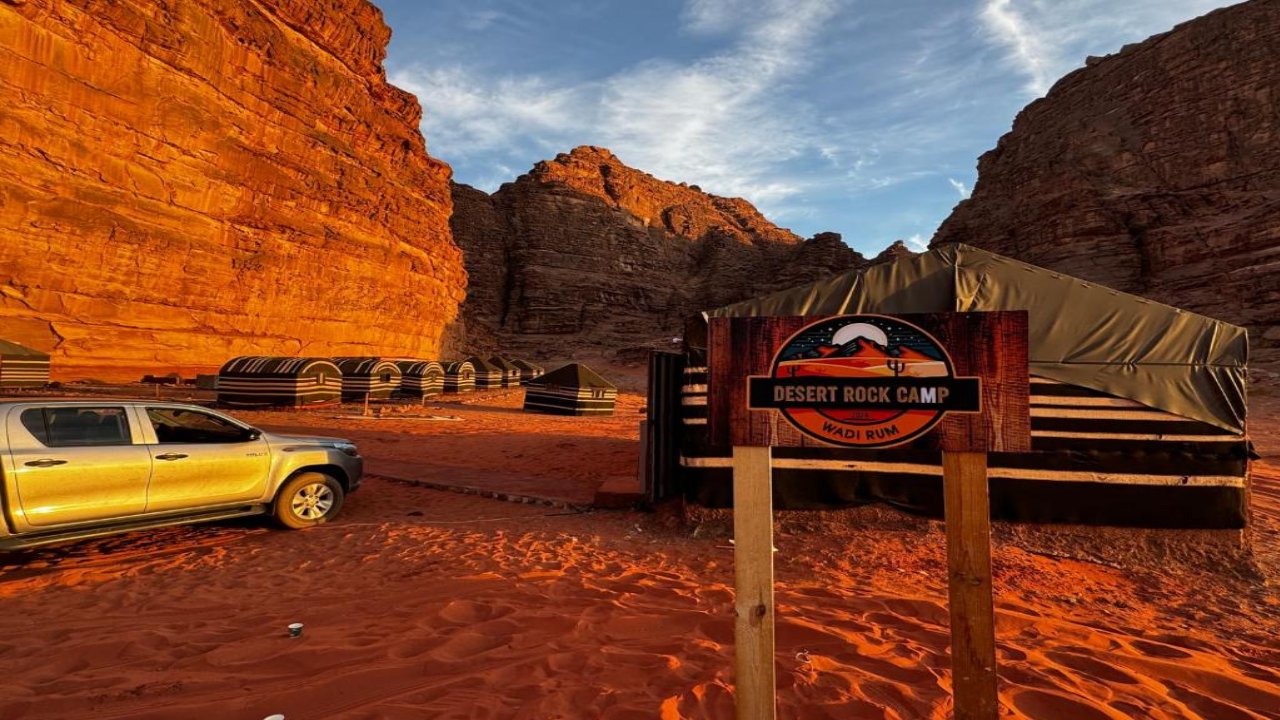
Wadi Rum is one of the most extraordinary desert destinations in the Middle East. Located in southern Jordan, this immense landscape of red sandstone mountains, golden sand dunes, narrow canyons and natural rock bridges is unlike anywhere else in the country. Sometimes called the Valley of the Moon, Wadi Rum is famous for its otherworldly scenery, traditional Bedouin hospitality and remarkably clear night skies. It is a place where travelers can leave busy cities behind and experience the silence, scale and changing colors of the desert.
The most popular way to explore Wadi Rum is by four-wheel-drive jeep with a local Bedouin guide. These desert excursions pass enormous sandstone cliffs, prehistoric rock inscriptions, red dunes and dramatic natural arches. Longer visits allow time for guided hiking, camel rides and sunset photography. Staying overnight is another highlight: traditional camps offer tents surrounded by mountains, while more comfortable desert lodges provide private bathrooms, panoramic windows and even futuristic dome-shaped accommodation.
However, Wadi Rum is not a conventional national park where visitors can simply drive between attractions using paved roads. Much of the protected landscape consists of open desert, unmarked tracks, remote canyons and isolated camps. Transportation, accommodation, food, mobile reception and tour arrangements need to be organized carefully. The desert can also be extremely hot during summer, cold at night and dangerous during flash-flood conditions.
This complete Wadi Rum Desert Travel Guide 2026 covers everything needed to plan a visit, including the history of the protected area, the best attractions, jeep safari prices, entrance fees, Jordan Pass information, transportation from Petra, Aqaba and Amman, three genuine desert camp recommendations, accommodation facilities, stargazing, a two-day itinerary, practical travel costs, safety precautions, packing essentials and frequently asked questions.


Photographs are credited to their creators and available through Wikimedia Commons. The three-image layout uses cropped display versions; the original images and licensing terms are available through the linked source pages.
Wadi Rum Desert at a Glance
| Detail | Information |
|---|---|
| Country | Jordan |
| Region | Southern Jordan, Aqaba Governorate |
| Official designation | Wadi Rum Protected Area |
| UNESCO World Heritage | Inscribed in 2011 |
| Protected area | Approximately 74,200 hectares |
| Landscape | Sandstone mountains, red dunes, valleys, canyons and natural arches |
| Foreign visitor entrance fee | JD 5 |
| Jordan Pass | Includes standard Wadi Rum admission |
| Recommended stay | 1–2 nights |
| Main arrival points | Wadi Rum Visitor Center and Rum Village |
| Best nearby city | Aqaba |
| Currency | Jordanian Dinar (JOD / JD) |
| Highlights | Jeep safaris, Bedouin camps, desert hiking, rock art and stargazing |
Where Is Wadi Rum Desert?
Wadi Rum is located in southern Jordan, northeast of the Red Sea coastal city of Aqaba and close to the border with Saudi Arabia.
The protected area lies approximately 60 kilometers northeast of Aqaba and about 290 kilometers south of Amman, according to UNESCO’s geographical description.
Unlike a typical desert of endless low sand dunes, Wadi Rum contains enormous sandstone massifs rising dramatically above broad sandy valleys.
These mountain formations create the distinctive skyline that makes the region recognizable in photographs and films.
The desert’s principal visitor gateway is the Wadi Rum Visitor Center. Rum Village lies farther along the approach road and is an important meeting point for local guides and camp operators.
Some accommodation properties are reached from Rum Village, while others use meeting points outside the main village or closer to the Disi area. Always confirm the exact arrival point with your accommodation provider.
Wadi Rum Desert Map
Use the map below to understand where Wadi Rum is located and how it relates to Aqaba, Petra and the surrounding region.
Digital maps may not accurately represent individual desert tracks, seasonal access restrictions or the actual pickup points used by Bedouin camps.
Do not navigate independently to an isolated camp using a normal rental car unless the operator has explicitly confirmed a suitable road and authorized vehicle access.
Why Is Wadi Rum a UNESCO World Heritage Site?
Wadi Rum was inscribed on the UNESCO World Heritage List in 2011 as a mixed natural and cultural property.
Its designation recognizes both the extraordinary desert landscape and the long history of human interaction with the region.
The natural formations are the result of geological processes operating over millions of years. Sandstone layers have been shaped by tectonic movement, uplift, faults, erosion and long-term weathering.
These processes created deep canyons, natural stone bridges, isolated rock towers and enormous cliffs.
The cultural heritage is equally significant.
UNESCO documents approximately 25,000 rock carvings, 20,000 inscriptions and 154 archaeological sites within the protected property.
These records provide evidence of at least 12,000 years of human occupation and changing land-use practices.
The carvings and inscriptions help researchers understand prehistoric communities, pastoral life, trade networks and the development of writing traditions across the region.
The protected area is therefore much more than an attractive backdrop for tourism. It is an exceptionally important record of geology, archaeology and human adaptation to an arid landscape.
The History of Wadi Rum and Bedouin Culture
Wadi Rum has been visited and inhabited by different communities over thousands of years.
Archaeological evidence shows that people used the area’s valleys, water sources and mountain corridors from prehistoric times onward.
Later communities left inscriptions and carvings in several writing traditions, including those associated with the Nabataeans.
The Nabataeans are particularly well known for their capital at Petra, but their cultural and commercial influence extended across a much wider region.
Wadi Rum’s location made it useful for movement through southern Jordan and the broader Arabian desert.
Traditional Bedouin Life
Bedouin communities have long developed ways of living in the desert by understanding water availability, grazing routes, seasonal weather and the demands of an arid environment.
Traditional practices include animal husbandry, desert navigation, weaving, cooking and hospitality.
Today, some local Bedouin families operate camps, drive sightseeing vehicles and guide visitors through the protected landscape.
These tourism businesses provide an important source of income, although modern Bedouin communities should not be portrayed as unchanged remnants of the past. Their culture continues to develop alongside contemporary life in Jordan.
Visitors can support local families by choosing responsibly operated camps, respecting cultural traditions and paying fairly for guiding services.
Wadi Rum and Lawrence of Arabia
Wadi Rum is closely associated with T. E. Lawrence, the British officer and writer who became famous for his activities during the Arab Revolt in the First World War.
The region’s dramatic scenery became widely known through stories associated with Lawrence and the 1962 film Lawrence of Arabia.
Several visitor attractions carry Lawrence-related names, including Lawrence’s Spring and Lawrence’s House.
However, these names often reflect modern tourism traditions and historical associations rather than conclusive evidence that Lawrence personally used every named location in the way popular stories suggest.
Visitors should distinguish documented history from later storytelling.
Best Things to Do in Wadi Rum Desert
1. Take a Four-Wheel-Drive Jeep Safari
A jeep safari is the most convenient introduction to Wadi Rum’s protected desert landscape.
Local Bedouin drivers use four-wheel-drive vehicles to travel between major viewpoints, dunes, rock bridges, canyons and archaeological features.
A standard sightseeing trip may include short walks, stops for photographs and traditional Bedouin tea.
Jeep tours vary in length, route and level of activity.
Short excursions concentrate on a limited selection of nearby sites, while longer tours can reach more distant landscapes and allow time for walking or sandboarding.
Recommended first-time tour: A four-hour jeep safari is a strong choice for visitors spending one night in the desert.
It offers more variety than a very short ride without requiring an entire day in an exposed vehicle.
For visitors who enjoy photography, a late-afternoon departure ending near sunset can be particularly rewarding.
2. Explore Khazali Canyon
Khazali Canyon is one of Wadi Rum’s most important historical and natural attractions.
The narrow sandstone passage is known for ancient petroglyphs and inscriptions associated with successive communities that used the region.
Some carvings depict people, animals and other recognizable forms.
Entering the canyon provides a close-up view of the layered sandstone walls and the way erosion has shaped the rock.
Visitors should use designated accessible sections and follow their guide’s instructions.
Parts of the canyon involve uneven surfaces or scrambling, and access conditions can change after rainfall.

The inscriptions are protected cultural heritage. Never touch, trace, wet or carve into the rock surfaces.
3. Climb a Red Sand Dune
Wadi Rum contains impressive areas of red and orange sand collected against cliffs and rocky slopes.
These dunes are among the most photogenic features of the landscape.
Climbing a dune provides elevated views across the surrounding desert, although walking uphill through loose sand can be unexpectedly tiring.
Some jeep tours include sandboarding when suitable equipment and conditions are available.
Ask whether sandboarding is included in your tour rather than assuming every operator provides boards.
Remove sand from footwear and equipment before leaving, and stay clear of fragile vegetation.
4. See Umm Fruth Rock Bridge
Umm Fruth is a natural sandstone bridge commonly included on longer jeep sightseeing routes.
The arch creates a striking opening against the surrounding desert and is a popular photography location.
Reaching the upper surface involves climbing uneven rock.
Visitors who are uncomfortable with heights or scrambling can appreciate the formation from below.
Do not feel pressured to climb simply because other tourists are doing so.
Weathering, sand on the rock and crowded conditions can affect grip and balance.
5. Visit Lawrence’s Spring
Lawrence’s Spring, commonly associated with the name Ain Shellaleh, is a well-known stop on Wadi Rum sightseeing tours.
The attraction is linked to the region’s water sources and its popular association with T. E. Lawrence.
The spring area provides an opportunity to learn how water availability influenced travel and settlement in the desert.
Some routes to elevated viewpoints near the spring involve loose stones and climbing.
Ask your guide about the difficulty and whether the climb is appropriate for your abilities.
6. Explore the Seven Pillars of Wisdom
The Seven Pillars of Wisdom is a prominent sandstone formation visible near the Wadi Rum entrance area.
Its name refers to Lawrence’s famous book, although the book’s title should not be mistaken for proof that the geological formation was originally named after it.
The dramatic cliffs are an excellent example of the natural erosion processes that shape the protected landscape.
They also provide a recognizable landmark for visitors arriving at the desert.
7. Watch Sunset Over the Desert
Sunset is one of Wadi Rum’s most memorable experiences.
As the sun lowers, the sandstone cliffs change from pale orange to deep red and brown, while longer shadows emphasize the shapes of the valleys and mountains.
Guides usually select a viewpoint according to the tour route and current conditions.
Some viewpoints are easily reached by jeep, while others involve a short walk or climb.
The best photographs often include a rock formation or dune in the foreground, helping communicate the enormous scale of the desert.
Do not climb unstable rocks for a better angle.
8. Experience Stargazing in Wadi Rum
Wadi Rum is known for its spectacular night skies.
When the sky is clear and moonlight is limited, the desert offers excellent conditions for observing stars and constellations.
The relatively low level of artificial lighting in some camp areas can make the night sky much more impressive than in large cities.
However, no location guarantees a cloudless or moonless night.
For travelers especially interested in the Milky Way, it is useful to check the moon phase before choosing travel dates.
Guided astronomy experiences are also available through providers such as RumSky, which is referenced by Jordan’s official tourism authority.
Official tourism information: Visit Jordan — Wadi Rum Activities.
9. Enjoy a Traditional Bedouin Dinner
Many desert camps prepare an evening meal inspired by traditional Jordanian and Bedouin cooking.
One of the best-known methods is zarb, in which meat and vegetables are cooked in a covered underground oven or pit.
The food is usually prepared slowly and served with rice, bread, salads or other accompaniments.
Camp menus vary, and not every accommodation serves the same dishes.
Vegetarian and dietary options may be available with advance notice.
Ask about meal inclusions before booking, particularly if your camp is far from any village restaurant.
10. Go Hiking or Rock Scrambling with a Guide
Beyond the popular jeep routes, Wadi Rum contains extraordinary opportunities for hiking and climbing.
Routes range from relatively gentle walks through sandy valleys to technically demanding ascents of sandstone mountains.
Jabal Burdah and its natural bridge are known for more challenging scrambling, while other local excursions focus on longer walks through remote canyons.
Serious climbing routes may require ropes, specialized equipment and experienced local guides.
Even a route that appears short on a map can become dangerous if you encounter exposed rock, loose sandstone, extreme heat or poor navigation.
If you enjoy hiking in dramatic terrain, Aoqira’s Santa Ana Volcano hiking guide
Wadi Rum Jeep Tour Prices in 2026
Jeep tour prices vary according to the operator, group size, duration, whether the experience is shared or private, and any additional activities included.
For a grounded comparison, Bedouin Lifestyle Camp publishes the following tour-only rates on its official website.
| Tour | Solo traveler | 2–4 adults | 5–8 adults |
|---|---|---|---|
| 2-hour jeep tour | JD 35 | JD 20 per adult | JD 15 per adult |
| 4-hour jeep tour | JD 65 | JD 35 per adult | JD 30 per adult |
The operator lists an additional JD 10 per person for making these tour-only experiences private, subject to its published conditions.
Tour descriptions include an English-speaking driver, bottled water, Bedouin tea and sandboarding.
Sources: Published 2-hour jeep tour and published 4-hour jeep tour.
These are real advertised prices from one operator, not government-regulated rates applying to every Wadi Rum tour company.
Before booking, confirm whether the price includes transfers from your meeting point, lunch, sunset, private guiding, children and any necessary entrance charges.
Wadi Rum Entrance Fee and Jordan Pass
Wadi Rum Protected Area has a separate entrance fee administered through the official visitor system.
Jordan’s Ministry of Tourism and Antiquities currently lists an entrance charge of JD 5 for foreign visitors.
Visitors holding an eligible Jordan Pass can use its included Wadi Rum admission benefit.
The Jordan Pass is particularly useful when a traveler plans to visit Petra and other major historical attractions during the same trip.
Jordan Pass Prices
| Jordan Pass | Price | Petra entry |
|---|---|---|
| Jordan Wanderer | JD 70 | 1 day |
| Jordan Explorer | JD 75 | 2 consecutive days |
| Jordan Expert | JD 80 | 3 consecutive days |
All three packages include prepaid admission to numerous participating attractions, including Wadi Rum.
The official Jordan Pass website also explains that eligible travelers may receive a waiver of the tourist entry visa fee if they purchase the pass before arriving and remain in Jordan for at least two nights, or three days.
Important: The Jordan Pass is not itself a visa. Eligibility and visa procedures depend on nationality, entry point and immigration rules. Verify your individual requirements before departure.
Check official Jordan Pass packages and current prices →
Wadi Rum Visitor Center Opening Hours
The official Jordan Pass attraction information lists Wadi Rum visitor-center hours of approximately 8:00 AM–5:00 PM.
These published administrative hours should not be confused with the hours of an overnight desert accommodation booking.
If you arrive late, confirm visitor-center procedures and camp pickup arrangements in advance.
Official Jordan Pass participating attractions →
How to Get to Wadi Rum Desert
Wadi Rum can be reached by road from Petra, Aqaba or Amman.
Most visitors arrive at the Visitor Center or a prearranged meeting point and continue to their camp in a suitable vehicle operated by the accommodation provider.
From Aqaba to Wadi Rum
Aqaba is one of the closest major cities to Wadi Rum.
Jordan’s official tourism website advises allowing approximately one hour by road from Aqaba.
Private taxis, prearranged transfers and available bus services provide potential transport options.
Travelers arriving through King Hussein International Airport should confirm their pickup arrangement and whether the driver will take them to the Visitor Center or directly to an authorized camp access point.
From Petra to Wadi Rum
Wadi Rum combines particularly well with Petra, making this one of Jordan’s most popular regional travel routes.
SunCity Camp’s published transport information suggests allowing approximately two hours from Petra, depending on the exact departure and destination.
Travelers can arrange a private taxi, hotel transfer or bus service operating on a suitable date.
If visiting Petra in the morning and Wadi Rum in the afternoon, avoid underestimating the amount of time spent walking at Petra.
A much more comfortable itinerary is to visit Petra on one day and travel to Wadi Rum the following morning or early afternoon.
From Amman to Wadi Rum
The road journey from Amman typically requires approximately four hours using the Desert Highway, according to Jordan’s official tourism authority.
The scenic King’s Highway takes longer, with published planning guidance suggesting approximately six hours.
Both times are estimates and depend on the actual route, traffic, stops and weather.
Travelers arriving at Queen Alia International Airport should allow additional time for airport formalities and the road connection.
Can You Reach Wadi Rum by Public Bus?
Bus connections may be available from major destinations including Aqaba, Petra and Amman.
However, routes and departure schedules can change, and not every service stops directly at Rum Village.
Some services use the main Desert Highway or designated pickup locations, requiring a separate transfer.
Before booking a camp, ask whether the operator can collect you from your intended bus stop.
If you have a flight or international connection on the same day, use confirmed transport arrangements rather than relying on an unverified local bus departure.
Can You Drive a Rental Car into Wadi Rum?
Travelers can drive a normal rental car to suitable road-accessible arrival areas.
However, most interior desert tracks are not appropriate for ordinary vehicles, and driving within the protected area is subject to access regulations.
Rental contracts may also exclude off-road driving.
The safer and more practical approach is to park at the location specified by your camp and continue in the operator’s authorized four-wheel-drive vehicle.
Where to Stay in Wadi Rum Desert
Accommodation is an important part of the Wadi Rum experience.
Rather than conventional large hotels, visitors usually stay at Bedouin camps, tented desert lodges or luxury glamping properties.
Facilities vary substantially. Some camps provide simple traditional tents with shared bathrooms, while others offer air-conditioned rooms, private bathrooms, heating and panoramic desert views.
The three genuine camps below offer distinct accommodation styles.
| Accommodation | Accommodation style | Best for |
|---|---|---|
| Obeid’s Bedouin Life Camp | Traditional tents and distinctive rock rooms | Local hospitality and traditional atmosphere |
| Captain’s Desert Camp | Panoramic tents, bubble tents and desert accommodation | Families and comfortable desert camping |
| SunCity Camp | Martian domes, suites and luxury tents | Luxury glamping and couples |
1. Obeid’s Bedouin Life Camp — Best for Traditional Bedouin Hospitality
Location: Wadi Rum Protected Area, Jordan.
Obeid’s Bedouin Life Camp is a family-operated desert camp with a history dating to 2001.
According to its official website, Obeid established the camp after retiring from the police, initially using a family tent associated with his own Bedouin upbringing.
The camp has since expanded with the involvement of his sons and continues to emphasize local hospitality and traditional design.
The property offers different levels of accommodation, from simpler rooms to more comfortable private rooms and distinctive spaces built against sandstone formations.


These photographs depict the named camp itself, rather than unrelated desert accommodation. They are historical photographs from 2012 and do not establish the present appearance of its rooms or amenities.
Obeid’s Bedouin Life Camp Room Types
The camp’s official accommodation information identifies several room options.
- Private Bedouin-style rooms: Accommodation suitable for groups of two to six guests, with ensuite bathrooms.
- Panoramic double rooms: Rooms with large windows facing the surrounding desert and air conditioning.
- Rock Room: A larger room built beneath sandstone rock, with a king-size bed and private bathroom.
- Cave Room: An elevated, traditionally decorated room with panoramic desert views and a king-size canopy bed.
- Budget rooms: Simpler accommodation using shared bathroom facilities with hot showers.
Best suited to: Couples, independent travelers and visitors interested in family-operated Bedouin accommodation.
Room prices: Confirm directly for your travel dates. No verified current date-specific rate is included here.
Official website: Obeid’s Bedouin Life Camp.
Current accommodation details: Official room descriptions and photographs.
2. Captain’s Desert Camp — Best for Comfortable Desert Camping
Location: Wadi Rum, southern Jordan.
Captain’s Desert Camp is an established accommodation business associated with the Jordanian hospitality company Captain’s Group.
The company’s official history identifies the establishment of its Wadi Rum camp in 1986.
The accommodation combines desert scenery with tented lodging and guest facilities.
Current published accommodation information describes panoramic tents and bubble-style rooms, along with dining and arrangements for outdoor activities.

Captain’s Desert Camp Room Options
Currently published accommodation listings describe options such as:
- Panoramic tents: Tented accommodation with mountain views, private bathrooms and air conditioning.
- Bubble tents: Larger glamping accommodation with private facilities and views toward the surrounding desert.
- Other accommodation configurations: Availability and exact features should be confirmed directly with the camp.
The property’s advertised guest facilities include dining areas, a restaurant, common spaces and outdoor activity arrangements.
Some published listings also describe Wi-Fi in shared areas and organized activities such as camel riding, jeep tours and stargazing.
Best suited to: Families, couples and travelers who want a more comfortable camping experience.
Room prices: Dynamic prices depend on dates and room category. Contact the operator for an accurate quotation.
Official operator website: Captain’s Group.
Official camp contact: Captain’s Desert Camp contact information.
3. SunCity Camp — Best for Luxury Martian Domes
Location: Wadi Rum desert region, Jordan.
SunCity Camp is a luxury desert accommodation property known for its futuristic Martian Dome rooms.
The domes offer large panoramic windows designed to frame views of the sandstone mountains and desert surroundings.
Unlike basic camping accommodation, the property focuses on modern hotel-style facilities.
Its official website lists several accommodation categories, including Martian Dome, Grande Suite, Royal Tent, Deluxe Tent and Family Suite options.
SunCity Camp Room Features
According to the official accommodation descriptions, room features include:
- Air conditioning and heating.
- Private ensuite bathroom.
- Hot showers.
- Comfortable bedding.
- Private terrace with seating.
- Desert-facing windows in selected categories.
- Mini refrigerator and minibar in listed categories.
- Breakfast and dinner included in the published room descriptions.
- Wi-Fi in common areas.
The property’s room listings describe accommodation spaces of approximately 32 square meters for several categories.
Family and group arrangements should be confirmed by selecting the precise room category rather than assuming all rooms have the same capacity.
Best suited to: Couples, honeymooners, families and travelers seeking a luxury glamping experience.
Room prices: Obtain a live quote from the camp for your intended dates.
Official website: SunCity Camp.
Actual dome, suite and tent photographs: SunCity Camp Official Accommodation Gallery.

SunCity’s actual property photography is available through the official room gallery above. Independent reuse permission for those photographs could not be verified, so an unrelated property photograph has not been presented as a SunCity image.
Which Wadi Rum Camp Should You Choose?
Choose Obeid’s Bedouin Life Camp for a family-operated property, traditional-style rooms and a range of comfort levels.
Choose Captain’s Desert Camp for an established desert accommodation operator offering more modern tent choices.
Choose SunCity Camp for contemporary luxury accommodation and panoramic Martian Dome rooms.
For a first-time visitor, the most important consideration is not only the appearance of the room but also whether the operator provides dependable transfers, suitable bathrooms, meals and organized desert tours.
How Much Does a Wadi Rum Overnight Stay Cost?
Camp accommodation prices vary widely because Wadi Rum offers everything from basic shared-facility tents to premium dome accommodation.
One useful published reference is Bedouin Lifestyle Camp’s four-hour jeep tour with an overnight stay.
For groups of two to four adults, the operator advertises:
| Package | Published price |
|---|---|
| 4-hour jeep tour + Standard Tent overnight | JD 50 per adult |
| 4-hour jeep tour + Panoramic Tent overnight | JD 75 per adult |
The operator lists the jeep excursion, overnight accommodation, dinner, breakfast, water, tea, sandboarding and return transfer to Rum Village as included.
These are real advertised package prices for a particular group-size category, not rates for every desert camp or a guarantee of availability.
View the operator’s published overnight package →
Luxury camps, especially dome accommodation, use separate pricing and may offer different meal or transfer inclusions.
Suggested 2-Day Wadi Rum Desert Itinerary
Two days and one night provide a balanced introduction to the region without requiring a long or expensive expedition.
Day 1: Arrival, Jeep Safari and Sunset
Arrive at Wadi Rum in the late morning or early afternoon.
Complete the required visitor-center admission procedure and meet your accommodation operator at the agreed pickup point.
If your camp permits early check-in, leave your luggage and prepare a small day bag containing water, sunscreen, a hat and your camera.
Begin a four-hour jeep tour visiting selected scenic locations.
Depending on your operator’s planned route, stops may include red dunes, Khazali Canyon, Lawrence’s Spring and a natural rock bridge.
Allow time for photographs, short walks and a tea break.
Finish the excursion at a suitable sunset viewpoint before returning to your camp.
Enjoy a traditional dinner and, if the sky is clear, spend time watching the stars.
Overnight: A Bedouin camp or desert glamping property.
Day 2: Sunrise and Departure
Wake up early to enjoy the desert scenery before the main daytime heat develops.
Some camps offer sunrise viewing close to their accommodation area, while others arrange a short excursion.
Check the walking distance and whether transportation is required.
After breakfast, consider a guided morning walk or a camel excursion if available and suitable.
Return to Rum Village or the agreed road-accessible departure point using your camp’s arranged transfer.
Continue toward Aqaba, Petra or your next Jordan destination.
Alternative: If you have two nights available, use the additional day for a longer desert jeep tour, photography or a guided hiking excursion.
Best Time to Visit Wadi Rum Desert
Wadi Rum is a year-round destination, but seasonal temperatures can significantly affect comfort and safety.
Spring: March to May
Spring is often one of the most comfortable periods for desert sightseeing.
Daytime weather can be pleasant for jeep tours, short hikes and outdoor photography, although temperatures become warmer toward late spring.
Weather is still variable, and occasional wind or rain can affect excursions.
Summer: June to August
Summer can be extremely hot, especially during the middle of the day.
Exposed jeep rides, dune climbing and hiking become more demanding in high temperatures.
Choose early morning or late-afternoon excursions, avoid strenuous midday activity and carry more water than you would for an ordinary city sightseeing day.
Travelers sensitive to heat may prefer a cooler season.
Autumn: September to November
Autumn is another attractive period for desert travel.
Temperatures generally become more comfortable after the summer heat, making it easier to combine jeep sightseeing with walking and overnight camping.
Late autumn may bring cooler nights and an increasing possibility of rainfall.
Winter: December to February
Winter provides cooler daytime weather, but nights can become very cold.
Freezing temperatures are possible under suitable conditions, especially in exposed desert locations.
Some visitors enjoy the dramatic light and quieter atmosphere of winter, but suitable accommodation heating is important.
Rainfall can also create dangerous flash-flood conditions in desert wadis.
If visiting during winter, check the weather forecast and make sure your accommodation provides enough warmth for the expected night temperatures.
Safety Guide: Is Wadi Rum Desert Safe?
Wadi Rum is a major Jordanian tourism destination, but the protected area is still a remote desert environment.
Visitors should prepare for sudden weather changes, extreme temperatures, challenging terrain and limited access to emergency assistance away from main roads.
Regional security developments can also affect travel arrangements within Jordan, so check government advisories shortly before departure.
1. Flash Floods and Rainstorms
Flash flooding is one of the most serious hazards in desert environments.
Rainfall far away from your location can send water rapidly through dry channels, narrow canyons and low-lying valleys.
The United Kingdom’s official Jordan travel advice identifies flash-flood risk in wadis during the wetter period from approximately November through March.
Before traveling:
- Check the current weather forecast and official warnings.
- Avoid entering wadis after heavy rain.
- Do not camp in a natural drainage channel.
- Never attempt to cross flowing floodwater.
- Move to higher ground if flooding develops.
- Follow instructions from experienced local guides and authorities.
Tour operators may cancel excursions or change routes when conditions are unsafe. These decisions should be respected.
2. Extreme Heat and Dehydration
Long periods in direct sun can cause dehydration, heat exhaustion and heatstroke.
Carry sufficient drinking water, cover exposed skin and take regular breaks.
For strenuous hikes, ask your guide how much water is needed for the route and expected weather.
Do not assume that every sightseeing stop has drinking water for sale.
3. Cold Desert Nights
Desert temperatures can fall sharply after sunset.
Visitors should not assume that a tent with comfortable daytime temperatures will remain warm overnight.
Confirm heating, blankets, bedding and bathroom arrangements before booking, particularly in winter.
4. Jeep Safari Safety
Desert roads and tracks are uneven, and vehicles may travel over sand, rocks and slopes.
Choose an experienced operator using a suitable vehicle.
Ask how passengers are secured, especially if the tour uses an open-backed jeep.
Do not stand or move around while the vehicle is traveling.
Families should confirm child seating and age suitability before booking.
5. Hiking, Scrambling and Rock Bridges
Sandstone can be brittle and slippery, especially where fine sand covers steep surfaces.
Stay away from exposed ledges unless you are following a route appropriate to your skills.
Serious rock climbing should be undertaken only with suitable equipment and an experienced guide.
Do not attempt demanding routes such as Jabal Burdah independently simply because photographs make them appear straightforward.
6. Desert Navigation
Much of Wadi Rum’s landscape consists of similar-looking valleys, cliffs and open sandy plains.
Mobile signal and digital maps may be unreliable in remote sections.
Independent navigation can become dangerous when visitors underestimate distances or lose track of their return route.
For remote excursions, travel with a knowledgeable local guide and let your accommodation know your plans.
7. Regional Security and Travel Advisories
Jordan’s overall security situation and regional air-travel conditions can change in response to developments elsewhere in the Middle East.
As of October 2026, the UK’s Foreign, Commonwealth and Development Office advises against travel to certain parts of Jordan, particularly close to the Syrian border. Its guidance also discusses regional hostilities and the potential for airspace disruptions.
Wadi Rum’s southern location does not eliminate the need to check wider national travel advice.
Monitor official announcements, avoid restricted military areas and confirm that your insurance covers the destination and planned activities.
Current UK Government Jordan travel advice →
8. Cultural Respect and Camp Etiquette
Ask permission before photographing local residents, especially inside family or community spaces.
Dress respectfully around villages and cultural sites.
Support responsible operators who protect archaeological features and minimize environmental damage.
Do not leave litter or remove rocks, archaeological fragments or other protected material.
9. Emergency Assistance
Jordan’s unified emergency telephone number is 911.
The Jordanian Public Security Directorate and Civil Defence services use this emergency system.
However, mobile phone coverage may be inconsistent in remote desert areas.
Before departure, save your camp’s telephone number, transfer provider details and the name of your local guide.
Jordan Civil Defence official contact information →
What to Pack for Wadi Rum Desert
A suitable packing list depends on the season, your accommodation type and whether you plan to hike.
For most travelers, the following items are useful:
- Comfortable closed-toe walking shoes.
- Lightweight breathable clothing.
- Long-sleeved shirt for sun protection.
- Sun hat and sunglasses.
- High-SPF sunscreen.
- Reusable water bottle.
- Warm jacket or fleece for evenings.
- Windproof layer.
- Light rain protection if needed.
- Scarf or face covering for blowing dust.
- Power bank.
- Headlamp or flashlight.
- Camera with dust protection.
- Passport and essential travel documents.
- Jordan Pass or entrance confirmation if applicable.
- Cash in Jordanian Dinars.
- Personal medicines and basic first-aid items.
- Small overnight bag for camp accommodation.
For climbing or remote hiking, ask your guide whether special equipment, additional water or technical footwear is required.
What to Eat in Wadi Rum
Most overnight camps provide dinner and breakfast, either as part of the room rate or through a package.
Traditional Jordanian dishes may include:
Zarb
Zarb is a well-known underground cooking method associated with Bedouin desert hospitality.
Meat and vegetables are cooked in a covered pit, often over several hours, and served with rice and accompaniments.
Mansaf
Mansaf is one of Jordan’s best-known national dishes, traditionally prepared with lamb, rice and a fermented dried-yogurt sauce called jameed.
Not every camp serves mansaf, so confirm the menu if it is a dish you particularly want to try.
Bedouin Tea
Tea is an important part of hospitality across many communities in Jordan.
Visitors may be offered tea during a jeep tour or while relaxing around a campfire.
The style and ingredients vary, but sweetened black tea with herbs is common.
Travelers with allergies or dietary restrictions should inform their accommodation before arriving, because remote camps may not have immediate access to alternative ingredients.
Can You Visit Wadi Rum Without Staying Overnight?
Yes. Wadi Rum can be visited as a day trip, particularly from Aqaba or Petra.
A short visit can include the Visitor Center, a jeep safari and several major sightseeing stops.
However, a day trip cannot fully reproduce the quieter evening and morning experiences that make an overnight stay memorable.
Travelers with limited time should prioritize a suitable guided excursion rather than attempting to reach distant attractions independently.
If your schedule allows one night, the combination of a jeep safari, sunset, camp dinner and early-morning desert views usually provides a more complete introduction.
Is Wadi Rum Suitable for Families?
Wadi Rum can be a memorable destination for families, particularly when they choose comfortable accommodation and a manageable jeep itinerary.
Important considerations include:
- Availability of suitable child restraints in vehicles.
- Travel time to and from the camp.
- Bathroom access and hot water.
- Room temperature during the season.
- Appropriate meals for children.
- Exposure to heat and sun.
- Accessibility of viewpoints and walking routes.
Families should avoid technical climbing routes and choose experiences suitable for the youngest travelers.
Visitors with reduced mobility should ask for detailed information about vehicle transfers, tent access, steps, bathroom layouts and whether assistance is available.
Wadi Rum’s natural terrain is not uniformly wheelchair accessible, even when a camp advertises modern accommodation facilities.
Wadi Rum Photography Tips
Wadi Rum is particularly appealing for landscape photography because the changing sun reveals different colors and textures in sandstone cliffs.
Early morning: Often provides softer light, long shadows and fewer visitors at selected locations.
Late afternoon: Ideal for warm rock colors and photographing dunes against the mountains.
Sunset: Look for compositions featuring layered mountains, isolated rock towers and shadows across the sand.
Night photography: Choose a clear night, check the moon phase and use a stable camera support where permitted.
Keep electronics protected from fine blowing sand and avoid changing lenses unnecessarily during windy conditions.
If dramatic sandstone landscapes interest you, Aoqira’s Arizona Slot Canyons guide
Responsible Tourism in Wadi Rum
Wadi Rum is both a protected natural landscape and an important cultural heritage site.
UNESCO identifies tourism-related vehicle tracks, infrastructure pressure and environmental change among the concerns requiring careful management.
Visitors can reduce their impact by:
- Choosing responsible local operators.
- Following established vehicle routes.
- Not touching ancient inscriptions.
- Taking all rubbish away.
- Using water responsibly.
- Respecting local communities.
- Avoiding unnecessary disturbance to wildlife and vegetation.
- Not removing natural or archaeological material.
These habits help preserve the desert’s landscapes and cultural records for future visitors.
Is Wadi Rum Desert Worth Visiting?
Yes. Wadi Rum is one of Jordan’s most distinctive destinations, particularly for travelers interested in remarkable landscapes, Bedouin culture, desert photography and outdoor adventures.
The combination of massive rock formations, ancient inscriptions, vast sandy valleys and star-filled night skies offers a travel experience very different from the historic cities and archaeological monuments elsewhere in Jordan.
The biggest planning challenge is understanding that accommodation and transportation in Wadi Rum are closely connected.
A reliable camp or tour operator can make the difference between a smooth visit and a frustrating arrival at the wrong location.
For most first-time visitors, a four-hour jeep safari and one night in a well-managed desert camp provide an excellent introduction.
For more landscapes where ancient history and dramatic terrain come together, Aoqira’s Temple of Queen Hatshepsut guide
Travelers interested in spectacular nature destinations may also enjoy the Khao Sok National Park travel guide And for another landscape made famous by cinema, see Aoqira’s Jiufen Spirited Away guide Wadi Rum is in southern Jordan, northeast of Aqaba and near the Saudi Arabian border. Its main visitor gateway is the Wadi Rum Visitor Center. The official foreign visitor entrance fee is currently JD 5. Standard admission is also included in an eligible Jordan Pass. Yes. The Jordan Pass includes admission to Wadi Rum along with numerous other participating attractions. Jeep tours and accommodation are not included automatically. One night and two days provide a good first-time experience. Two nights offer more flexibility for hiking, photography or longer desert tours. Yes. Day trips are possible, especially from Aqaba or Petra. However, staying overnight allows visitors to experience sunset, the night sky and early-morning desert scenery. A guided four-wheel-drive jeep tour is one of the most practical options. It allows visitors to explore major attractions without independently navigating remote desert tracks. Prices vary by operator and group size. One published example charges JD 20 per adult for a two-hour tour and JD 35 per adult for a four-hour tour when traveling in a group of two to four adults. Yes. Visitors can stay in traditional Bedouin camps, modern tent accommodation and luxury desert domes. Facilities vary between properties. Bubble tents and Martian domes can be appealing for travelers who want panoramic desert views and modern comfort. Before booking, confirm privacy, room temperature, bathroom facilities and the property’s actual location. Wadi Rum is an established tourism destination, but visitors must prepare for heat, cold nights, remote terrain, flash floods and off-road vehicle travel. Current regional security advice should also be checked before departure. Travelers can reach designated road-accessible arrival points by car. Driving on interior desert tracks requires suitable vehicle access and must follow protected-area rules. Ordinary rental cars should not be taken off-road without authorization. Spring and autumn are often the most comfortable periods for outdoor activities. Summer can be extremely hot, while winter nights can be cold and wet-weather flooding is a concern. Under clear, dark conditions with limited moonlight, the Milky Way may be visible. Visibility depends on weather, season, moon phase and local lighting. Yes, provided families choose safe transport, suitable accommodation and age-appropriate activities. Vehicle seating, heat exposure, camp facilities and walking difficulty should be confirmed before booking. Wadi Rum has served as a location for productions including Lawrence of Arabia, The Martian and Dune, with its desert landscapes frequently used to represent otherworldly environments. Wadi Rum is one of the most remarkable places to visit in Jordan. Its enormous sandstone mountains, red dunes, ancient rock art and open desert valleys create a landscape that feels very different from the country’s historic towns and archaeological attractions. The most rewarding experience is not necessarily the longest or most expensive tour. A carefully planned jeep safari, time to appreciate the sunset and a comfortable overnight stay can provide a memorable introduction. For a first trip, allow at least one night, arrange transportation before arrival and choose a Bedouin camp that clearly explains its facilities and tour inclusions. If you have additional time, consider guided hiking, a longer desert excursion or a dedicated stargazing experience. Above all, respect the desert’s weather, landscape and cultural heritage. Wadi Rum is a protected environment, and responsible travel helps ensure that its extraordinary scenery and historical records remain preserved. This guide uses official tourism and heritage authorities, published tour-operator information, camp websites and documented image licenses. Fees, transport arrangements, safety conditions and accommodation facilities should be reconfirmed before travel. Wadi Rum Landscape — Harry Van den Bulck, CC BY-SA 4.0. Wadi Rum View Near Little Bridge — Anastasia Pozdnyakova, CC BY-SA 4.0. Seven Pillars of Wisdom — Harry Van den Bulck, CC BY-SA 4.0. Khazali Petroglyphs — Berthold Werner, CC BY-SA 3.0. Obeid’s Bedouin Life Camp Photo 1 — Jumilla, CC BY 2.0. Obeid’s Bedouin Life Camp Photo 2 — Jumilla, CC BY 2.0. Captain’s Desert Camp — Harry Van den Bulck, CC BY-SA 4.0. Traditional Desert Camp Illustration — Irina Alexandra S., CC BY-SA 4.0. All photographs above have identifiable source pages and published Creative Commons licensing information. The photographs of Obeid’s Bedouin Life Camp and Captain’s Desert Camp depict the named properties but were taken in earlier years. Photographs used as illustrative examples are identified as such. Reuse must comply with the linked licenses, including attribution and applicable ShareAlike requirements.Frequently Asked Questions About Wadi Rum
Where is Wadi Rum Desert?
How much is the Wadi Rum entrance fee?
Is Wadi Rum included in the Jordan Pass?
How many days do you need in Wadi Rum?
Can you visit Wadi Rum in one day?
What is the best way to explore Wadi Rum?
How much does a Wadi Rum jeep safari cost?
Can you sleep in the Wadi Rum desert?
Are Wadi Rum bubble tents worth it?
Is Wadi Rum safe for tourists?
Can you drive your own car into Wadi Rum?
What is the best month to visit Wadi Rum?
Can you see the Milky Way in Wadi Rum?
Is Wadi Rum suitable for children?
What films were shot in Wadi Rum?
Final Thoughts
Sources and Further Reading
World Heritage designation, geological landscape, archaeological evidence, rock art, protected-area extent and conservation.
Official heritage description and cultural significance.
Attractions, desert experiences, historical background and transportation guidance.
Official Wadi Rum entrance fee for foreign visitors.
Jordan Wanderer, Explorer and Expert packages and applicable visa-fee waiver conditions.
Wadi Rum admission and published visitor hours.
Current security advisories and regional travel risks.
Flash floods, outdoor activities, travel-operator precautions and safety guidance.
Official emergency telephone information.
Family-operated camp history, accommodation and guiding services.
Room types, bathrooms, cave room and facilities.
Captain’s Desert Camp operator information.
Martian Dome, suites, luxury tents and property amenities.
Real tour-price examples and inclusions.
Published accommodation-and-tour package structures.Photograph Credits and Licenses