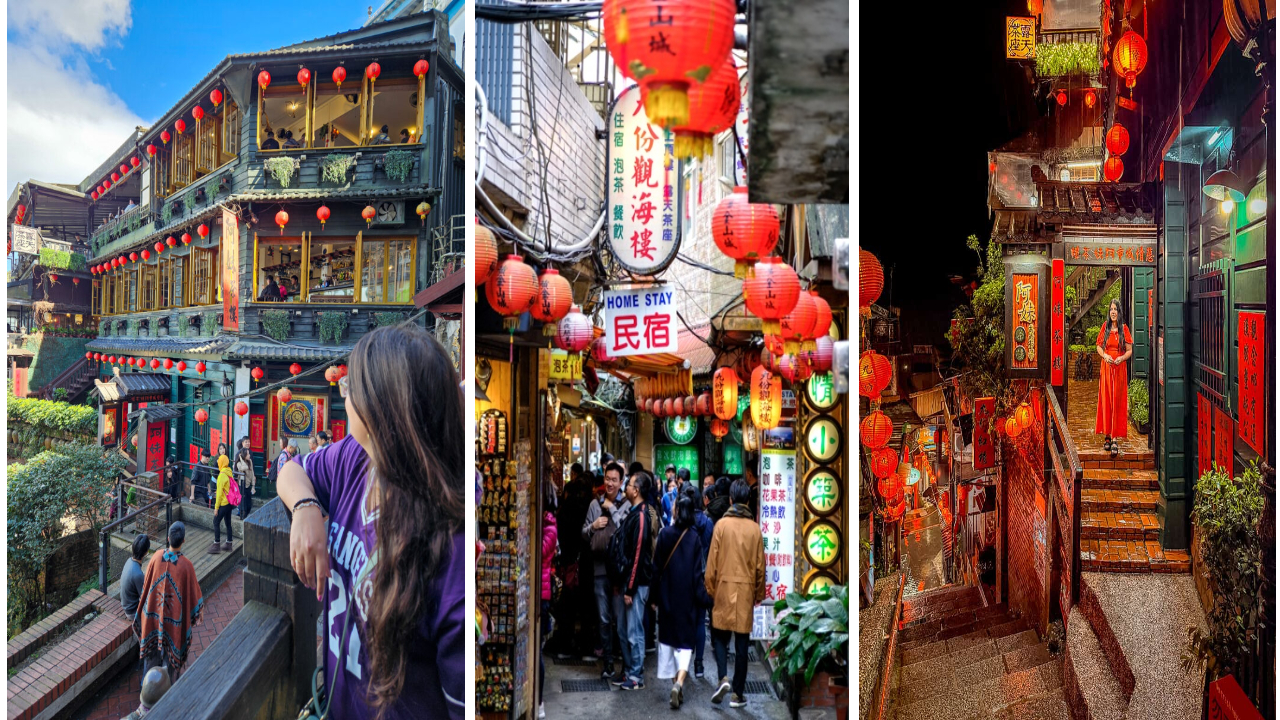
Jiufen is one of Taiwan’s most enchanting mountain towns. Perched on the hills of New Taipei City, its narrow stairways, red lanterns, traditional tea houses, and sweeping coastal views create an atmosphere that feels almost imaginary. As daylight fades, glowing lanterns transform the steep streets into a scene that many travelers immediately associate with Studio Ghibli’s famous animated film Spirited Away.
For years, travelers have described Jiufen as the real-life inspiration for the movie. Pictures of the famous A-Mei Tea House frequently appear beside images of the fictional bathhouse from the film. But the actual story is more complicated—and Jiufen’s real history as a former gold-mining settlement is just as fascinating as the legend.
This complete Jiufen Spirited Away travel guide explains the truth behind the movie connection, the best things to see in Jiufen, how to reach the town from Taipei, where to photograph the red lanterns, what to eat, which tea houses to visit, where to stay overnight, nearby attractions, costs, walking routes, and practical tips for planning an unforgettable Taiwan day trip.


Jiufen Taiwan At A Glance
| Detail | Information |
|---|---|
| Location | Ruifang District, New Taipei City, Taiwan |
| Famous for | Red lanterns, historic lanes, tea houses, gold-mining history |
| Movie connection | Resembles Spirited Away; direct inspiration denied |
| Best departure city | Taipei |
| Travel options | Direct bus, train plus local bus, taxi, organized tour |
| Old Street admission | Free to explore |
| Recommended visit | 3–5 hours |
| Best atmosphere | Late afternoon through dusk |
| Nearby attractions | Jinguashi, Gold Museum, Keelung Mountain, Golden Waterfall, Shifen |
Where Is Jiufen?
Jiufen is in the mountains of Ruifang District, New Taipei City, northeastern Taiwan. The settlement sits above the coastline, surrounded by green hills overlooking the East China Sea.
Unlike Taipei’s broad avenues and high-rise districts, Jiufen is a compact historic mountain community made up of steep stairways, hillside buildings, winding alleys, shops, and traditional tea houses.
The town’s topography is part of its appeal. Streets frequently change elevation, and a short walk can reveal a completely different view of the sea, mountains, or lantern-covered buildings.
Jiufen is usually visited as a day trip from Taipei, although staying overnight allows you to experience quieter streets after most tour groups leave.
Map Of Jiufen Old Street
The main sightseeing area centers on Jishan Street and Shuqi Road, with A-Mei Tea House and Shengping Theater among the most recognizable stops.
Did Jiufen Really Inspire Spirited Away?
The short answer is no confirmed direct connection exists, and the filmmakers have denied the claim.
The comparison became popular because Jiufen’s architecture, lanterns, stairways, crowded lanes, and teahouses resemble parts of the spirit world depicted in the 2001 animated film.
The building most commonly associated with the movie is A-Mei Tea House, whose illuminated façade reminds visitors of the elaborate bathhouse featured in the story.
However, Miyazaki denied using Jiufen as the model for the film during a 2013 interview. In 2023, Studio Ghibli producer Toshio Suzuki again addressed the rumor, saying that neither he nor Miyazaki had visited Jiufen.
So although the visual similarities are striking, it would be inaccurate to call Jiufen the official filming location or the confirmed real-life bathhouse from Spirited Away.
What visitors experience instead is something arguably more interesting: a real Taiwanese mountain town with its own historical identity, architecture, food traditions, and mining heritage.
Why Does Jiufen Look Like Spirited Away?
There are several visual features that explain the association.
The first is the town’s vertical design. Buildings stand at different elevations along the hillside, and narrow stairways connect the streets. This produces layered views that feel theatrical, especially when people move between brightly illuminated shopfronts.
The second is the lanterns. Red paper lanterns hang outside many businesses and along stairways. At dusk, their warm light contrasts with the blue evening sky and dark surrounding mountains.
The third is the architectural character of the teahouses. Traditional timber details, tiled roofs, balconies, and multi-level structures add to the atmosphere.
There is also a cultural link through history: Taiwan experienced Japanese rule from 1895 to 1945, and architecture from that era remains part of Jiufen’s story.
Those features explain the resemblance without implying that the town was copied into the movie.

The Real History Of Jiufen
Jiufen’s actual history begins long before the arrival of Studio Ghibli fans.
The surrounding mountains became economically important through mining, particularly during the late nineteenth and early twentieth centuries.
As gold mining expanded, the settlement grew into a prosperous mountain community. Miners, merchants, families, and business owners crowded into the steep hillsides.
During the Japanese colonial period, the mining industry supported further development, including accommodation, entertainment venues, commercial streets, and transportation networks.
After the mining industry declined, the area became much quieter.
Jiufen later gained renewed attention through Taiwanese cinema. The critically acclaimed 1989 film A City of Sadness, directed by Hou Hsiao-hsien, played a major role in bringing the town’s nostalgic streets and landscape back into public attention.
This film connection is historically documented and should not be confused with the later Spirited Away rumor.
Today, traditional shops and teahouses occupy many of the town’s older buildings, preserving an atmosphere that still reflects its mining past.
Best Things To Do In Jiufen
1. Explore Jiufen Old Street
Jiufen Old Street is the main reason most visitors come to town.
Jishan Street is filled with Taiwanese snack stalls, tea shops, sweets, souvenir stores, and small businesses selling regional products.
Walking here is more about slowing down and discovering interesting corners than completing a specific sightseeing checklist.
Some lanes are crowded, while a turn onto a quieter connecting street may reveal an old doorway, tiled roof, or uninterrupted view across the mountains.
Visit twice if your schedule permits: once in daylight for food and shopping, and again around sunset for the illuminated atmosphere.
2. Visit A-Mei Tea House
A-Mei Tea House is Jiufen’s most recognizable building and the landmark most frequently linked to Spirited Away.
Set along the steep stone stairway, the teahouse features wooden balconies, traditional design elements, red lanterns, and views toward Taiwan’s northeastern coastline.
Visitors can enjoy tea while looking out over the town, although terrace seats may be limited during busy periods.
A tea visit is particularly memorable when the weather is cool or misty, when the interior provides a quiet contrast to the busy streets outside.
The teahouse offers tea service and selected snacks. Menu prices and reservations may change, so consult the official A-Mei Tea House website before visiting.

3. Walk Down Shuqi Road
Shuqi Road is one of Jiufen’s most photogenic stairways.
The stone steps descend between restaurants, teahouses, and traditional buildings, with hanging lanterns creating a dramatic visual effect.
This is one of the best areas to photograph the evening atmosphere.
Expect crowds around the famous teahouse viewpoints. Keep the steps clear for other visitors, avoid blocking shop entrances, and do not enter private property to obtain a photograph.
4. See Shengping Theater
Shengping Theater is one of the best places to understand Jiufen’s history as a prosperous mining town.
Its history dates back to the early twentieth century, when entertainment became an important part of community life.
The present historic theater building reflects the development of the town during the gold-mining era.
Inside, visitors can encounter displays and architectural details evoking older Taiwanese cinema and theater culture.
New Taipei City’s tourism department currently lists regular daytime visiting hours of approximately 9:30 AM–5:00 PM on weekdays and until 6:00 PM on weekends, with specific closure days.
Check the official listing before planning your visit.

5. Have Traditional Taiwanese Tea
Although A-Mei Tea House receives the most attention, several other teahouses around Jiufen offer atmospheric interiors and views of the surrounding coastline.
Jiufen Teahouse, housed in a historic building, is another well-known choice.
A tea experience can be a pleasant way to escape the crowded streets and learn about Taiwanese tea preparation.
Rather than treating the experience as simply buying a drink, visitors may enjoy choosing a tea, observing the brewing process, and sharing several small cups.
Before ordering, ask whether tea is priced per person, per pot, or as a set. This helps avoid surprises on the final bill.
6. Enjoy The Coastal Views
Jiufen’s natural setting is one of its greatest attractions.
From selected terraces and openings between buildings, visitors can see forested mountains falling toward the coast.
The scenery changes dramatically with the weather.
On clear afternoons, the coastline may stretch into the distance. During misty conditions, parts of the town seem to disappear into clouds.
For another destination where mountains create remarkable scenery, Aoqira’s Zhangjiajie Forest Park guide explores a very different landscape of dramatic rock formations and forested peaks in China.
7. Hike Keelung Mountain
Travelers who want more than food and teahouses can consider nearby Keelung Mountain.
New Taipei City’s tourism department identifies the mountain as one of Taiwan’s small peaks, with a summit elevation of approximately 588 meters.
The trail features a substantial series of stairs and viewpoints overlooking Jiufen, Jinguashi, and the northeastern coastline.
The route is more physically demanding than exploring the Old Street, especially during hot or wet weather.
Do not begin the hike close to darkness unless you are properly equipped and familiar with the conditions.
For readers who enjoy combining sightseeing with hiking, Aoqira also has a Santa Ana Volcano hiking guide, focused on another memorable mountain adventure.
8. Explore Jinguashi And The Gold Museum
Jinguashi is a neighboring historic mining area, making it a natural addition to a Jiufen itinerary.
The Gold Museum explores Taiwan’s mining history and contains historic buildings, mining-related displays, and exhibits associated with gold extraction.
A particularly famous exhibit is the museum’s enormous gold block, weighing approximately 220 kilograms.
New Taipei tourism currently lists general admission at NT$80, excluding certain optional activities.
Opening hours and the availability of tunnel experiences or special exhibitions can change, so check current museum announcements.
9. Visit Golden Waterfall
The Golden Waterfall, near Shuinandong, is famous for the orange and golden colors visible along the rock.
The unusual appearance is associated with mineral-rich drainage from the surrounding historic mining region.
This is a scenic stop rather than a swimming waterfall. Do not enter the water.
It works best as part of a longer Jinguashi and northern coast itinerary rather than a detour squeezed into a short visit focused only on Jiufen Old Street.
10. Experience Jiufen After Dark
The lantern-lit streets are what many visitors most want to see.
The atmosphere changes around sunset as the remaining daylight fades and the lanterns begin to dominate the scene.
But there is one important detail: Jiufen is not a conventional late-night shopping district. Individual shops and teahouses set their own hours, and many close earlier than visitors expect.
The best approach is to arrive in daylight, enjoy the town while the businesses are open, and remain through dusk for the illuminated streets.

Best Food To Try In Jiufen
Jiufen Old Street is as much a food destination as a sightseeing attraction.
Taro Balls
Taro balls are one of Jiufen’s signature snacks. These chewy pieces are made using taro or sweet potato and commonly served with sweet syrup, beans, or shaved ice. Both hot and cold preparations are popular.
Peanut Ice Cream Rolls
A thin wrapper filled with shaved peanut candy and ice cream is a memorable local street snack. Some versions include cilantro, so ask before ordering if you prefer to avoid it.
Herbal Rice Cakes
Traditional mugwort rice cakes, sometimes called chháu-á-kóe, are another Jiufen specialty. They may contain savory or sweet fillings.
Fish Balls
Fish-ball soup and related snacks are popular in the region and make a useful savory break between sweeter street-food choices.
Tea And Traditional Sweets
Pairing Taiwanese tea with small pastries or sweets is an atmospheric experience, especially from a teahouse overlooking the mountain and coast.
How To Get To Jiufen From Taipei
Jiufen can be reached using public transport, a taxi, or a guided excursion.
Option 1: Direct Bus 965
One of the most convenient public transport options is the 965 Jiufen–Jinguashi route.
New Taipei City’s tourism department states that this service connects major locations such as Banqiao, Ximen, Beimen, and Ruifang with Jiufen and Jinguashi.
This option is particularly useful if you are staying near central Taipei transport connections and prefer not to change from a train to a local bus.
Check the latest route timetable, departure stop, and final return service before your trip.
Option 2: Train To Ruifang + Local Bus
The train-and-bus combination is a flexible alternative.
- Travel from Taipei to Ruifang Railway Station using a suitable Taiwan Railways service.
- Exit the station and find the correct local bus stop for Jiufen.
- Continue by local bus toward Jiufen Old Street.
- Walk into the historic shopping and teahouse area.
Several local services connect Ruifang with Jiufen, including connections used by the 965 route and other regional buses.
Allow additional time for waiting, especially during weekends or holidays.
Option 3: Taxi Or Private Driver
A taxi or private driver is convenient for families, small groups, or travelers combining several attractions in one day.
It also removes the need to coordinate trains and buses on the return journey after sunset.
However, road congestion near Jiufen can be significant during peak periods, and a vehicle cannot take you through many of the historic pedestrian lanes.
Option 4: Organized Day Tour
Organized tours commonly combine Jiufen with places such as Shifen, Jinguashi, or the northeastern coastline.
A tour is worthwhile if you have limited time and want straightforward transportation.
Before booking, confirm whether you will actually have enough time in Jiufen around dusk. Some excursions return to Taipei before the best lantern-lit atmosphere.
Jiufen Opening Hours And Entrance Fees
Jiufen Old Street itself does not charge a general admission fee. You can walk the public streets without purchasing an attraction ticket.
Restaurants, tea houses, museums, and individual attractions may charge separately.
Official tourism sources publish slightly different general hours for Jiufen Old Street. For example, the Taipei tourism listing shows 10:00 AM–8:00 PM, while New Taipei’s tourism listing gives longer Friday-to-Sunday evening hours and shorter hours on some weekdays.
These schedules should be treated as general visitor guidance, not a guarantee that every business will remain open until the published closing time.
For a comfortable visit, plan your food and shopping during the afternoon rather than arriving very late.
How Much Does A Jiufen Day Trip Cost?
Jiufen can be relatively inexpensive because the central streets are free to explore.
Your total depends mainly on transportation, eating, tea experiences, paid attractions, and shopping.
| Expense | Planning Guidance |
|---|---|
| Old Street entry | Free |
| Public transport | Fare varies by route and departure point; check current operator pricing |
| Street food | Pay per snack; prices displayed by individual stalls |
| Tea house | Depends on tea set, number of guests, and menu |
| Gold Museum | NT$80 general admission currently listed |
| Accommodation | Date and room dependent; compare live rates |
Public transport and street food are generally the easiest ways to control spending. A private transfer and longer tea service will make the day more expensive.
Perfect Jiufen Day Trip Itinerary
If Jiufen is your main destination, this schedule gives you time to explore the town before sunset without rushing.
10:30 AM — Leave Taipei.
Travel toward Ruifang and Jiufen using your preferred transportation.
12:00 PM — Explore Jiufen Old Street.
Browse traditional shops and try some local food.
1:30 PM — Visit Shengping Theater.
Learn about the former mining town and its entertainment history.
2:30 PM — Explore the side streets.
Walk through Shuqi Road and discover quieter viewpoints.
3:30 PM — Traditional tea experience.
Visit A-Mei or another teahouse.
5:00 PM onward — Sunset and lantern photography.
Enjoy the changing atmosphere around the historic stairs.
Evening — Return to Taipei or stay overnight.
Confirm your return transport before it becomes late.
These times are illustrative rather than fixed tour schedules. Sunset changes by season, and transport times depend on your starting point.
Can You Visit Jiufen And Shifen In One Day?
Yes. Jiufen and Shifen are commonly combined during a day trip from Taipei.
Shifen is known for its railway-side Old Street and sky lantern activities, while nearby Shifen Waterfall is a popular nature attraction.
They are not within easy walking distance of each other. You will need trains, buses, a private transfer, or an organized tour to connect the destinations.
A reasonable plan is to visit Shifen earlier in the day and reserve the late afternoon and evening for Jiufen.
Sky lantern releases have environmental impacts, including litter and fire concerns. If you take part, follow local guidance and consider lower-impact alternatives.
Travelers who would rather focus on nature than multiple tourist towns might enjoy Aoqira’s Khao Sok National Park guide, which covers rainforest and limestone landscapes in Thailand.
Best Time To Visit Jiufen
Spring
Spring offers mild periods and green mountain scenery, although rain and cloud are possible.
Summer
Summer can be hot and humid. Sudden showers and tropical weather systems may also affect outdoor sightseeing.
Autumn
Autumn can offer pleasant conditions for exploring, with opportunities for clearer coastal views between rainy periods.
Winter
Winter can be damp, windy, and cool in the mountains. The misty atmosphere is photogenic, but warm and waterproof layers are useful.
No season guarantees clear skies. The northeast coast receives substantial rain, and Jiufen’s weather can differ from central Taipei.
Where To Stay In Jiufen: 3 Accommodation Options
Although many travelers return to Taipei, spending one night in Jiufen can be worthwhile.
Staying overnight gives you more time for the lanterns, an unhurried tea experience, and a quieter morning before the largest sightseeing crowds arrive.
The following properties offer different styles of accommodation in the historic town. Room prices are not fixed here because dates and availability were not supplied.
1. Something Easy Inn — For A Stylish Sea-View Stay
Location: Jishan Street, Jiufen
Best for: Couples and travelers seeking scenic accommodation
Something Easy Inn is a design-focused property situated within Jiufen’s historic hillside setting.
Its accommodation options include rooms with sea views and balconies, making it particularly attractive if you want to enjoy the coastal scenery from your room rather than only from public viewpoints.
Published room options include a double room with balcony and sea view, plus a larger quadruple room category suitable for some family or group bookings.
Room details: Selected accommodation listings show a roughly 30 m² sea-view double room and a larger 60 m² premium quadruple category. Facilities vary by room, so check the exact category before booking.
View official website, rooms and hotel photographs
2. Jiufen The Ore Inn — For A Characterful Historic-Town Stay
Location: Jishan Street, Jiufen
Best for: Couples, independent travelers, and small families
Jiufen The Ore Inn offers rooms inspired by the town’s mountain and mining heritage.
Its official website lists several accommodation categories, including standard double rooms, superior double rooms, sea-view rooms, and larger four-person options.
Some room categories include bathtubs or sea views. The property also promotes a flexible self-check-in process.
Room details: Officially listed categories include a small sea-view double room and deluxe quadruple rooms with bathtub options.
This is a useful choice for travelers who want to stay in Jiufen’s historic center rather than at a large city hotel.
View official rooms and hotel photographs
3. Windsor’s Sunlight Han-Guan — For Wide Coastal Views
Location: Jishan Street, Jiufen
Best for: Couples, families, and travelers prioritizing views
Windsor’s Sunlight Han-Guan is another well-established Jiufen guesthouse option.
Accommodation listings describe spacious rooms with coastal views, air conditioning, private bathrooms, and Wi-Fi.
Some rooms have private balconies, while larger categories cater to families.
Room details: Listings include queen and double sea-view rooms, with selected larger rooms suitable for groups.
The property is especially interesting if you want to wake up to the sea and mountain landscape before exploring the Old Street.
View room options, hotel photographs and availability
Is Jiufen Better As A Day Trip Or Overnight Stay?
A day trip is enough for travelers who mainly want to see the Old Street, visit a teahouse, and take photos around sunset.
An overnight stay is better if you want a relaxed experience, extra time for photography, or a nearby morning hike.
Jiufen is particularly atmospheric in the quiet periods before and after the busiest sightseeing hours.
However, accommodation in the historic center may be less convenient for people with heavy luggage or significant mobility limitations.
Is Jiufen Good For Families?
Jiufen can be enjoyable for families, especially those interested in food, tea, and unusual streetscapes.
But it is important to understand the walking conditions.
The historic center contains many stairs, crowded passages, and uneven sections.
Strollers may be difficult to use in the steepest areas, and parents should supervise young children near busy stairways.
For families with very young children, visiting during less crowded hours and keeping the itinerary short may be more comfortable.
Photography Tips For Jiufen
Jiufen is one of Taiwan’s most photographed destinations, but its narrow streets make composition challenging.
The best photographs often include several layers: a lantern or building in the foreground, a descending stairway in the middle, and mountain or sea views in the background.
For photographs of A-Mei Tea House, look for publicly accessible positions from which the building’s façade and lanterns can be seen without blocking circulation.
Arriving before dusk gives you time to identify a composition while there is still natural light.
Rain can produce attractive reflections and mist, but protect your camera and be careful on wet steps.
Never climb onto walls, rooftops, or private balconies for a photograph.
Practical Tips Before Visiting Jiufen
- Wear comfortable shoes: The streets contain many stairways and sloped surfaces.
- Carry a compact umbrella: Rain is common on Taiwan’s northeastern coast.
- Bring a light jacket: Evenings can feel cool or windy, particularly outside summer.
- Carry some cash: Smaller food stalls may not accept all payment cards.
- Check transport before sunset: Return buses can be busy, and the final schedule depends on the route.
- Respect residential areas: Jiufen is a living community, not just a movie-themed attraction.
- Book tea or accommodation ahead: Popular places may fill during weekends and holidays.
- Avoid overloading the itinerary: Jiufen is best appreciated slowly.
Frequently Asked Questions
Is Jiufen really the town from Spirited Away?
No. Jiufen resembles the fictional setting, but Miyazaki and Studio Ghibli’s producer have denied that it directly inspired the movie.
Where is the Spirited Away tea house in Jiufen?
The building commonly associated with the movie is A-Mei Tea House. It is a real historic-style teahouse, not an officially confirmed Studio Ghibli filming or design location.
Where is Jiufen located?
Jiufen is in Ruifang District, New Taipei City, in northeastern Taiwan.
How do you get to Jiufen from Taipei?
You can take the direct 965 bus from supported Taipei stops, travel by train to Ruifang and transfer to a local bus, or use a taxi or organized excursion.
How long should I spend in Jiufen?
Three to five hours is a comfortable amount of time for the Old Street, tea houses, food, and lantern photography. Nearby hikes and Jinguashi require more time.
Is Jiufen free to enter?
Yes. The public Old Street is free to explore. Tea, food, accommodation, and certain museums or activities cost extra.
What time do the red lanterns light up?
The atmosphere becomes most dramatic around dusk, but individual businesses control their lighting and closing hours. There is no single guaranteed lighting time for the entire town.
Is Jiufen worth visiting in the rain?
Yes, provided conditions are safe. Mist and wet stone streets can make the town particularly atmospheric, although views may be limited and steps can be slippery.
What is Jiufen famous for besides Spirited Away?
Jiufen is known for gold-mining history, traditional tea houses, Taiwanese street food, historic mountain architecture, coastal scenery, and its connection to the film A City of Sadness.
Can I visit Jiufen and Shifen together?
Yes. The two destinations are often combined on day trips, although they require transportation between them and should not be treated as one continuous walking area.
Should I stay overnight in Jiufen?
Staying overnight is worthwhile if you want quieter streets, additional photography time, or a more relaxed mountain-town experience. Taipei remains more convenient for a short visit.
Final Thoughts
Jiufen may not be the confirmed inspiration for Spirited Away, but the resemblance has helped introduce this extraordinary Taiwanese mountain town to travelers around the world.
Its real appeal goes far beyond the movie comparison.
Jiufen is a place where Taiwan’s mining history, old architecture, distinctive snacks, traditional tea culture, and dramatic mountain scenery come together in an unusually compact setting.
The best way to experience the town is to arrive before sunset, explore the historic streets in daylight, try the local food, spend some time in a teahouse, and stay until the red lanterns illuminate the narrow lanes.
Whether you visit for the movie-like scenery or the history, Jiufen is one of the most distinctive excursions you can make from Taipei.
Sources & Further Reading
New Taipei City Tourism — Jiufen Old Street
Official tourism information covering Jiufen’s mining history, food, streets, teahouses, and general opening hours.
Taiwan Tourism Administration — Jiufen
Official location and visitor information.
New Taipei City Tourism — 965 Jiufen–Jinguashi Route
Official information about the transport connection between Taipei, Ruifang, Jiufen, and Jinguashi.
New Taipei City Tourism — Shengping Theater
History, address, and opening hours for the historic theater.
New Taipei City Tourism — Gold Museum
Official museum details, entry price, and opening times.
New Taipei City Tourism — Keelung Mountain
Hiking information and scenic viewpoint details.
New Taipei City Tourism — Shifen Old Street
Official information about the nearby railway town.
A-Mei Tea House — Official Website
Tea house information and contact details.
National Geographic — Exploring Jiufen’s Spirited Away Association
Travel reporting discussing the visual resemblance and Miyazaki’s denial.
CTS News Taiwan — Studio Ghibli Producer’s Statement
Reporting on Toshio Suzuki’s denial of the alleged Jiufen inspiration.
Something Easy Inn — Official Accommodation Website
Jiufen The Ore Inn — Official Accommodation Website
Windsor’s Sunlight Han-Guan — Room Listings
Photo credits and licences: All article photographs are linked to their individual Wikimedia Commons file-description pages in the captions. The images are offered under the stated Creative Commons licences; retain the attribution and check each licence if editing or redistributing the images.
Information reviewed: October 2026. Bus services, individual shop hours, tea-house menus, accommodation availability, and attraction fees can change. Check the relevant official websites before traveling.