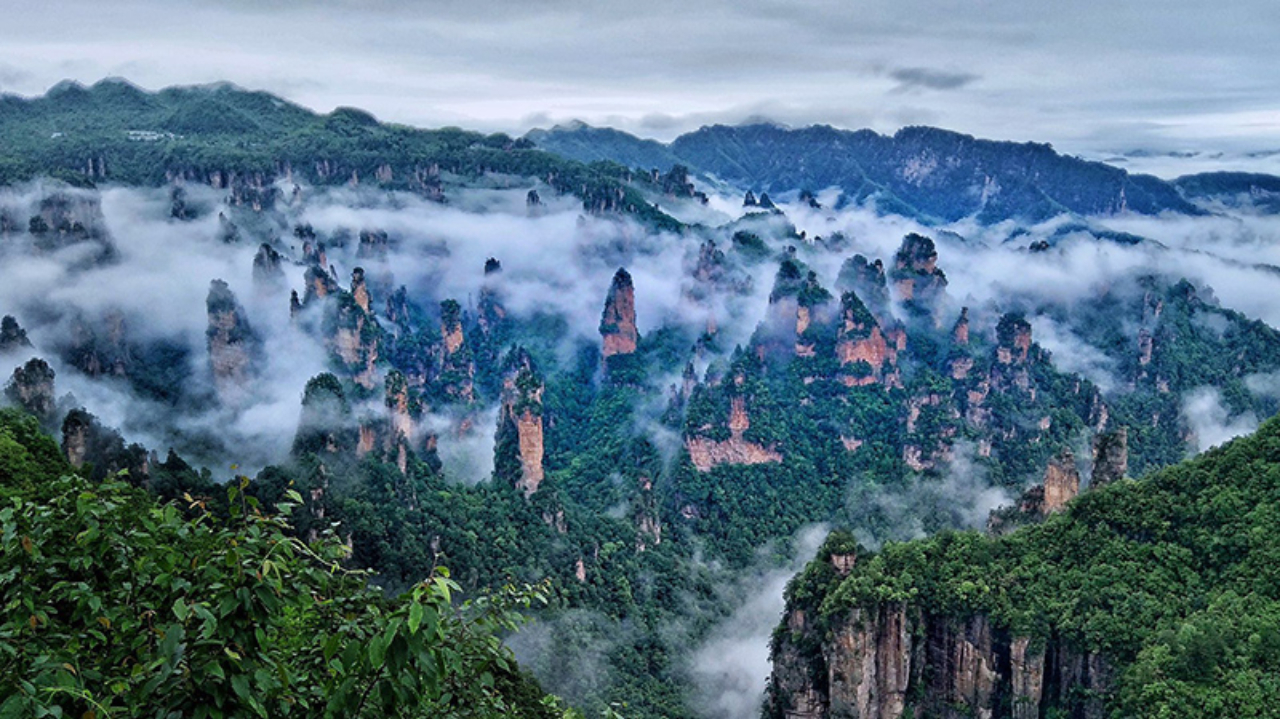
Zhangjiajie National Forest Park is one of the most remarkable natural destinations in China. Hidden among the mountains of northwestern Hunan Province, the park is famous for thousands of towering sandstone pillars rising above deep, forested valleys. On misty mornings, the narrow rock formations appear to float above the clouds, creating a landscape that feels almost impossible.
These extraordinary formations have earned Zhangjiajie the nickname “Avatar Mountains” because of their visual connection to the floating Hallelujah Mountains in James Cameron’s science-fiction film. Yet the real landscape is far more varied than the famous photographs suggest. Visitors can walk beside forest streams, cross natural stone bridges, ride a dramatic cliffside elevator, explore mountaintop viewpoints, and travel through the landscape by cable car.
Planning a visit, however, can be confusing. The national forest park has several entrances, its major attractions are spread across different elevations, and the transport network combines sightseeing buses, elevators, cableways, and walking trails. Zhangjiajie Grand Canyon and Tianmen Mountain are also frequently mistaken for parts of the same park, even though they are separate attractions requiring their own tickets.
This complete Zhangjiajie National Forest Park travel guide explains the best things to see, how to reach the park, ticket prices, opening hours, walking routes, accommodation, local transportation, the best time to visit, practical expenses, safety advice, and detailed itineraries for one, two, or three days.


Photographs are from Wikimedia Commons and remain subject to their linked Creative Commons licenses. Cropped display views are used in the image row.
Zhangjiajie National Forest Park at a Glance
| Detail | Information |
|---|---|
| Country | China |
| Province | Hunan |
| Established | 1982 |
| UNESCO status | Part of Wulingyuan World Heritage Site, inscribed in 1992 |
| Landscape | Quartz-sandstone pillars, ravines, forest, streams and natural bridges |
| Main tourist base | Wulingyuan District |
| Recommended duration | 2–3 full days |
| Typical ticket validity | 4 consecutive days |
| Frequently listed adult entry | CNY 227, subject to seasonal policy and confirmation |
| Main gateway station | Zhangjiajie West Railway Station |
| Airport | Zhangjiajie Hehua International Airport |
| Currency | Chinese Yuan (CNY / RMB) |
Where Is Zhangjiajie National Forest Park?
Zhangjiajie National Forest Park is in the Wulingyuan region of Zhangjiajie City, northwestern Hunan Province in south-central China.
It forms part of the broader Wulingyuan Scenic and Historic Interest Area, a UNESCO World Heritage property covering approximately 26,400 hectares. The wider protected region contains more than 3,000 narrow sandstone pillars, many exceeding 200 meters in height.
For visitors, it is important to distinguish three locations:
- Zhangjiajie City: The main urban transport hub, with railway stations, an airport and access to Tianmen Mountain.
- Wulingyuan: The tourist town near the national park’s East Gate, with hotels, restaurants and convenient access to sightseeing routes.
- Zhangjiajie National Forest Park: The extensive protected landscape containing Yuanjiajie, Tianzi Mountain, Golden Whip Stream, Huangshizhai and additional scenic areas.
Wulingyuan is usually the best base for visitors whose primary objective is exploring the famous rock pillars rather than spending most of their time in Zhangjiajie City.
Zhangjiajie National Forest Park Map
The map below shows the Wulingyuan park entrance area. Use it to identify your hotel, nearby roads and the starting point for your sightseeing route.
Because parts of the park are separated by deep valleys and high ridges, straight-line distances on digital maps can be misleading. Use the official scenic-area transport network and current park signage rather than assuming two nearby viewpoints can be reached directly on foot.
What Makes Zhangjiajie’s Mountains So Unique?
The most extraordinary feature of Wulingyuan is its concentration of tall, narrow quartz-sandstone formations. These pillars resemble an enormous natural city of stone towers, with trees and shrubs growing along their ledges.
They formed through long geological processes involving sediment deposition, tectonic uplift, natural fractures and erosion. Water gradually widened weaknesses within the rock, separating broad masses of sandstone into distinct pillars and ridges.
This geological structure explains why the mountains look so different from ordinary rounded hills. Many formations have nearly vertical sides and comparatively narrow summits, while others appear as ridges, natural bridges or isolated towers.
Dense vegetation creates another defining contrast. Forests fill the lower valleys, while pines and other plants survive on rock ledges where soil and moisture collect.
UNESCO recognizes Wulingyuan for its exceptional natural beauty. The region also contains streams, waterfalls, caves and important habitats for wildlife, although large wild animals are rarely encountered along crowded sightseeing routes.
Why Is Zhangjiajie Called the Avatar Mountains?
The nickname comes from comparisons with the fictional floating mountains in the 2009 film Avatar. Zhangjiajie’s cloud-wrapped pillars create a convincing real-world visual parallel to Pandora’s spectacular landscape.
A prominent sandstone column in Yuanjiajie was renamed “Avatar Hallelujah Mountain” in 2010, strengthening the connection for visitors.
However, the park is a natural landscape rather than an actual film set. Its value does not depend on the movie connection, and travelers can appreciate the scenery without knowing the film.
For another destination with a famous connection to fantasy cinema, see Aoqira’s Jiufen Spirited Away travel guide, which examines the real story behind Taiwan’s lantern-lit mountain town.
Best Things to Do in Zhangjiajie National Forest Park
1. Explore Yuanjiajie — Home of the Avatar Mountains
Yuanjiajie is one of the most popular areas of Zhangjiajie National Forest Park and is essential for first-time visitors.
Its mountaintop paths connect a series of viewpoints overlooking narrow sandstone columns and forested valleys. The scenery is especially impressive when mist moves through the gaps between the peaks.
Important stops include Avatar Hallelujah Mountain, the First Bridge Under Heaven and scenic viewing platforms along the cliffside route.
The First Bridge Under Heaven is a natural stone connection between rock masses. It demonstrates that erosion here has produced not only isolated columns but also unusual surviving geological structures.
Most visitors reach the upper Yuanjiajie area using the Bailong Elevator and continue by designated scenic-area buses and walking paths.
Planning advice: Start early, particularly during weekends and major Chinese holidays. Yuanjiajie is one of the busiest zones, and crowding at the principal viewpoints can be substantial.
2. Ride the Bailong Elevator
The Bailong Elevator is among Zhangjiajie’s most remarkable engineering attractions. Built along a sheer cliff face, the sightseeing lift rises approximately 326 meters, connecting the lower valley transportation system with the elevated Yuanjiajie area.
The ride itself is short, but the time required can be significantly longer when there are queues. The elevator is therefore best considered part of your transport route rather than a separate activity with a guaranteed short visit.
It is particularly useful for visitors who want to reach the famous upper viewpoints without undertaking a strenuous climb from the valley floor.

The elevator requires a separate ticket or a suitable transport package. Before purchasing, compare your planned route with the available combinations, since an elevator ride may not be necessary if you enter and exit through other parts of the park.
3. Visit Tianzi Mountain
Tianzi Mountain is famous for broad panoramic views across dense formations of sandstone peaks.
Unlike some individual Yuanjiajie viewpoints, the Tianzi area offers sweeping vistas in which dozens of pillars appear to extend into the distance.
Popular viewpoints include locations associated with the Imperial Writing Brush Peaks and the West Sea stone-forest landscape.
The Tianzi Mountain Cableway provides a scenic way to travel between lower and upper elevations. From the cabins, visitors can see the distinctive structure of the mountains and the deep forest between them.
Weather makes a major difference here. Clear conditions reveal the scale of the landscape, while broken cloud can create dramatic layers. Dense fog, however, can hide the formations entirely.
Because Tianzi Mountain connects to the upper scenic transport system, it combines naturally with Yuanjiajie in a single sightseeing day.

4. Walk Along Golden Whip Stream
Golden Whip Stream offers a completely different experience from the park’s elevated viewing platforms.
Instead of looking down over rock pillars, visitors follow a forested valley beside a flowing stream. The main walking route extends for approximately 7.5 kilometers, although you can explore a shorter section and turn back.
The path is generally gentler than the steep routes climbing to the upper scenic areas, making it attractive for travelers who prefer walking in the forest.
Along the way, tall sandstone cliffs rise above the valley and vegetation creates shade. It is a good location for appreciating the park’s lower-elevation environment, including running water, subtropical plants and birdlife.
Wild macaques are sometimes encountered along this route. Do not feed them, approach them for photographs or display food unnecessarily.
Suggested duration: Allow several hours if walking a substantial section, with additional time for photographs and breaks.
5. Explore Huangshizhai (Yellow Stone Village)
Huangshizhai, also called Huangshi Village or Yellow Stone Village, is another major elevated scenic area.
Its loop of viewpoints provides a different perspective on the surrounding mountain formations, with broad panoramas across forested ridges and rock towers.
A cableway helps visitors reach the upper area, although hiking routes are also available for those who prefer a more physically demanding visit.
Huangshizhai is particularly convenient when entering through the South Gate. For travelers with two days, it can form part of a valley-and-viewpoint itinerary alongside Golden Whip Stream.
Do not assume that every scenic platform can be reached without steps. Even when using the cableway, some viewpoints require walking on uneven or stepped paths.
6. Discover Yangjiajie Scenic Area
Yangjiajie is another impressive section of the Wulingyuan landscape, known for dramatic cliffs, natural stone features and rugged viewpoints.
It can be less convenient to navigate than the classic Yuanjiajie–Tianzi route, so it is better suited to visitors with additional time.
Some routes in Yangjiajie involve narrow passageways, steep steps and more demanding walking conditions. Trail availability may change because of weather or maintenance.
If your trip is limited to one day, prioritize Yuanjiajie and Tianzi Mountain. Consider Yangjiajie when you have a third day or want to explore areas beyond the most photographed stops.
7. Visit Ten-Mile Gallery
Ten-Mile Gallery is a scenic valley where visitors can appreciate unusual rock formations from below rather than from high cliff viewpoints.
The area is known for mountains traditionally associated with imaginative names and recognizable shapes, including the Old Man Gathering Herbs formation.
Visitors can follow the walking route or use a small sightseeing train that operates within the valley area.
The train is an optional paid attraction rather than essential transportation. Walking is a reasonable alternative for travelers who want more freedom to stop and photograph individual formations.
8. Experience the Forest in Misty Weather
Many of Zhangjiajie’s most recognizable photographs show rock columns rising out of drifting white clouds.
This atmosphere is created when moisture and changing mountain temperatures produce mist in the valleys. It can be particularly striking after rainfall, although there is no reliable way to guarantee a cloud-sea view.
Light mist can make the sandstone towers appear separated from the earth below. Dense fog can produce the opposite result, completely obscuring the mountains.
If you are staying for several days, check visibility before selecting the day’s route. On a heavily clouded morning, a lower forest walk may be more rewarding than traveling directly to a viewpoint with no visibility.
Zhangjiajie National Forest Park vs Tianmen Mountain vs Grand Canyon
These three attractions are often grouped together in travel packages, but they are not interchangeable.
| Attraction | Main highlights | Recommended time |
|---|---|---|
| Zhangjiajie National Forest Park | Avatar-like pillars, Yuanjiajie, Tianzi, Golden Whip Stream | 2–3 days |
| Tianmen Mountain | Tianmen Cave, mountain cableways, cliff walkways | 1 day |
| Zhangjiajie Grand Canyon | Glass bridge, canyon scenery and optional activities | Half to full day |
Tianmen Mountain is accessed from the Zhangjiajie city side, while the national forest park is most conveniently explored from Wulingyuan.
The Grand Canyon and its glass bridge are also separate ticketed attractions. Buying a ticket to Zhangjiajie National Forest Park does not automatically give admission to either of them.
For a first trip of four or five days, a sensible plan is two days in the forest park, one day at Tianmen Mountain, and an optional additional day for the Grand Canyon or nearby scenic sites.
Zhangjiajie National Forest Park Entrance Fees and Tickets
The national forest park normally uses a multi-day admission arrangement. The standard entry ticket covers access to core sightseeing areas and the designated internal sightseeing-bus system.
Recent published ticket guidance lists a regular adult admission of CNY 227, including park entry, the eco-bus system and insurance. Discounts and alternative seasonal rates may apply.
The park’s normal admission validity is four consecutive days, but reservations and entry procedures still need to be followed.
| Ticket or service | Cost information | Included in basic admission? |
|---|---|---|
| Regular adult park entry | CNY 227 in recent published guidance | Main ticket |
| Designated eco-buses | Covered by standard admission | Yes |
| Bailong Elevator | Separate single-ride or package pricing | No |
| Tianzi Mountain Cableway | Separate fare or package | No |
| Huangshizhai Cableway | Separate fare or package | No |
| Ten-Mile Gallery train | Optional paid ride | No |
Important: Ticket prices and combinations can change, particularly between peak and off-peak periods or during promotions. Check the live amount displayed by the authorized booking channel before paying. Do not mistake a small online reservation or service fee for the full admission price.
How to Book Park Tickets
Admission increasingly relies on advance real-name reservations. Visitors generally need to provide identification details when booking, choose the intended entry date, and comply with any assigned admission time slot.
Foreign travelers should use their passport details exactly as they appear in their travel document and carry the original passport on the day of entry.
Hotels in Wulingyuan can often help explain booking procedures and suitable entry gates. The local tourism and park administration’s current notices should take priority over older travel blogs.
Because popular entry periods can fill up, reserve ahead during Chinese national holidays and school vacations. If planning a second day, verify whether the current system requires another time-slot reservation even while your multi-day ticket remains valid.
Park Opening Hours
Published general visitor guidance commonly lists opening hours around 7:30 AM–6:00 PM. However, the official operating arrangements of individual entrances, cableways, buses and sightseeing facilities may differ.
Opening hours can also change because of seasonal daylight, severe weather, maintenance or temporary crowd-control measures.
Confirm the last operating time of the cableway or elevator you need for your return. Leaving a distant upper viewpoint too late can make the journey back unnecessarily difficult.
How to Get to Zhangjiajie National Forest Park
Travelers generally arrive in Zhangjiajie by high-speed railway or plane, then continue by road to Wulingyuan.
By High-Speed Train
Zhangjiajie West Railway Station is an important gateway for travelers arriving by train from elsewhere in China.
China Railway’s official 12306 platform allows eligible foreign travelers to book tickets using passport details. Identity verification may be required before tickets can be purchased.
Train connections depend on your departure city and date. Changsha is a common regional interchange, while journeys from larger cities may involve direct services or transfers.
Official railway booking: China Railway 12306.
By Plane
Zhangjiajie Hehua International Airport serves the city, with domestic and some international or regional connections depending on the operating season.
From the airport, travelers can arrange a taxi, private transfer or suitable public transportation toward Wulingyuan.
Allow approximately one hour or more for a road transfer when planning conservatively. Actual journey times depend on traffic, the location of your hotel and the transport arrangement.
By Tourist Bus from Zhangjiajie City
Public and designated tourist buses connect Zhangjiajie’s urban transport hubs with Wulingyuan and several regional attractions.
The Hunan Provincial Government reported the introduction of six coordinated tourist routes in April 2024, serving attractions including Wulingyuan, the national forest park and Zhangjiajie Grand Canyon.
Services originate from major transport hubs such as the central bus station and Zhangjiajie West Railway Station. Current routes and departure points should be confirmed through the local transport service, including the Xiang Yue Xing (湘悦行) information channel.
If using a public bus, confirm whether its destination is Wulingyuan town, the East Gate or the South Gate. These are different locations.
By Taxi or Private Transfer
A taxi is convenient if you arrive with luggage, are traveling with children or reach Zhangjiajie late in the day.
Use an official taxi or reputable booked transfer and confirm the final fare or metered arrangement before departure.
If you are staying in Wulingyuan, give the driver your hotel’s Chinese address. English hotel names may be unfamiliar, and similarly named locations can cause confusion.
Understanding the Park Entrances
Choosing the correct entrance is one of the most important parts of organizing your day.
East Gate — Best for First-Time Visitors
The East Gate, commonly called the Wulingyuan or Wujiayu entrance, is the most convenient for many first-time visitors.
It is close to a large concentration of accommodation and restaurants. Internal shuttle connections serve the lower Bailong Elevator area, Ten-Mile Gallery and the Tianzi Mountain Cableway area.
Best for: Visitors planning Yuanjiajie and Tianzi Mountain, families and travelers staying in Wulingyuan.
South Gate — Best for Golden Whip Stream
The South Gate, also called the Forest Park entrance, is convenient for accessing Golden Whip Stream and the Huangshizhai area.
This is a practical starting point for visitors who want a valley walk before exploring elevated viewpoints.
However, it is not next to Wulingyuan East Gate. Confirm road transport between the two areas if your itinerary begins and ends at different entrances.
Other Gates
Additional entrances serve areas such as Yangjiajie, Tianzi Mountain and Zimugang. They may be useful for repeat visitors, organized groups or itineraries designed around specific viewpoints.
For most first-time independent travelers, the East and South Gates provide the easiest framework for planning.
How to Travel Around Inside the Park
The size and vertical layout of Zhangjiajie National Forest Park make its transportation network particularly important.
Eco-buses: The designated internal buses connect major sightseeing areas and transport stations. Standard park admission generally includes these buses, but they operate on specific routes rather than functioning as an unrestricted point-to-point service.
Bailong Elevator: Provides a fast vertical connection between the lower valley and the Yuanjiajie area.
Tianzi Mountain Cableway: Connects lower and upper parts of the Tianzi scenic area.
Huangshizhai Cableway: Helps travelers reach the elevated Huangshizhai viewpoints.
Yangjiajie Cableway: Offers access to another section of the mountain sightseeing network.
Ten-Mile Gallery train: An optional sightseeing ride through a lower valley.
Travelers should plan the day’s route around the connections they intend to use. A particularly useful classic route is to take the Bailong Elevator up, visit Yuanjiajie, continue to Tianzi Mountain by scenic-area bus, and descend using the Tianzi Mountain Cableway.
This reduces major changes in elevation on foot, although it still involves walking between viewpoints and waiting for transportation.
Where to Stay Near Zhangjiajie National Forest Park
Accommodation location affects how much sightseeing you can comfortably complete. If your priority is the national forest park, choose Wulingyuan rather than Zhangjiajie City.
The following three hotels are real properties with published information from their own international hotel brands. They offer different combinations of proximity, room categories and facilities.
| Hotel | Location | Best for |
|---|---|---|
| Pullman Zhangjiajie | Gaoyun Road, Wulingyuan | Resort-style comfort and families |
| Hampton by Hilton Zhangjiajie National Forest Park | Guihua Road and Jundi Road, Wulingyuan | Convenient East Gate access |
| Hilton Garden Inn Zhangjiajie Wulingyuan | 108 Bao Feng Road, Wulingyuan | Couples, families and flexible room types |
1. Pullman Zhangjiajie — Best for Resort Comfort
Address: No. 188 Gaoyun Road, Wulingyuan, Zhangjiajie, Hunan, China.
Pullman Zhangjiajie is a five-star hotel in the Wulingyuan area, positioned conveniently for visits to Zhangjiajie National Forest Park.
According to the hotel’s official Accor website, the property has 456 guestrooms and offers an outdoor garden swimming pool, fitness facilities, restaurants, meeting spaces and guest services.
Its location near the scenic area makes it attractive for travelers who want a comfortable hotel after long sightseeing days.
Pullman Room Types and Facilities
The official accommodation selection includes Superior Rooms with king or twin beds, Deluxe Rooms, Deluxe Executive Rooms and spacious suites.
The Superior King Room is listed at approximately 38 square meters, with amenities including air conditioning, Wi-Fi, television, a safe, tea and coffee facilities and a private bathroom.
The Deluxe Suite offers approximately 71 square meters, including separate sleeping and living areas.
Other hotel facilities include several dining venues, room service, parking and a garden swimming pool.
Best suited to: Couples, families, and visitors who prefer a full-service hotel.
Room prices: Rates vary by booking date, season and room category. Check the official booking calendar for current prices.
Actual hotel and room photographs:
View Pullman Zhangjiajie’s official room photographs, swimming pool and hotel gallery →
2. Hampton by Hilton Zhangjiajie National Forest Park — Best for Location
Address: Guihua Road and Jundi Road, Wulingyuan District, Zhangjiajie, China.
Hampton by Hilton Zhangjiajie National Forest Park is particularly practical for sightseeing because the hotel reports a location approximately 500 meters from the Wulingyuan East Gate Ticket Office.
That proximity can be valuable if you plan to enter the park early on consecutive mornings.
The hotel offers complimentary hot breakfast, Wi-Fi, parking, a fitness center, an on-site restaurant and business facilities.
Rooms and Guest Facilities
Guests can review the currently bookable bed configurations and room categories through Hilton’s reservation system.
Family facilities include cribs, while the hotel also provides fitness and meeting facilities. Travelers requiring connecting rooms, specific accessibility features or particular bedding arrangements should request confirmation before booking.
The property is a good choice for visitors who prioritize a straightforward morning walk to the East Gate over extensive resort facilities.
Best suited to: Couples, families, and travelers planning two or more early park visits.
Room prices: Check live date-specific rates on Hilton’s official website.
Actual property photographs and booking details:
3. Hilton Garden Inn Zhangjiajie Wulingyuan — Best for Modern Rooms
Address: 108 Bao Feng Road, Zhangjiajie, Hunan, China.
Hilton Garden Inn Zhangjiajie Wulingyuan is another established international hotel option in the Wulingyuan area.
The official hotel website highlights mountain views and access to surrounding restaurants and attractions.
Its amenities include free Wi-Fi, a fitness center, on-site restaurant, complimentary parking, connecting rooms, concierge services and meeting facilities.
Hilton Garden Inn Room Options
The hotel’s official image gallery shows several room categories, including King Deluxe Rooms, Twin Deluxe Rooms, a King Family Suite and King Deluxe Suites.
The precise room size, bedding and facilities should be confirmed by selecting a category for your intended booking dates.
The hotel also provides a restaurant serving breakfast and offering dinner arrangements, which can be convenient after a long day inside the park.
Best suited to: Travelers seeking contemporary hotel accommodation, connecting-room options or family suites.
Room prices: The hotel uses dynamic rates, so compare the exact room category and date on its official website.
Actual room and hotel photographs:
View the official gallery, including hotel exterior, deluxe rooms and family suite →
Which Zhangjiajie Hotel Should You Choose?
Choose Pullman Zhangjiajie if you want a larger resort-style property, restaurants and leisure facilities.
Choose Hampton by Hilton National Forest Park if walking distance to the East Gate is your main priority.
Choose Hilton Garden Inn Wulingyuan if you prefer contemporary room options, family accommodation choices and international-brand services.
For an itinerary focused on Yuanjiajie and Tianzi Mountain, East Gate convenience is usually more useful than a hotel beside Tianmen Mountain in Zhangjiajie City.
Suggested 3-Day Zhangjiajie National Forest Park Itinerary
Three full days give you time to explore the upper viewpoints and lower valleys without turning the trip into a race between transport stations.
Day 1: Yuanjiajie and Tianzi Mountain
Start early at the Wulingyuan East Gate.
Use the internal sightseeing bus to reach the lower Bailong Elevator station. Take the elevator to the upper scenic area and continue toward Yuanjiajie.
Explore the famous Avatar Hallelujah Mountain viewpoint, the First Bridge Under Heaven and other accessible viewing platforms.
Allow sufficient time for walking, photography, transport queues and lunch.
Later, take the designated shuttle connection toward Tianzi Mountain.
Visit the principal Tianzi viewpoints and descend by the Tianzi Mountain Cableway, subject to operating conditions and your return route.
Return to Wulingyuan and enjoy dinner near your hotel.
Main highlights: Avatar Mountains, First Bridge Under Heaven, Bailong Elevator, Tianzi Mountain.
Day 2: Golden Whip Stream and Huangshizhai
Begin the second day near the South Gate.
Spend the morning walking along Golden Whip Stream, enjoying the valley scenery and quieter sections of forest.
Depending on how far you walk, either return toward the South Gate or follow the designated connection that best suits your afternoon plan.
Visit Huangshizhai using its cableway, or choose an approved walking route if you have sufficient time and fitness.
Explore the mountaintop viewpoints before returning to the lower area.
Because the Golden Whip Stream and Huangshizhai areas can involve significant walking, keep the day’s schedule flexible.
Main highlights: Streamside forest walk, sandstone formations from below and Huangshizhai viewpoints.
Day 3: Ten-Mile Gallery and Optional Yangjiajie
Use the third day for attractions you missed, scenic areas with better weather, or a less demanding combination.
Begin with Ten-Mile Gallery and explore the unusual formations along the valley.
If the walking route suits your ability, continue on foot rather than purchasing the optional sightseeing train.
Travelers comfortable with more demanding terrain can consider visiting accessible sections of Yangjiajie, provided the relevant paths and transport are operating.
Alternatively, spend the afternoon revisiting a favorite viewpoint under improved weather conditions.
Main highlights: Ten-Mile Gallery, additional viewpoints and flexible photography opportunities.
Can You Visit Zhangjiajie National Forest Park in One Day?
Yes, but you will need to limit the itinerary to the most important upper viewpoints.
A sensible one-day route is:
- Enter through Wulingyuan East Gate early.
- Take the internal bus and Bailong Elevator toward Yuanjiajie.
- Explore Avatar Hallelujah Mountain and the First Bridge Under Heaven.
- Continue by scenic bus to Tianzi Mountain.
- Visit the principal Tianzi viewpoints.
- Descend via the Tianzi Mountain Cableway and return to the entrance.
This is a full sightseeing day, particularly if queues are long. Avoid adding Golden Whip Stream, Huangshizhai and distant Yangjiajie trails unless the operating conditions and available time genuinely permit it.
For a more enjoyable trip, two days remain the better choice for first-time visitors.
Best Time to Visit Zhangjiajie National Forest Park
Zhangjiajie can be visited throughout the year, but seasonal weather changes the experience significantly.
Spring: March to May
Spring brings increasing greenery, seasonal flowers and variable mountain weather.
Mist and showers are common, making the landscape atmospheric but sometimes limiting visibility.
It is a rewarding period for visitors interested in forest scenery and photography, provided they can accommodate changing weather conditions.
Summer: June to August
Summer brings warm weather, high humidity and lush vegetation.
Rainfall can be heavy, and school holidays create busy periods.
Allow extra time for queues at popular transport facilities and carry reliable rain protection.
Heavy rainfall can also lead to temporary closures. The park was suspended for several days in June 2025 because of severe rain before reopening following safety inspections.
Autumn: September to November
Autumn is often a strong choice for walking and landscape photography.
Temperatures generally become more comfortable than in midsummer, although rain and fog remain possible.
Visitors should pay particular attention to the Chinese National Day holiday period in early October, when domestic tourism demand can be very high.
Winter: December to February
Winter offers a very different atmosphere, occasionally with frost, snow or icy conditions on elevated walkways.
Photographs of snow-covered sandstone pillars can be beautiful, but winter weather makes some paths more hazardous.
Transport services and routes may be affected by low temperatures, ice or maintenance closures.
Wear warm layers and check whether the areas you wish to visit are operating before departure.
How Much Does a Zhangjiajie Trip Cost?
The total cost depends on accommodation choice, how many paid transport rides you use, and whether you travel independently or with a guide.
For budgeting, separate expenses into park admission, optional transport, food, accommodation and transfers.
| Expense | What to budget for |
|---|---|
| Park admission | Recent regular adult listing: CNY 227; confirm current category and season |
| Cableways and elevator | Depends on number of rides and available packages |
| Transport from the city | Public bus, taxi or private transfer fare |
| Food and drinks | Restaurant meals, snacks and bottled water |
| Accommodation | Live hotel price for your chosen nights and room category |
| Guided tour | Optional guide or private tour package |
Travelers seeking to control expenses can stay near the East Gate, use designated eco-buses and walk where appropriate instead of purchasing every available sightseeing ride.
However, taking a cable car or the Bailong Elevator can be worthwhile when it makes the route substantially easier or allows you to see more without exhausting yourself.
Food and Restaurants Around Zhangjiajie
Wulingyuan has numerous restaurants serving Chinese meals, including specialties associated with Hunan and the local Tujia culture.
Hunan cuisine is well known for its use of chili, aromatics and bold flavors. Visitors may encounter stir-fried dishes, preserved vegetables, tofu preparations and local-style hotpot meals.
If you do not enjoy spicy food, ask whether a dish can be prepared with less chili. Language translation apps can be helpful when communicating dietary needs.
Food is also available at selected facilities inside the scenic area, but choices can be more limited and prices may differ from restaurants in town.
Carry drinking water and suitable snacks for long walking days. Keep food secured around wild macaques.
Hiking in Zhangjiajie: Difficulty and Accessibility
Zhangjiajie is unusual because visitors can enjoy extraordinary mountain views without completing a technical mountain ascent.
Many upper scenic areas are connected by buses, cableways and an elevator. Nevertheless, this does not make the entire park flat or fully accessible.
Walking conditions range from relatively gentle valley paths to steep flights of stone steps, narrow cliffside walkways and longer mountainous trails.
Easier Walking Options
Golden Whip Stream is generally among the more approachable routes because much of the walking follows the valley floor.
Selected upper viewpoint paths can also be manageable when using mechanical transport, although some stairs and uneven surfaces remain.
More Demanding Routes
Hiking up to elevated viewpoints rather than using cableways or elevators can involve strenuous climbing.
Parts of Yangjiajie and other less-developed trails may require better balance, fitness and confidence on narrow or stepped paths.
Never assume an older blog’s hiking route remains available. Follow current park signage and staff instructions.
If you enjoy physically demanding mountain adventures, Aoqira’s Inerie Volcano hiking guide explores a very different type of terrain on the Indonesian island of Flores.
Wildlife and Nature in Zhangjiajie
Wulingyuan protects important subtropical ecosystems as well as its iconic geological formations.
Forests cover many valleys and slopes, supporting a variety of trees, shrubs, birds, insects and other wildlife.
Visitors may notice macaques near popular trails. These are wild animals rather than tame attractions.
Keep a respectful distance and never try to feed or touch them. Avoid displaying loose food bags and do not leave snacks unattended.
Other wildlife can be difficult to observe because the park receives large numbers of visitors and many species avoid busy routes.
For travelers interested in a very different forest ecosystem, see Aoqira’s Khao Sok National Park travel guide, which covers tropical rainforest and lake-based nature experiences in southern Thailand.
What to Pack for Zhangjiajie National Forest Park
The most useful items are those that help you remain comfortable while walking in changing mountain weather.
- Comfortable walking or hiking shoes with good traction.
- Lightweight waterproof jacket.
- Breathable clothing for warm conditions.
- Warm layer for higher elevations and cooler seasons.
- Compact daypack.
- Reusable water bottle.
- Snacks packed securely away from wildlife.
- Portable phone charger.
- Downloaded park and transportation maps.
- Passport and relevant booking confirmations.
- Small supply of Chinese Yuan cash.
- Necessary medication and basic personal first-aid supplies.
- Sun protection.
- Waterproof protection for electronics.
Photography enthusiasts should consider a lens cloth and protection from rain or mist.
A large tripod may be inconvenient in narrow, crowded viewing areas. Respect any equipment restrictions and avoid obstructing paths.
Is Zhangjiajie National Forest Park Safe?
Zhangjiajie is a well-established visitor destination, with formal entrances, sightseeing transport and designated paths. Nevertheless, the mountainous environment requires care.
Stay behind barriers: Many viewpoints are located above steep drops. Never cross railings for photographs.
Take wet surfaces seriously: Stone steps can be slippery after rain, especially where leaves or mud collect.
Respect wildlife: Do not approach or feed macaques. Seek medical attention promptly for bites or scratches.
Check severe weather warnings: Heavy rain can affect trails, roads and transport services. Temporary park closures are possible.
Watch operating times: Confirm how you will return from the upper scenic areas before the final shuttle, elevator or cableway service.
Keep identification secure: Your passport may be required for ticket verification.
Follow drone rules: Do not fly a drone without checking current scenic-area restrictions and obtaining any required authorization.
Travel within your ability: Choose routes suitable for your fitness and mobility rather than relying on a viewpoint’s photograph to judge its accessibility.
Practical China Travel Tips for International Visitors
Payments
Alipay and WeChat Pay are widely used in mainland China.
Official Chinese government guidance explains that eligible foreign visitors can register and link supported international bank cards to mobile payment services.
Cash remains useful as a backup, but a mobile payment method is convenient for restaurants, small purchases and certain transportation services.
Language
English may be available at some hotels, important transport hubs and major visitor facilities, but it should not be assumed everywhere.
Save your hotel’s Chinese address and use a translation app when necessary.
When asking about a park gate, show the exact Chinese name if available, since the different entrances can otherwise be confused.
Mobile Internet and Maps
Check how your mobile data service will operate in mainland China before departure.
Some international websites and applications may be unavailable or function differently. Download essential maps and booking details in advance.
Having a working data connection is particularly useful when arranging transport and making mobile payments.
Visa and Entry Requirements
China’s visa requirements depend on nationality, passport type and the applicable entry arrangements.
Do not assume that visa-free policies available to travelers from one country also apply to another.
Check the current requirements through the appropriate Chinese embassy, consulate or official government immigration resources before booking international flights.
Common Mistakes to Avoid in Zhangjiajie
Confusing the forest park with Tianmen Mountain. These are separate areas with different tickets and transport arrangements.
Staying too far from the entrance. A hotel in Zhangjiajie City may be convenient for Tianmen Mountain but less practical for several consecutive forest park days.
Trying to visit everything in one day. Travel between scenic areas takes time, and queues are unpredictable.
Ignoring the weather forecast. Dense fog can hide major viewpoints. A flexible schedule provides alternatives.
Forgetting additional transport costs. The basic park ticket does not normally include every cableway, elevator and sightseeing train.
Underestimating walking distances. Cableways reduce major climbs but do not remove all walking or steps.
Arriving without checking reservations. Real-name tickets and entry time slots can affect admission.
Leaving the return journey until late. Your route must account for the final operating time of the relevant transport facilities.
Is Zhangjiajie National Forest Park Worth Visiting?
Yes. Zhangjiajie National Forest Park is one of China’s most distinctive landscape destinations, particularly for travelers interested in dramatic geology, mountain photography and scenic walking.
The biggest advantage is the combination of extraordinary scenery and an extensive sightseeing transport network. Visitors can experience dramatic high viewpoints without necessarily completing strenuous mountain climbs.
Its main disadvantages are crowding, transport complexity and unpredictable visibility. Those factors become easier to manage when you stay near the right entrance and allow several days.
Zhangjiajie is especially rewarding for photographers who appreciate changing light, misty mountains and unusual rock formations.
For readers who enjoy combining adventure with striking natural scenery, Aoqira also covers the Santa Ana Volcano Hike in El Salvador, another destination where terrain and weather are central parts of the experience.
Frequently Asked Questions
Where is Zhangjiajie National Forest Park?
It is located in Zhangjiajie, Hunan Province, China, within the wider Wulingyuan Scenic and Historic Interest Area.
Is Zhangjiajie a UNESCO World Heritage Site?
Yes. The Wulingyuan Scenic and Historic Interest Area, which includes Zhangjiajie National Forest Park, was inscribed on the UNESCO World Heritage List in 1992.
How many days do you need in Zhangjiajie National Forest Park?
Two full days provide a good introduction to Yuanjiajie, Tianzi Mountain, Golden Whip Stream and other major highlights. Three days offer more flexibility and additional sightseeing opportunities.
How much is the entrance ticket?
Recent published guidance lists regular adult admission at CNY 227, with discounted categories and different seasonal arrangements possible. Check the price offered by the authorized booking channel for your intended dates.
Is the entrance ticket valid for four days?
The regular admission arrangement is generally valid for four consecutive days, allowing visitors to explore different scenic areas. Follow current reservation procedures for entry and repeat visits.
Are the shuttle buses free?
Designated scenic-area eco-buses are generally included in the regular admission ticket. Cableways, the Bailong Elevator and some other transport facilities require separate tickets or appropriate packages.
Can you visit the Avatar Mountains without hiking?
Yes. Visitors can reach important elevated areas using buses, the Bailong Elevator and cableways. Some walking and steps are still required to reach individual viewpoints.
Which entrance is best?
Wulingyuan East Gate is usually the most convenient for first-time visitors. South Gate is particularly useful for Golden Whip Stream and Huangshizhai.
Is Zhangjiajie suitable for elderly travelers?
Some sightseeing areas are accessible with mechanical transport, but the park is not uniformly step-free. Route selection should account for walking ability, stairways, queue conditions and specific accessibility requirements.
Are the monkeys dangerous?
Wild macaques may approach visitors, especially where food is visible. Do not feed, touch or provoke them. Keep belongings and food secured.
Is a guide necessary?
Many visitors explore the principal tourist routes independently using park signs, maps and sightseeing transport. A guide may be useful for route planning, local interpretation and communication assistance.
Can you visit Tianmen Mountain on the same ticket?
No. Tianmen Mountain is a separate attraction and requires its own admission arrangements.
Does it snow in Zhangjiajie?
Snow and frost can occur during winter, particularly in elevated areas. They are not guaranteed, and icy conditions may affect visitor access.
What is the best month to visit Zhangjiajie?
April, May, September and November can be attractive choices depending on your preferred weather and scenery. No month guarantees clear viewpoints; check holiday dates and allow flexibility for fog or rain.
Final Thoughts
Zhangjiajie National Forest Park deserves its reputation as one of China’s most extraordinary natural destinations. Its sandstone pillars, narrow ridges, forests and cloud-filled valleys create a landscape unlike most conventional mountain parks.
The best experience comes from planning around geography rather than trying to visit every named attraction. Stay close to Wulingyuan East Gate, spend one day exploring Yuanjiajie and Tianzi Mountain, and use another day for Golden Whip Stream, Huangshizhai or quieter scenic areas.
Check your ticket conditions, choose mechanical transport only where it supports your route, and remain flexible when the weather changes.
Whether you come to photograph the famous Avatar-like pillars, explore forest trails or experience the mountains from a cable car, Zhangjiajie rewards travelers who give the landscape enough time.
Sources and Further Reading
The following authoritative heritage, government, transportation, hotel and photography sources support the historical and practical information in this guide. Tickets, schedules and accommodation details should be reconfirmed before travel.
- UNESCO World Heritage Centre — Wulingyuan Scenic and Historic Interest Area
World Heritage designation, geology, sandstone pillars, conservation and the protected landscape. - Hunan Provincial Government — Zhangjiajie National Forest Park Reopens
Heavy-rainfall closures, visitor safety, advance reservations and visitor-management information. - Hunan Provincial Government — Zhangjiajie Tourist Bus Services
Tourist transport routes connecting central Zhangjiajie, railway stations and regional attractions. - Travel China Guide — Zhangjiajie National Forest Park
Published visitor-ticket information, main scenic areas, transport and practical sightseeing routes. - China Railway 12306 — Official Train Booking
Train schedules, railway tickets and passenger identification procedures. - State Council of China — Guide to Living and Traveling in China
Official guidance on railway booking, electronic payments, currency and accommodation registration. - Pullman Zhangjiajie — Official Accor Website
Verified hotel location, room categories, room sizes, facilities and photographs. - Hampton by Hilton Zhangjiajie National Forest Park
Official location information, proximity to East Gate and hotel facilities. - Hilton Garden Inn Zhangjiajie Wulingyuan
Verified property address, amenities, guest facilities and accommodation details. - Hilton Garden Inn — Official Property and Room Gallery
Hotel exterior, deluxe room categories, family suite and public-space photographs.
Photograph Credits and Licenses
Wulingyuan landscape — 颐园居, CC BY-SA 4.0.
Tianzi Mountain and cableway — ICOLEF / visualtravelguide.com, CC BY-SA 4.0.
Misty rock formations — Rocio Gil, CC BY-SA 4.0.
Bailong Elevator — CrunchLabs, CC BY-SA 4.0.
Tianzi Mountain sandstone pillars — ICOLEF / visualtravelguide.com, CC BY-SA 4.0.
The photographs above use Creative Commons Attribution-ShareAlike 4.0 International licenses. See each original file page for the complete terms, including attribution and share-alike requirements.