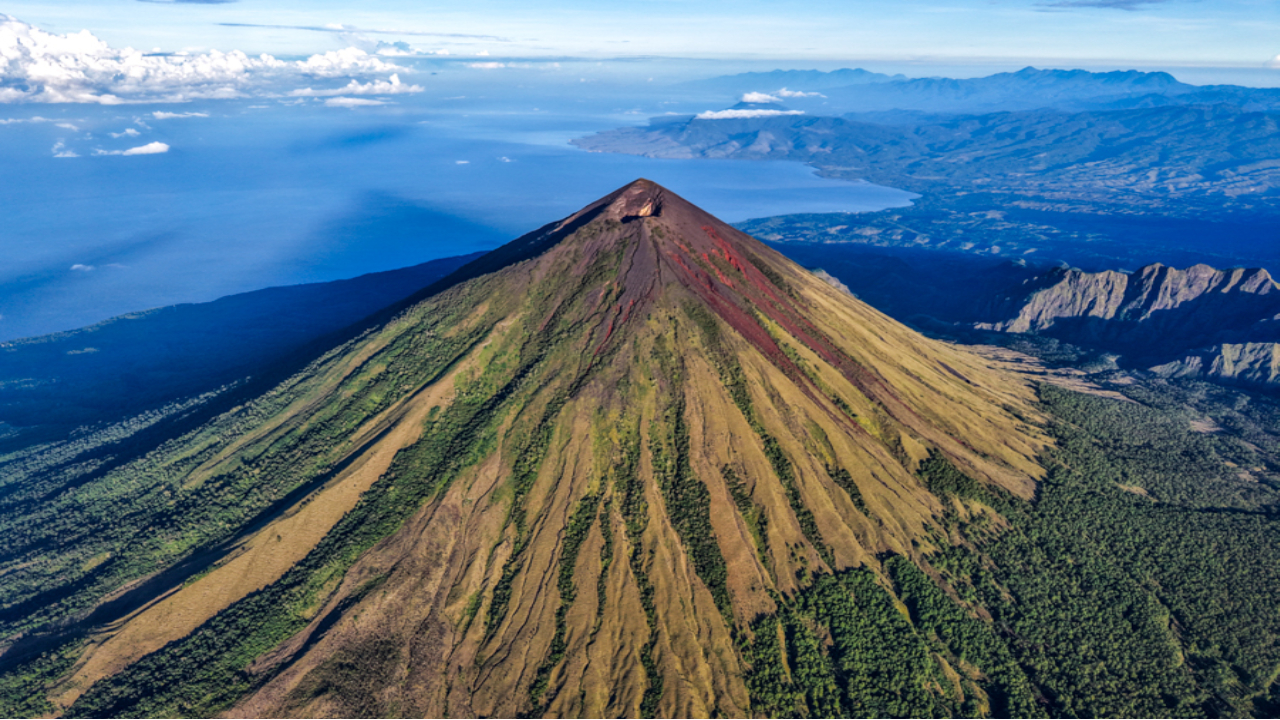
Mount Inerie is one of the most spectacular mountains on Flores Island, Indonesia. Rising 2,245 meters above sea level, this remarkably symmetrical volcano dominates the skyline south of Bajawa, a highland town in East Nusa Tenggara. From nearby villages, Inerie looks almost like a perfect pyramid, its steep dark slopes rising above green hills, cultivated fields and traditional Ngada settlements.
Climbing Mount Inerie is a different experience from visiting an accessible volcanic viewpoint. The route involves a sustained ascent, changing terrain, exposed ridges and loose volcanic rock that makes the descent especially demanding. Hikers who reach the summit in suitable weather may be rewarded with extraordinary views across the Bajawa highlands, surrounding volcanic mountains and, in clear conditions, the distant Flores coastline.
What makes the Inerie Volcano hike particularly special is its setting. The surrounding Ngada region combines volcanic landscapes with traditional villages such as Bena, hot springs, local agricultural communities and a strong cultural identity. Visitors can experience the mountain as part of a broader stay around Bajawa rather than treating it as an isolated summit challenge. However, good preparation is essential: this is a strenuous hike, routes are not uniformly marked, and the weather can change rapidly at elevation.
This detailed Inerie Volcano Hike travel guide covers the route, difficulty, summit height, realistic hiking times, sunrise trekking, how to reach Bajawa, local guiding options, published tour prices, nearby hotels, traditional villages, safety considerations, packing advice, recommended itineraries and frequently asked questions.


Inerie Volcano Hike at a Glance
| Detail | Information |
|---|---|
| Volcano | Mount Inerie / Gunung Inierie |
| Country | Indonesia |
| Island | Flores |
| Province | East Nusa Tenggara |
| Nearest major town | Bajawa, Ngada Regency |
| Summit elevation | 2,245 meters / 7,365 feet |
| Volcano type | Stratovolcano |
| Hike difficulty | Challenging / strenuous |
| Typical ascent | Approximately 3.5–5 hours, depending on route and fitness |
| Typical descent | Approximately 2–4 hours |
| Best base | Bajawa or accommodation near the southern highlands |
| Best general season | Relatively dry months, around May–October |
| Guided trek | Strongly recommended; local routes and conditions require advance confirmation |
| Published guided package example | Rp1,500,000 per person, including an extended guided itinerary |
| Currency | Indonesian Rupiah (IDR) |
Hiking times are approximate because access points, conditions and individual fitness vary. There is no single standardized route measurement that applies to every Inerie trekking itinerary.
Where Is Mount Inerie?
Mount Inerie is located just south of Bajawa in the central highlands of Flores Island, within Ngada Regency.
The volcano is one of the most recognizable features of the region because of its distinctive, steep-sided cone. Its upper slopes are largely exposed, while the lower hills support vegetation, villages and cultivated land.
Bajawa is the most practical town for arranging a summit hike. It has accommodation, small restaurants, transport services and access to nearby Ngada villages.
Mount Inerie is also close to traditional communities such as Bena, where houses, stone structures and local customs are important parts of Ngada cultural heritage.
Unlike a mountain in a large tourist resort area, Mount Inerie is surrounded by relatively small communities and rural roads. Visitors should not expect the same facilities, signage or transport availability found around Bali’s more developed attractions.

Mount Inerie Location Map
The map below shows Mount Inerie and the Bajawa region. The mountain pin is not a confirmed trailhead. Ask your local guide for the exact access point and where your transport should stop.
Download an offline map of the wider Bajawa area before traveling. A phone map may help with orientation, but it is not a replacement for a local guide on poorly marked volcanic slopes.
How Difficult Is the Inerie Volcano Hike?
The Mount Inerie hike is considerably more demanding than a short volcano viewpoint walk.
The difficulty comes from its combination of height gain, steep gradients, unstable volcanic surfaces, early starting hours and exposed upper slopes.
Hikers may begin on agricultural tracks or vegetated paths before moving onto increasingly steep volcanic terrain. Higher sections can contain loose stones and scree that shift underfoot.
There may also be narrow or exposed sections near the summit, so balance and confidence on uneven mountain terrain are important.
Is Mount Inerie Suitable for Beginners?
Complete beginners with little hiking fitness should not treat Mount Inerie as their first challenging mountain.
If you have comfortably completed long hill walks, steep descents and several hours of sustained exercise, the hike may be achievable with an experienced guide in favorable conditions.
However, being able to walk around a city for several hours is not necessarily the same as being prepared for Inerie’s upper slopes.
The descent can be especially difficult because loose volcanic rock places additional strain on knees, ankles and balance.
Practical recommendation: If you are uncertain about your fitness or comfort with exposure, arrange a shorter viewpoint hike around Bajawa instead of committing to the summit.
How Long Does the Inerie Hike Take?
A sunrise ascent often begins in the very early morning, sometimes around 2:00–3:00 AM.
Depending on the trailhead, the group and conditions, reaching the summit may take three and a half to five hours. The descent can require another two to four hours.
Some organized programs arrange a very early start, an early summit arrival and a separate stop at hot springs afterward.
For example, Manulalu’s published trek itinerary begins with a 1:00 AM pickup and returns to the accommodation at approximately 11:30 AM, including a hot-spring stop.
That schedule is specific to this operator and should not be treated as the universal timing for every route.

Mount Inerie Hiking Route: What to Expect
Stage 1: Meeting the Guide and Reaching the Trailhead
For most hikers, the adventure begins in Bajawa or at accommodation in the surrounding highlands.
Tour operators organize early transport toward a chosen starting point on the lower slopes.
Access routes can involve areas near Bena, Watujaji or other approaches selected by the guide. Do not assume every tour uses the same village or begins at the same elevation.
Before setting off, confirm the correct trailhead, expected total walking time, fee inclusions and where the driver will meet you afterward.
If departing before sunrise, check that everyone has a functioning headlamp and sufficient warm clothing.
Stage 2: Fields, Lower Slopes and Vegetation
The lower approach can pass through agricultural land and vegetation surrounding the mountain.
This part of the hike may contain earthen paths, grass and occasional steeper slopes. Conditions depend on the route and the season.
Because the climb begins at a lower elevation than the summit, the early hours are useful for finding a sustainable pace.
Avoid pushing too quickly. On a strenuous volcano trek, conserving energy early often makes the upper slopes safer and more manageable.
Stage 3: Steep Volcanic Slopes
Higher up, the mountain becomes increasingly exposed.
The terrain can include steep volcanic scree, compacted rock, stones and loose gravel. On certain slopes, each upward step may cause small amounts of material to slide backward.
Use short, controlled steps and keep an appropriate distance from other hikers to avoid dislodged stones.
Trekking poles can provide additional balance, although their use depends on terrain and the guide’s instructions.
The lack of shade can make the climb physically demanding once sunlight reaches the slopes. Conversely, early-morning wind can feel very cold.
Take a break when needed, but avoid sitting directly beneath unstable slopes where loose stones may fall.
Stage 4: The Summit Area
The summit of Mount Inerie reaches 2,245 meters above sea level.
From this height, suitable weather may reveal broad views across the Ngada highlands and nearby volcanic landscapes.
The summit area is not equivalent to a wide, flat viewing platform. The terrain can be exposed and uneven, while the crater lies immediately east of the highest point.
Cloud, wind and visibility can change quickly, even after a clear morning.
A responsible guide will decide whether the group should approach the summit and how long it is safe to remain there.
Do not cross an exposed ridge or enter the crater merely to recreate a photograph.
Stage 5: The Difficult Descent
For many hikers, the descent is the most technically uncomfortable part of the day.
Loose volcanic stones can shift underfoot, and prolonged downhill walking places pressure on knees and ankles.
It may be tempting to slide quickly through loose material, but an uncontrolled fall on steep volcanic terrain can cause serious injury.
Follow your guide’s route, avoid running downhill and keep enough water and energy for the return journey.
When the trail reaches vegetation or farmland again, continue carefully rather than assuming the difficult portion is completely finished.


Should You Hike Mount Inerie for Sunrise?
Sunrise is a popular reason for climbing Mount Inerie.
Starting in darkness allows hikers to reach higher terrain before the day becomes hot. On a clear morning, the mountain can offer striking views across the highlands as the first light reaches the surrounding valleys.
However, sunrise hiking creates additional challenges.
You must travel safely in darkness, navigate rough terrain with a headlamp and cope with cold wind at higher elevation.
It is also possible to encounter cloud cover that blocks the sunrise or summit panorama.
For travelers with previous mountain experience, an organized sunrise trek can be rewarding.
For less confident hikers, a daylight trek or an easier highland viewpoint may be a more appropriate option, subject to local guidance and access conditions.
Example Sunrise Trek Schedule
The following is a published operator itinerary, not an official public hiking timetable.
| Time | Activity |
|---|---|
| 1:00 AM | Pickup from Manulalu |
| 2:00 AM | Begin the guided hike |
| 5:30 AM | Target summit arrival and sunrise |
| 6:30 AM | Begin descent |
| 9:30 AM | Breakfast and Malanage hot-spring stop |
| 11:30 AM | Return to Manulalu |
Weather, fitness, route changes and individual circumstances may affect this schedule. The tour provider can adjust or cancel activities for safety.
Operator source: Manulalu Inerie Volcano Trekking.
Inerie Volcano Guide and Trekking Prices
There is no single universally verified price that covers every Inerie Volcano hike.
Costs depend on the guide, number of travelers, starting point, included transport, food, equipment and any additional activities.
Local Guide Arrangements
Many independent travelers organize a local guide through their guesthouse or a trusted contact in the Bajawa area.
Guide-only arrangements may cost substantially less than a full-service package, but it is essential to establish exactly what is included.
Some travel providers quote guide-only amounts of roughly Rp300,000–500,000 as an indicative range, but this is not an official rate and cannot be guaranteed for your date or group.
Ask whether the quotation covers one person or an entire group.
Full-Service Sunrise Package
Manulalu publishes a guided Inerie Volcano and hot-spring experience at Rp1,500,000 per person.
The advertised package includes an English-speaking guide, transport to and from Manulalu, coffee, tea, water, breakfast, snacks, fruit, selected trekking equipment and donation fees.
It also combines the summit trek with a stop at Malanage hot springs.
This is a concrete published price from one accommodation and excursion provider, not the standard price for all Mount Inerie hikes.
Before reserving, confirm group requirements, cancellation policies, insurance and exactly what happens if weather prevents the summit ascent.
Questions to Ask Before Booking
- Which village or trailhead does the hike start from?
- How many hours are expected for the ascent and descent?
- How many hikers will join each guide?
- Is the guide experienced on this particular route?
- Does the price include transportation and donations?
- Is a headlamp or any other equipment provided?
- What food and drinking water are included?
- What is the policy for unsafe weather or volcanic restrictions?
- Does travel insurance need to cover high-altitude hiking?
How to Get to Bajawa for the Inerie Volcano Hike
Bajawa is located in central Flores and requires more travel planning than popular destinations in Bali.
The most common broader travel route begins in Labuan Bajo, the gateway to Komodo National Park.
From Labuan Bajo by Road
The road journey from Labuan Bajo to Bajawa is scenic but slow.
Travelers drive through the Trans-Flores region, passing mountainous terrain and often routing through or near Ruteng.
Several transport operators estimate approximately eight to ten hours for the complete journey, depending on road conditions and stops.
This is important because planning the journey as an easy four-hour transfer can result in arriving late or exhausted.
The mountain roads contain many bends and steep sections. If traveling in one day, an early departure is advisable.
A more relaxed option is to stop overnight in Ruteng before continuing to Bajawa.
If you are beginning your Flores trip in Labuan Bajo, Aoqira’s Komodo Pink Beaches travel guide explains nearby marine destinations that can be combined with a longer Flores itinerary.
Flights to Bajawa Soa Airport
Bajawa is served by Soa Airport, with the airport code BJW.
Wings Air has published and operated connections between Labuan Bajo and Bajawa, with flight times around 40–45 minutes.
Flight schedules and availability can change. Check actual operating dates and luggage limits rather than assuming daily flights will always remain available.
After landing, arrange onward transport to Bajawa or your rural accommodation. Some hillside properties are a considerable drive from the airport.
From Ende or Other Parts of Flores
Travelers making an overland journey across Flores can include Bajawa between other major destinations.
Road transfers involve winding highland routes, so travel time should be planned conservatively.
If visiting Kelimutu or Ende as part of the same journey, consider how many days you want to spend driving compared with actual sightseeing.
Getting Around Bajawa
Local transport options include hired drivers, hotel-arranged vehicles and motorcycles.
For a pre-dawn volcano ascent, hotel-arranged transport is usually preferable to trying to locate a driver during the night.
If hiring a motorcycle, make sure you have a valid license and appropriate insurance. Mountain roads can be narrow and slippery, particularly in rain.

Best Time to Hike Mount Inerie
Flores has a generally drier season and a wetter season, but weather patterns vary across the island’s mountains.
May to October
These are commonly preferred months for hiking because conditions tend to be drier.
Clear mornings can provide broad mountain views, but strong winds, low temperatures and cloud are still possible.
June through September can be attractive for trekking, although availability of guides and accommodation may become more limited during busy travel periods.
November to April
Rainfall becomes more likely, particularly during the wetter months.
Steep trails can become muddy, loose rocks may be less stable and poor visibility can make navigation more difficult.
It is not advisable to attempt an exposed summit hike simply because you have already paid for accommodation or transport.
Consult a knowledgeable local guide and current weather forecasts before committing.
Weather Can Change at the Summit
The summit is more exposed than Bajawa town.
Cold wind, fog and changing cloud cover can make conditions feel substantially different from the lower slopes.
Carry layers even when the forecast for the town looks warm.
Where to Stay Near Mount Inerie
Bajawa offers a mix of guesthouses, hotels and countryside lodges.
For a summit attempt, staying within reasonable driving distance of the trailhead matters more than choosing accommodation solely because it looks beautiful in photographs.
| Accommodation | Style | Best for |
|---|---|---|
| Manulalu Jungle | Private jungle bungalows | Couples and nature-focused stays |
| Manulalu B&B | Private hillside rooms | Travelers wanting a simpler room with services nearby |
| Bajawa-Roo Hotel | Town-area hotel | Travelers preferring a Bajawa base |
1. Manulalu Jungle — Best for Scenic Bungalows
Location: Manulalu area, near Bajawa, Flores.
Manulalu Jungle provides nature-focused accommodation in distinctive circular bungalows surrounded by vegetation.
The property has seven bungalows, with double and family options.
Its family bungalow is described as accommodating four guests, with two double beds, private terrace, ensuite bathroom and mountain views.
The official published family-bungalow rates are Rp1,950,000 in low season and Rp2,350,000 in high season. Actual booking rates and inclusions should be checked for your dates.
The resort also organizes an Inerie sunrise trek, which can make trip planning easier for guests wanting an accommodation-and-guiding arrangement.
The Heaven’s Door restaurant is located separately from the jungle bungalows, so guests should ask about transport to meals.
Best for: Couples, families and visitors seeking scenic countryside accommodation.
Actual hotel photographs: View the official Manulalu Jungle bungalow and room gallery.
2. Manulalu B&B — Best for Comfortable Private Rooms
Location: Manulalu area, Bajawa.
Manulalu B&B offers a simpler accommodation style than the Jungle bungalows.
Its official room categories include Standard Double, Budget Double and Budget Twin rooms, with private bathrooms.
The Standard Double room has a queen-size bed, private ensuite bathroom and terrace overlooking the garden.
The operator publishes Standard Double rates of Rp520,000 during its low season and Rp650,000 during its high season.
Budget Double and Twin rooms are listed from Rp460,000 in low season and Rp620,000 in high season.
Breakfast inclusion and occupancy conditions depend on the room category.
The nearby Heaven’s Door restaurant provides a practical dining option.
Best for: Couples, friends and travelers wanting private facilities at a more moderate published price.
Actual hotel photographs: View the official Manulalu B&B rooms and bathrooms.
3. Bajawa-Roo Hotel — Best for a Town-Based Stay
Location: Jalan Rogangole, Ngali, Bajawa, Indonesia.
Bajawa-Roo Hotel is a genuine accommodation property serving visitors to the Bajawa area.
Its published accommodation listing includes guest-room photography, bathroom information, dining facilities and property views.
This type of stay may be more practical for travelers who want to base themselves around the town rather than at a remote hillside property.
Before booking, confirm the current room category, breakfast arrangement, transport pickup and exact driving time to the Inerie trailhead.
Tour operators may be able to arrange pickup from Bajawa, but this should not be assumed to be included in the standard room rate.
Best for: Travelers planning a broader Bajawa itinerary with a volcano hike, village visits and town services.
Actual hotel photographs: View Bajawa-Roo Hotel’s property and guest-room gallery.
Explore the Traditional Ngada Villages Near Inerie
One of the most distinctive reasons to stay in Bajawa is the opportunity to explore the surrounding Ngada communities.
Traditional villages in the region are known for their houses with high thatched roofs, stone monuments, family compounds and long-established cultural practices.
These are living communities rather than abandoned archaeological attractions.
Bena Traditional Village
Bena is among the best-known traditional villages near Mount Inerie.
Its arrangement of houses and ceremonial stone structures provides an introduction to the architectural and cultural heritage of the Ngada people.
The village sits beneath the volcanic landscape, creating an especially memorable contrast between the built environment and the mountain behind it.
Visitors should respect village access arrangements, ask permission before photographing residents and avoid interrupting daily activities or ceremonies.
If local textiles or crafts are available, purchasing directly from the community can be a meaningful way to support local livelihoods.

Other Villages Around Bajawa
The wider area includes other traditional settlements such as Luba and Tololela.
These communities can offer a quieter experience than the most visited village, although transport and local access arrangements need to be confirmed.
A local guide can explain the significance of village structures and customs, helping visitors understand the landscape beyond its appearance.
Do not assume every ceremony or community area is open for tourist access.


Malanage Hot Springs and Other Attractions
Malanage is known for its natural geothermal waters, where hot water interacts with cooler water in a stream setting.
It is a popular place to relax after hiking, and some guided Inerie itineraries include it as a post-trek stop.
However, geothermal water can be dangerously hot in some locations.
Use the areas recommended by your guide, test water temperature cautiously and do not approach scalding outlets.
Other activities around Bajawa include traditional village visits, highland viewpoints, local coffee experiences and shorter nature walks.
Wolobobo is one well-known scenic area associated with views of the surrounding hills and Mount Inerie.
These are useful alternatives if poor weather makes the summit hike unsafe.
Is Mount Inerie an Active Volcano?
Mount Inerie is classified by the Smithsonian Institution’s Global Volcanism Program as a stratovolcano.
However, descriptions of its eruption history require care.
Some online travel articles identify 1970 as the year of the last eruption. The Smithsonian’s volcano database does not support that as a confirmed eruption date.
The database lists the last known eruption at approximately 8050 BCE while also stating that the age of Inerie’s latest eruption is not known with confidence.
An observed plume was recorded in 1911, but seeing a plume or volcanic steam is not the same as establishing a major eruption in that year.
This geological uncertainty does not mean the mountain is risk-free.
Before planning an ascent, consult Indonesia’s official volcanic monitoring resources, local authorities and your guide regarding access and any current restrictions.
Scientific reference: Smithsonian Global Volcanism Program — Inierie.
Volcanic monitoring: MAGMA Indonesia.
Mount Inerie Hiking Safety Guide
Inerie’s greatest hazards are associated with steep terrain, loose rock, exposure, darkness, rapidly changing mountain weather and the difficulties of arranging assistance on remote slopes.
1. Avoid Hiking Without Reliable Route Knowledge
Trail markings may be limited, and the mountain has different possible approaches.
Finding the correct trail during darkness can be difficult even for hikers who have mountain experience elsewhere.
Arrange a local guide with direct knowledge of the route and current access conditions.
Do not rely solely on a downloaded GPS track that may have been recorded under different conditions.
2. Loose Volcanic Scree Creates Fall Risks
The upper slopes can contain loose volcanic fragments that move underfoot.
Hikers may slip during the ascent or lose control while descending.
Maintain distance between group members, especially where dislodged stones could strike someone below.
Wear sturdy hiking shoes and avoid deliberately sliding down steep terrain without your guide’s instruction.
3. Watch for Changing Mountain Weather
Strong winds, low cloud and rain can make exposed areas uncomfortable or unsafe.
Never enter a narrow summit section when wind or visibility makes safe movement uncertain.
Lightning is a serious hazard on an exposed volcano. Postpone or turn back when thunderstorms threaten.
4. Take Cold Temperatures Seriously
Although Flores has a tropical climate, the summit is high and exposed.
Pre-dawn temperatures can be cold, particularly when wind increases.
Bring a warm layer, wind-resistant jacket and gloves rather than relying on the temperature forecast for Bajawa town.
5. Carry Enough Water and Food
Do not assume potable water, food vendors or emergency supplies will be available along the route.
For a long, strenuous ascent, carry enough water for your personal needs. Many hikers plan around two liters or more, adjusting for weather, duration and individual hydration requirements.
Pack energy-dense snacks that can be eaten without stopping for a long meal.
6. Be Careful Near the Summit and Crater
The summit area includes exposed rock and the volcanic crater.
Stay away from unstable edges and follow any restrictions on approaching crater terrain.
If your guide identifies unsafe gas emissions, unstable ground or an exclusion zone, retreat immediately.
Do not climb into the crater or approach vents.
7. Check Current Volcanic and Local Access Conditions
Before hiking any volcano, confirm that the route is open and that there are no current safety restrictions.
For Indonesia, MAGMA is an important official source for volcano monitoring.
Never continue against an exclusion notice, regardless of previous visitor reports or commercial tour advertisements.
8. Plan for Limited Emergency Access
Rescue operations on remote volcanic terrain can be difficult.
Carry essential medication, appropriate travel insurance and emergency contacts.
Tell your accommodation your planned route and expected return time.
If the guide believes a member of the group is too unwell or exhausted to continue, turning back is the appropriate decision.
What to Pack for the Inerie Volcano Hike
- Hiking boots or trail shoes with strong grip.
- Headlamp with fully charged batteries.
- Backup flashlight or spare power source.
- Warm fleece or insulating layer.
- Wind-resistant and rain-resistant jacket.
- Gloves and a warm hat for pre-dawn conditions.
- At least enough drinking water for the full hiking duration.
- Energy snacks and a light meal.
- Sun protection for the descent.
- Trekking poles if suitable for the planned route.
- Compact daypack.
- Small first-aid kit and personal medication.
- Phone with offline maps.
- Portable charger.
- Cash in Indonesian Rupiah.
- Bag to carry all rubbish back down.
Do not bring a heavy backpack unless it is genuinely necessary. Additional weight makes steep ascents more tiring and can reduce balance during the descent.
Suggested 3-Day Bajawa and Mount Inerie Itinerary
Day 1: Arrive in Bajawa and Prepare for the Hike
Travel to Bajawa and check into your accommodation.
If time permits, explore the town, enjoy a local meal and meet your hiking guide.
Confirm the trailhead, pickup time, route duration, equipment and weather conditions.
Arrange an early dinner and sleep well before the pre-dawn departure.
Day 2: Inerie Summit and Recovery
Begin the hike according to your guide’s planned departure time.
Reach the upper mountain only if terrain and weather conditions remain suitable.
Descend carefully and return to the lower slopes.
If included in your itinerary, consider a relaxing stop at Malanage hot springs afterward.
Spend the afternoon resting rather than immediately attempting another demanding hike.
Day 3: Bena Village and the Ngada Highlands
Visit Bena village or another community that welcomes visitors.
Learn about traditional architecture, local crafts and cultural heritage.
If time permits, enjoy a countryside viewpoint or shorter walk.
Continue the journey across Flores or spend an additional night in Bajawa.
Frequently Asked Questions About the Inerie Volcano Hike
How tall is Mount Inerie?
Mount Inerie reaches 2,245 meters, or approximately 7,365 feet, above sea level.
Where is Mount Inerie located?
It is located near Bajawa in Ngada Regency on Flores Island, East Nusa Tenggara, Indonesia.
How difficult is the Inerie Volcano hike?
It is a strenuous hike involving steep terrain, loose volcanic rocks and sustained climbing. It is more appropriate for fit hikers than complete beginners.
How long does it take to reach the summit?
Approximately three and a half to five hours is a useful estimate for many itineraries, but the exact time depends on the starting point, route and fitness level.
Do I need a guide?
A knowledgeable local guide is strongly recommended, particularly for sunrise hiking. The route can be difficult to navigate, and guidance is valuable for terrain and weather decisions. Confirm current local access requirements before hiking.
What time should I start for sunrise?
Many organized itineraries begin around 2:00–3:00 AM or earlier. Your guide should set the schedule based on the route and expected hiking pace.
How much does an Inerie Volcano tour cost?
Prices vary by service and group size. Manulalu advertises a guided sunrise volcano and hot-spring package at Rp1,500,000 per person. Simpler guide-only arrangements may be cheaper but require a direct quotation.
Can I hike Mount Inerie in the rainy season?
Rain can make the steep volcanic route slippery and less safe. Postpone the summit attempt if the weather, trail or guide’s assessment is unfavorable.
Can beginners climb Inerie?
It is not an ideal first mountain for someone without hiking experience. Fit hikers with some experience on steep terrain are better prepared.
Is Mount Inerie an active volcano?
It is a stratovolcano with geological evidence of relatively recent activity on geological timescales. The Smithsonian’s record does not confirm the frequently repeated claim that it erupted in 1970. Check current volcanic monitoring and access restrictions before attempting the climb.
Where should I stay?
Bajawa is a practical base. Manulalu Jungle and Manulalu B&B offer accommodation in the surrounding highlands, while Bajawa-Roo Hotel is an option closer to the town.
Can I visit Bena Village after hiking?
Yes, but consider your energy level. Many travelers prefer to visit Bena on a separate day after recovering from the strenuous summit hike.
How do I reach Bajawa from Labuan Bajo?
By private road transport, allow approximately eight to ten hours depending on road conditions and stops. Flights between Labuan Bajo and Bajawa Soa Airport may also be available on selected schedules.
Is the Inerie hike worth it without reaching the summit?
Yes. The lower mountain scenery and nearby Ngada highlands are beautiful in their own right. A shorter walk or scenic viewpoint may be the better experience when fitness, weather or access conditions make the summit inappropriate.
Final Thoughts: Is the Inerie Volcano Hike Worth It?
Mount Inerie is one of Flores Island’s most extraordinary natural landmarks. Its near-perfect volcanic cone rises above traditional villages and rural highlands, offering a landscape that is as culturally interesting as it is visually striking.
For hikers with the right experience and preparation, reaching the summit can be a memorable achievement. However, the mountain should never be underestimated. The steep slopes, loose rock, exposed upper terrain and changing weather require caution and sound judgment.
A local guide, suitable hiking equipment and realistic scheduling can make the experience safer and more enjoyable.
Allow time to explore Bajawa and surrounding Ngada villages rather than rushing immediately onward. The region’s traditional architecture, local communities, hot springs and scenic highlands are important parts of the experience.
Whether you complete the summit climb or admire Inerie from a village below, this dramatic mountain is a remarkable destination within Indonesia’s Flores region.
Sources and Further Reading
- Smithsonian Global Volcanism Program — Inierie. Scientific height, volcano classification, crater and eruption history.
- MAGMA Indonesia. Official Indonesian volcanic monitoring and safety information.
- Manulalu — Inerie Volcano Trekking. Published sunrise schedule, package price, equipment and inclusions.
- Manulalu Jungle. Official bungalow categories, photographs and accommodation facilities.
- Manulalu B&B. Official room types, photographs and published rates.
- Manulalu — Bajawa Travel Information. Regional transport, villages, hot springs and accommodation guidance.
- Indonesia Ministry of Transportation — Soa Airport. Airport route information.
- Wikimedia Commons — Mount Inerie Photographs. Source files, individual credits and licenses.
- Wikimedia Commons — Bena Traditional Village. Documentary photographs and licensing details.
Photo Reuse and Attribution
Photographs in this article are sourced from Wikimedia Commons. Their individual photographer names and license details appear beneath each image. Before publishing, save permitted photographs in the WordPress Media Library, preserve their original source URLs, follow the applicable Creative Commons attribution and ShareAlike requirements, and indicate any modifications or crops.
Property photographs belong to their respective accommodation providers or photographers. Actual property galleries are linked in the hotel sections rather than copying unlicensed hotel images.