Lamanai is one of the most fascinating Maya archaeological sites in Belize. Hidden beside the New River Lagoon in the tropical forests of Orange Walk District, the ancient city combines monumental temples, giant carved masks, Maya plazas, wildlife, Spanish colonial ruins and the remains of a nineteenth-century sugar mill.
Getting there is part of the experience. Instead of simply driving to a parking lot beside the ruins, many visitors travel by boat along the New River, watching for crocodiles, iguanas, tropical birds and monkeys before arriving at Lamanai’s archaeological reserve.
This complete guide explains how to visit Lamanai Ruins Belize, including how to get there from Orange Walk, Belize City and the cayes, the New River boat trip, current entrance fees and opening hours, the best temples to see, how long to spend, wildlife, history, road access, what to bring and practical tips for planning your visit.


Lamanai Ruins At A Glance
| Detail | Information |
|---|---|
| Location | Orange Walk District, Belize |
| Nearest main town | Orange Walk Town |
| Nearby community | Indian Church Village |
| Meaning of Lamanai | Submerged Crocodile |
| Opening hours | 8:00 AM–5:00 PM daily |
| Last tour | One hour before closing |
| Foreign / non-resident adult entry | BZD 25 |
| Classic transport | Boat along the New River |
| Boat journey | Around 45 minutes on typical Orange Walk route |
| Suggested ruins visit | 2–3 hours |
Where Is Lamanai?
Lamanai Archaeological Reserve is located in Orange Walk District in northern Belize.
The archaeological site lies beside the New River Lagoon near Indian Church Village.
Belize’s National Institute of Culture and History lists the reserve at approximately 9,585 acres.
The setting is important because Lamanai was closely connected with waterways throughout its history.
The New River provided communication, transport and access to regional trade networks long before modern roads existed.
Today that same waterway gives visitors one of the most interesting approaches to any Maya site in Belize.
Map Of Lamanai Ruins Belize
The map below shows the archaeological reserve and its position beside the New River Lagoon.
What Does Lamanai Mean?
The name Lamanai is commonly translated as “Submerged Crocodile.”
NICH notes that Lamanai is unusual because it retained a version of its original Maya name rather than receiving an entirely modern archaeological name.
The crocodile connection appears throughout the site’s identity and ancient imagery.
The famous Mask Temple includes a royal figure associated with a crocodile headdress.
Why Is Lamanai Important?
Lamanai stands out among Maya archaeological sites because of the extraordinary length of its occupation.
NICH describes the site’s occupation history as extending from roughly 1500 BC through the historical period.
Belize’s official tourism board similarly emphasizes that Lamanai was occupied for more than 3,000 years and remained an active community when Europeans reached the region.
This is important because many major southern Maya cities declined dramatically near the end of the Classic period.
Lamanai continued to play an important role much later.
That long history means visitors encounter evidence from several very different periods in one place:
- Preclassic Maya occupation;
- Classic Maya monumental construction;
- Postclassic Maya activity;
- Spanish missionary presence;
- British colonial-era sugar production.
Best Way To Visit Lamanai
For most first-time visitors, the New River boat trip from the Orange Walk area is the most memorable approach.
It combines two experiences in one day:
- a wildlife-rich river journey;
- a guided or independent visit to an ancient Maya city.
The official Belize tourism site specifically recommends boating up the New River from Orange Walk to Lamanai.
Road access also exists, and NICH lists both parking and a boat-docking facility among the reserve’s visitor amenities.
Orange Walk To Lamanai By Boat
Orange Walk Town is the traditional starting point for the New River journey.
Tour operators typically use launching points in or around the Orange Walk area before traveling south along the river toward the New River Lagoon and Lamanai.
Travel Belize describes the standard river journey as approximately 45 minutes.
Actual travel time depends on:
- the exact launch point;
- boat speed;
- water conditions;
- wildlife stops;
- how much time the guide spends explaining the river ecosystem.
The boat ride is not simply transportation.
For many travelers, it is one of the highlights of the entire day.
New River Wildlife
Belize’s official tourism site highlights the New River journey for wildlife sightings.
Possible animals and birds include:
- Morelet’s crocodiles;
- iguanas;
- snail kites;
- jacanas;
- other water birds;
- monkeys in forested areas.
Some visitors may also be lucky enough to encounter manatees, although sightings should never be expected or guaranteed.
Keep cameras ready, but remember that wildlife is unpredictable.

How To Get To Lamanai By Road
Lamanai can also be reached overland.
The archaeological reserve lies near Indian Church Village, and NICH lists a parking area among the facilities available to visitors.
Driving can make sense if you have a rental vehicle and are exploring northern Belize independently.
However, the boat route is generally more scenic and includes the New River wildlife experience.
If driving, confirm current road conditions locally before departure, especially after significant rainfall.
How To Visit Lamanai From Belize City
A Lamanai day trip from Belize City normally involves two stages.
First, travel north by road toward Orange Walk District and a New River launching point.
Then continue by boat toward Lamanai.
Several licensed tour companies package the entire journey as one full-day excursion.
A typical tour may include:
- Belize City hotel or meeting-point pickup;
- road transportation north;
- New River boat safari;
- Lamanai entrance;
- licensed guide;
- lunch;
- return transportation.
Exact tour schedules and prices vary by company, so compare what is actually included before booking.
How To Visit Lamanai From San Pedro
You can visit Lamanai while staying on Ambergris Caye, but it becomes a long full-day trip.
A common itinerary involves:
- early water taxi from San Pedro toward Belize City;
- road transfer north toward Orange Walk;
- New River boat journey;
- guided ruins visit;
- the entire journey in reverse.
Some tour operators also offer domestic-flight versions that reduce part of the travel time.
If archaeology is a major priority, spending a night on the mainland can be more relaxing than completing four separate transportation stages in one day.
How To Visit Lamanai From Caye Caulker
The basic logistics are similar to visiting from San Pedro.
You first travel from the island to the mainland, then continue north by road and finally use the New River route.
Because this becomes a long day, booking a coordinated tour can be easier than arranging every transfer independently.
Lamanai Opening Hours
NICH currently lists Lamanai as:
Open daily from 8:00 AM to 5:00 PM.
This includes:
- Sundays;
- public holidays;
- bank holidays.
The last tour is listed as one hour before closing.
Hours can still change because of weather, maintenance or emergency site closures, so check NICH shortly before traveling.
Lamanai Entrance Fee
The current NICH ticketing system lists Lamanai tickets in the range of BZD 10–25 depending on visitor category.
The current non-resident adult fee is:
NICH’s fee schedule states that archaeological-reserve fees are charged in Belize dollars (BZD).
Different rates apply to resident categories and qualifying visitors.
Very young children have separate ticket categories, so check the official ticket portal for the exact rate that applies to your group.
Tour packages may already include archaeological-site admission. Do not buy a second ticket without first checking what your tour includes.
How To Buy Lamanai Tickets
NICH operates an official online ticketing platform for Belize’s archaeological reserves.
The process is:
- Select Lamanai.
- Select the correct resident/non-resident category.
- Enter visitor details.
- Complete payment.
- Receive your QR ticket by email.
NICH states that standard site tickets are valid for one visit and may remain valid for up to six months before they are validated at the archaeological reserve.
Once used, they cannot be used again.
Lamanai Visitor Facilities
NICH currently lists the following amenities:
- visitor center;
- restrooms;
- picnic area;
- walking trails;
- parking;
- boat docking facility;
- gift shops.
The visitor center is worth seeing because it provides archaeological context before or after exploring the monuments.
Best Things To See At Lamanai
The archaeological reserve is much larger than its handful of famous photographs suggest.
Much of the ancient settlement remains covered by forest, while the principal excavated structures are connected by shaded walking trails.
1. High Temple
The High Temple, Structure N10-43, is one of Lamanai’s most impressive monuments.
The structure rises approximately 33 meters and dominates its plaza.
Archaeological research indicates that the initial monumental construction began around the Late Preclassic period, around 100 BC.
The building was modified over time rather than representing a single construction event.
This was normal in ancient Maya cities, where important ceremonial buildings were repeatedly enlarged or rebuilt by later generations.
When visitor access is permitted, use only the designated climbing route and handrails.
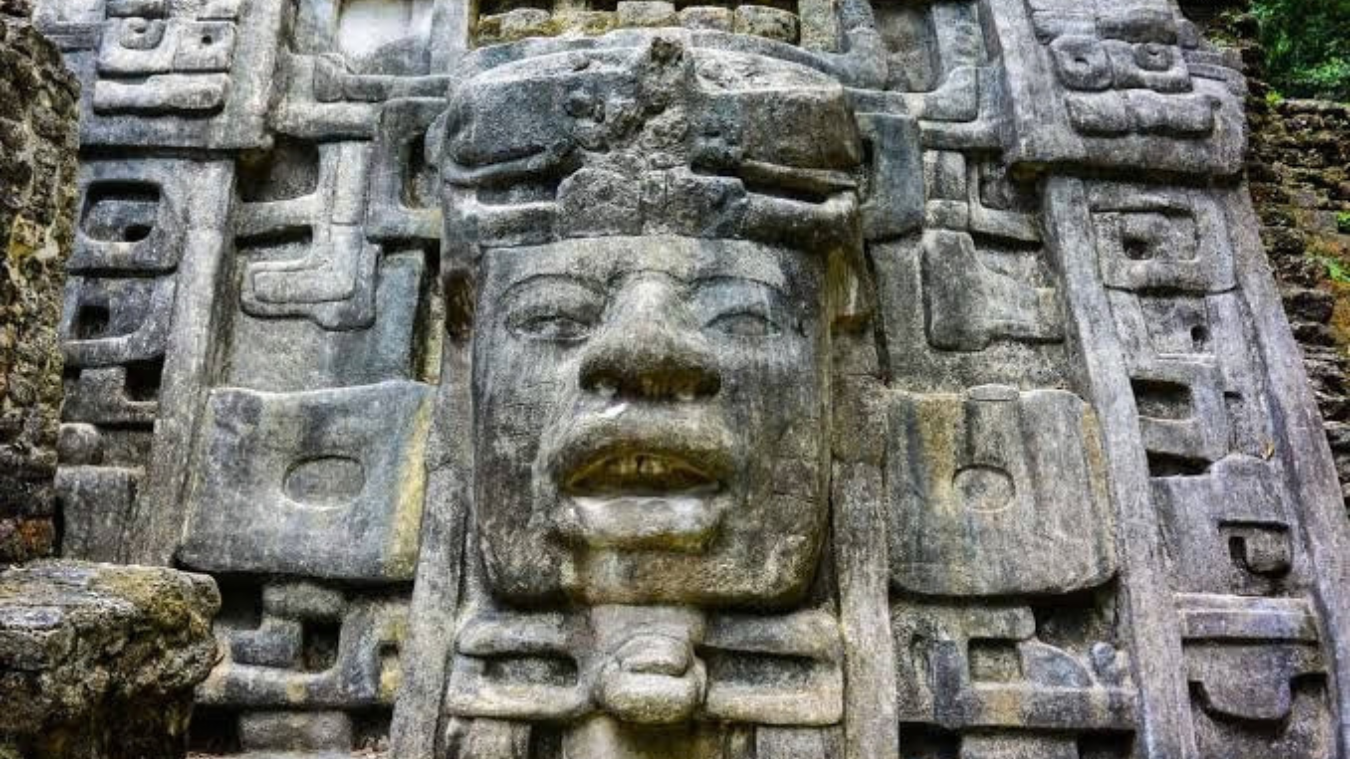
2. Mask Temple
The Mask Temple is Structure N9-56.
Its most famous feature is the enormous carved face beside the main stairway.
The exposed mask represents a royal figure and includes a crocodile headdress — a particularly appropriate symbol at a city whose name is associated with a submerged crocodile.
The original sculpture is highly significant because much Maya monumental decoration was made using stucco, while this mask is carved in limestone.
Excavation inside the temple also revealed important burials.

3. Jaguar Temple
The Jaguar Temple is another of Lamanai’s major monumental structures.
The temple gets its modern name from stylized jaguar imagery associated with the building.
The Jaguar Temple and its surrounding plaza also illustrate Lamanai’s unusually long history because this section of the city continued to be important well into later periods.

4. Maya Ball Court
Lamanai contains a Maya ball court, one of the characteristic ceremonial and political spaces found in many ancient Maya cities.
The Lamanai ball court is particularly famous because archaeologists discovered an unusual ritual deposit beneath its central marker.
The offering included liquid mercury along with other valuable materials.
Belize’s official tourism site notes that the discovery is one of only a very small number of known mercury finds in the Maya world.
5. Royal & Residential Areas
Lamanai was a living city, not simply a collection of temples.
The site contained residences, administrative spaces and elite compounds alongside ceremonial architecture.
Walking between the major structures helps reveal just how much of the ancient settlement remains beneath the forest.
6. Spanish Churches
Lamanai’s history continued after Spanish contact.
Spanish missionaries arrived in the sixteenth century and constructed churches as part of efforts to convert Maya communities to Christianity.
The reserve preserves the remains of two Spanish churches.
Their presence makes Lamanai particularly interesting because you can physically see Maya monumental architecture and later European colonial structures within the same archaeological landscape.
7. Colonial Sugar Mill
The site’s story continued into the nineteenth century.
A sugar-production operation was established at Lamanai during the 1800s.
Travel Belize dates the surviving colonial sugar mill to around 1860.
The project ultimately failed after economic and health problems affected the operation.
Its ruins add yet another historical layer to Lamanai.
Lamanai History: Why The Site Is Unusual
Most visitors naturally focus on pyramids, but Lamanai’s greatest archaeological importance may be the continuity of human activity.
Research indicates that major community development was already underway during the Preclassic period.
Large ceremonial buildings appeared centuries before the height of the Classic Maya era.
Later generations repeatedly rebuilt temples, changed plazas and reused older sacred spaces.
Even when other major Lowland Maya centers experienced dramatic political decline, Lamanai continued to be occupied.
Eventually Spanish missionaries arrived, followed centuries later by colonial economic projects.
That continuity means Lamanai is useful for understanding not just the “Classic Maya,” but thousands of years of change in northern Belize.
Can You Climb The Lamanai Temples?
Visitor access to archaeological structures is controlled by Belize’s Institute of Archaeology.
Some areas may allow designated climbing access, but this can change because of conservation, weather or safety conditions.
NICH specifically requires visitors to:
- remain on marked trails;
- use handrails where provided;
- avoid jumping on monuments;
- follow instructions from archaeological-reserve staff.
Never assume that a structure is open for climbing simply because an older photograph shows someone standing on top.
How Long Do You Need At Lamanai?
1.5 Hours
Possible for a fast guided highlights tour, but you will move quickly.
2–3 Hours
The better amount of time for most visitors.
This gives you enough time to see the main temples, museum/visitor center and historical areas without rushing constantly.
Half Day At The Reserve
Best for archaeology enthusiasts, photographers and wildlife lovers who want to move slowly through the forest.
Remember that a complete Orange Walk boat trip takes considerably longer once the return river journey and transportation are included.
Suggested Lamanai Walking Route
A practical first visit might look like this:
- Boat dock / visitor center
- Site museum and orientation
- High Temple
- Ball Court
- Mask Temple
- Residential / plaza areas
- Jaguar Temple
- Spanish church remains
- Sugar mill area if included in your route
Exact walking order may vary depending on your guide, current trail access and where your boat or vehicle enters the reserve.
Do You Need A Guide?
A guide can make a major difference at Lamanai.
Without explanation, the large monuments are impressive.
With a knowledgeable guide, the same site becomes a story involving:
- thousands of years of Maya settlement;
- royal imagery;
- Maya religion;
- river trade;
- burials;
- ball-court rituals;
- Spanish missionaries;
- colonial sugar production;
- local wildlife.
NICH currently limits each tour guide to a maximum of 15 visitors at the reserve.
Lamanai Wildlife
The reserve is surrounded by tropical vegetation, so the natural environment is an important part of the experience.
You may hear wildlife before seeing it.
Black howler monkeys are particularly memorable because their calls can carry through the forest and sound much more intimidating than the animals actually look.
Other possible wildlife includes:
- spider monkeys;
- iguanas;
- crocodiles along waterways;
- tropical birds;
- butterflies;
- other forest wildlife.
Do not feed wildlife or leave food waste behind.
Best Time Of Day To Visit
Morning is usually the most comfortable period.
Benefits include:
- cooler temperatures;
- better wildlife activity;
- less intense afternoon humidity;
- more time before the 5:00 PM closing time.
Most river tours are naturally scheduled around a morning departure for this reason.
Best Time Of Year To Visit
Lamanai can be visited throughout the year.
Northern Belize has a tropical climate, so expect warmth and humidity in every season.
The wetter months can bring:
- more rain;
- muddy trails;
- higher humidity;
- lush green vegetation.
The relatively drier part of the year can make walking and river travel more comfortable, but tropical showers remain possible.
What To Wear
NICH recommends outdoor-appropriate footwear because parts of the reserve have rugged terrain.
Wear:
- comfortable walking shoes;
- light breathable clothing;
- sun hat;
- clothing suitable for humidity;
- a light rain layer when rain is likely.
Closed shoes are generally more comfortable than delicate sandals on jungle trails.
What To Bring
- Insect repellent
- Water
- Sunscreen
- Hat
- Comfortable walking shoes
- Rain jacket or poncho
- Camera or phone
- Power bank
- Cash for small expenses
- Dry bag if you want extra protection for electronics during the river trip
Photography Rules
NICH permits ordinary photography for personal use.
However, its current archaeological-reserve policies prohibit:
- drones;
- tripods;
- monopods;
- selfie sticks;
- other stabilization equipment;
- commercial photography without authorization.
If you are visiting specifically for professional photography or filming, obtain permission in advance rather than assuming normal visitor admission covers it.
Other Important Site Rules
Belize’s Institute of Archaeology prohibits activities that can damage the archaeological reserve or disturb other visitors.
Do not:
- remove stones, pottery, plants or archaeological material;
- write on or damage structures;
- enter active excavations;
- feed or hunt wildlife;
- play loud music;
- smoke;
- consume alcohol;
- start fires;
- litter.
Follow all instructions from reserve staff because access to individual structures may change.
Where To Stay For Lamanai
Orange Walk Town
Orange Walk is the most convenient base for the classic New River trip.
It also gives you access to restaurants, local markets, transportation and tour operators.
New River Area
Some accommodation is located closer to river launching points and can work well if Lamanai is the main purpose of your northern Belize stay.
Belize City
Belize City is practical if you only have one day for an organized Lamanai excursion and do not want to move hotels.
The downside is a longer day because you need road transportation north before the river trip begins.
Lamanai Or Altun Ha?
Both are major Maya archaeological destinations in Belize, but the experiences are quite different.
Lamanai offers:
- a New River boat journey;
- more forest atmosphere;
- wildlife;
- a very long occupation history;
- Spanish churches and colonial remains.
Altun Ha is easier to reach from Belize City and works better for travelers with limited time.
If you want the more immersive full-day archaeology-and-nature experience, Lamanai is particularly compelling.
Lamanai Or Xunantunich?
Xunantunich is in western Belize near San Ignacio and is reached by crossing the Mopan River on a hand-cranked ferry.
Lamanai is in northern Belize and is best known for the New River approach.
If your itinerary includes San Ignacio, Xunantunich is much easier geographically.
If you are staying around Orange Walk, Belize City or northern Belize, Lamanai fits more naturally.
With enough time, the two complement each other well because the landscapes and travel experiences are very different.
Suggested Lamanai Day Trip
Morning: Meet your boat or tour in the Orange Walk area.
River journey: Travel along the New River while watching for birds, crocodiles, iguanas and other wildlife.
Arrival: Dock at Lamanai and visit the visitor center.
Ruins: Explore High Temple, Mask Temple, ball court and major plazas.
Later: Continue toward Jaguar Temple and colonial-era sites.
Lunch: Many organized excursions include a Belizean lunch; confirm before booking.
Afternoon: Return by boat to the Orange Walk area.
Frequently Asked Questions
Where is Lamanai in Belize?
Lamanai Archaeological Reserve is in Orange Walk District beside the New River Lagoon near Indian Church Village.
What is the best way to get to Lamanai?
The classic approach is a boat ride along the New River from the Orange Walk area. Road access is also available.
How long is the boat ride to Lamanai?
Belize’s official tourism website describes the typical Orange Walk boat journey as approximately 45 minutes, although actual time varies by launch point and wildlife stops.
What time does Lamanai open?
NICH currently lists Lamanai as open every day from 8:00 AM to 5:00 PM.
How much does Lamanai cost?
The current non-resident adult entrance fee is BZD 25. Different visitor categories have different prices.
Can I buy Lamanai tickets online?
Yes. NICH operates an official online ticketing platform and issues QR tickets by email.
What does Lamanai mean?
Lamanai is generally translated as “Submerged Crocodile.”
How old is Lamanai?
NICH describes an occupation span beginning around 1500 BC and extending through later historical occupation, making Lamanai one of the longest-lived Maya communities in Belize.
What are the main temples at Lamanai?
The best-known structures are the High Temple, Mask Temple and Jaguar Temple. The site also contains a ball court, plazas, residential areas, Spanish churches and a colonial sugar mill.
Can you climb the temples?
Only use structures and designated stairways that are officially open during your visit. Access can change for safety and conservation reasons.
How long should I spend at Lamanai?
Two to three hours at the archaeological reserve is comfortable for most first-time visitors. The complete river excursion normally takes much longer.
Can I visit Lamanai from San Pedro?
Yes, but it is usually a long full-day journey involving water and land transportation plus the New River boat trip. Organized excursions simplify the connections.
Is Lamanai worth visiting?
Yes. The combination of a jungle river trip, monumental Maya architecture, wildlife and more than three thousand years of history makes it one of the most distinctive archaeological experiences in Belize.
Final Thoughts
Lamanai is more than another Maya ruins stop.
The journey begins on the New River, where tropical forest and wildlife create the feeling of traveling into a remote archaeological landscape long before the temples appear.
Inside the reserve, the High Temple, giant Mask Temple sculpture and Jaguar Temple reveal the monumental side of ancient Lamanai, while the ball court, Spanish churches and sugar mill show how the area continued to change for centuries.
For the easiest experience, stay in or travel through Orange Walk and combine the ruins with a New River boat tour.
Allow at least two or three hours at the archaeological reserve itself, bring insect repellent and water, and spend time understanding the site’s long history rather than rushing between the three largest temples.
The unusual mix of archaeology, river travel and wildlife makes Lamanai one of the most memorable cultural day trips in northern Belize.
Sources
National Institute of Culture and History — Lamanai Visitor Information
Official opening hours, visitor facilities, safety rules and current ticket categories.
NICH Official Archaeological Reserve Ticketing Portal
Official online ticket purchasing and current archaeological-reserve fees.
Institute of Archaeology / NICH — Lamanai Archaeological Reserve
Official location, meaning of the name, reserve size and occupation-history information.
Official Belize tourism information about the New River approach, Maya history, wildlife, Spanish churches and colonial sugar mill.
Travel Belize — Maya City of Lamanai
Official tourism information on the approximately 45-minute New River journey and major Lamanai structures.
NICH — Archaeological Reserve Ticket & Visitor Policies
Official rules covering tickets, photography, closures and visitor responsibilities.
NICH — Archaeological Reserve Code of Conduct
Official rules for monument protection, wildlife, photography equipment, drones, smoking, litter and visitor behavior.
Belize Institute of Archaeology — Lamanai Virtual Tour & Archaeological Reserves
Information about Lamanai conservation, the High Temple and archaeological-site management.
Lamanai Archaeology Project — Archaeological Research
Detailed archaeological research about Lamanai’s development, monumental architecture and long occupation history.
Wikimedia Commons — Lamanai High Temple Image
Wikimedia Commons — Lamanai Mask Image
Wikimedia Commons — Jaguar Temple Image
Information checked: September 2026. Opening hours, entrance fees, archaeological structure access, boat schedules and road conditions can change. Check NICH and your transport or tour operator shortly before traveling.