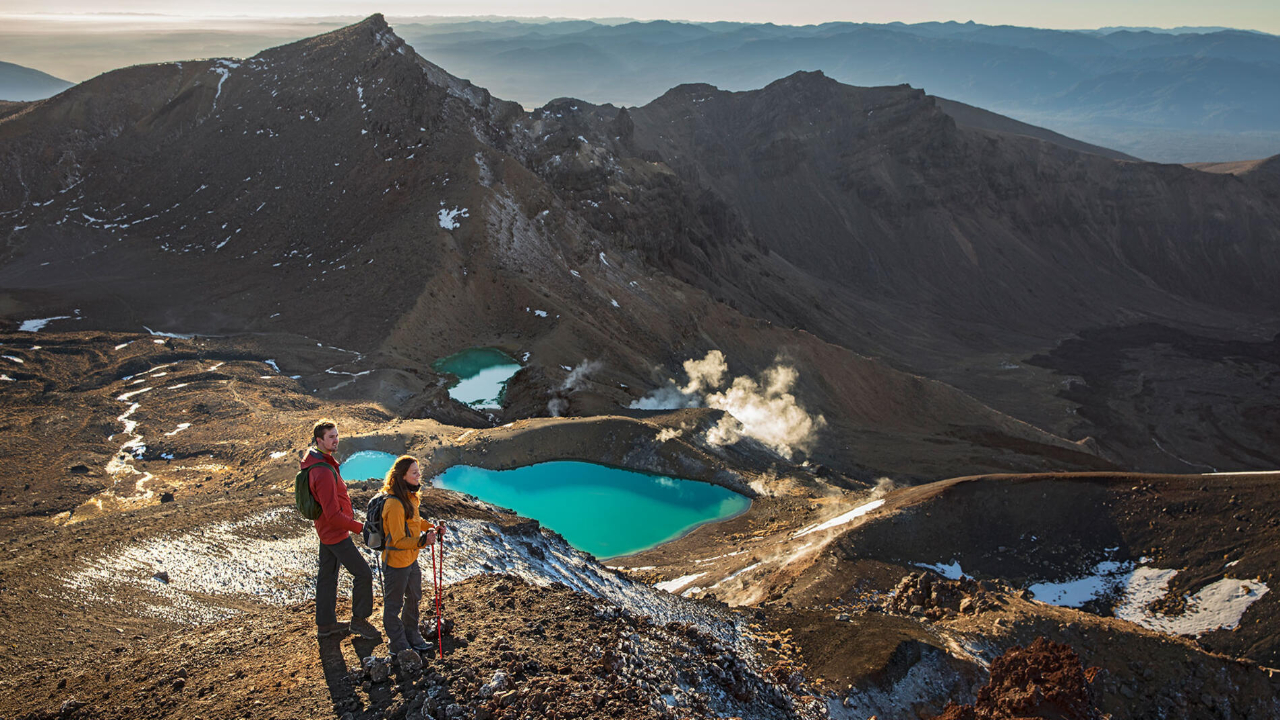
The Tongariro Alpine Crossing is one of New Zealand’s most remarkable day hikes. Stretching across the volcanic heart of Tongariro National Park on the North Island, this challenging trail takes hikers past ancient lava flows, dramatic craters, steaming geothermal areas and brilliantly colored alpine lakes. Its most recognizable views include the red and black slopes of Red Crater, the striking cone of Mount Ngauruhoe and the vivid Emerald Lakes, which stand out against the surrounding volcanic landscape.
The crossing is famous for its extraordinary scenery, but it is also a serious mountain walk. The full route covers 20.2 kilometers in one direction, with steep climbs, unstable volcanic scree, exposed ridges and a lengthy descent. In favorable conditions, reasonably fit and prepared hikers usually need seven to eight hours. Poor weather can make the journey much harder, and winter transforms the route into an alpine undertaking requiring specialist skills and equipment.
Planning the Tongariro hike properly is particularly important because the route does not finish where it starts. Most visitors begin at Mangatepōpō and finish at Ketetahi, using a prearranged shuttle to manage transportation. There is also a free Department of Conservation booking system, seasonal parking restrictions and important cultural guidance from Ngāti Hikairo ki Tongariro, the local hapū who are guardians of this sacred mountain landscape.
This complete Tongariro Alpine Crossing guide covers the trail section by section, hiking difficulty, transportation, shuttle prices, parking, booking rules, weather, seasonal conditions, recommended accommodation, equipment, volcanic safety, alternative walks and a practical itinerary. It is designed to help travelers understand not only why the crossing is beautiful, but also how to complete it responsibly.


Tongariro Alpine Crossing at a Glance
| Detail | Information |
|---|---|
| Country | New Zealand |
| Region | Central North Island |
| National park | Tongariro National Park |
| Track distance | 20.2 km / approximately 12.6 miles, one way |
| Main walking season | Approximately November–April |
| Main-season walking time | 7–8 hours |
| Winter walking time | Allow approximately 9 hours, with alpine experience required |
| Difficulty | Challenging; high fitness required |
| Highest point | Red Crater, approximately 1,886 m |
| Starting point | Mangatepōpō Road end |
| Finish | Ketetahi Road end |
| DOC track booking | Free; recommended for all, required for shuttle and guided services |
| Shuttle price example | From NZ$65 for a published park-and-ride service |
| Best nearby bases | National Park Village, Whakapapa Village and Tūrangi |
| Major highlights | Red Crater, Emerald Lakes, Blue Lake and Mount Ngauruhoe |
Older guidebooks may describe the route as 19.4 km. For practical planning, this article uses DOC’s current listed distance of 20.2 km. Track maintenance or access changes can affect the measured walking distance.
Where Is the Tongariro Alpine Crossing?
The Tongariro Alpine Crossing lies within Tongariro National Park in the central volcanic plateau of New Zealand’s North Island.
The national park surrounds several important volcanic mountains, including Tongariro, Ngauruhoe and Ruapehu.
The standard crossing begins at Mangatepōpō Road end on the western side of the volcanic landscape. Hikers travel across elevated volcanic terrain and finish at Ketetahi Road end to the north.
National Park Village and Whakapapa Village are convenient accommodation areas. Tūrangi is another popular base, particularly for visitors approaching from Lake Taupō.
According to DOC, approximate distances from the crossing to nearby settlements include 13.5 km to National Park Village, 36.7 km to Tūrangi and 86.5 km to Taupō. These are location references, not complete shuttle journey distances.
Tongariro Alpine Crossing Map
Use the map below to understand the park’s location. The route is a one-way alpine walk; a map marker alone does not show where shuttle passengers must be collected.
For actual route navigation, use DOC’s official track information, download suitable offline maps and follow the marked track. Do not rely on a road-navigation application for alpine route finding.
Official DOC track guide, maps, weather links and booking information.
Why Is the Tongariro Alpine Crossing Famous?
The crossing travels through an unusually dramatic combination of volcanic features within a single day.
Hikers encounter older lava flows, wide crater floors, mineral-stained ridges, steaming geothermal areas and brilliantly colored lakes.
The nearby symmetrical cone of Mount Ngauruhoe adds another striking element to the scenery.
Fans of The Lord of the Rings may recognize Ngauruhoe as one of the landscape references used to portray Mount Doom.
However, Tongariro is far more than a movie location.
Its mountains, lakes and waterways are culturally and spiritually significant to local Māori, particularly Ngāti Hikairo ki Tongariro of Ngāti Tūwharetoa.
Tongariro National Park is recognized by UNESCO for both its natural and cultural importance. Responsible hiking means appreciating that this is a living cultural landscape rather than simply a scenic playground.
Tongariro Alpine Crossing: Trail Guide Section by Section
1. Mangatepōpō Valley to Soda Springs
The hike normally begins at Mangatepōpō Road end, approximately 1,120 meters above sea level.
The opening section follows the Mangatepōpō Valley through low vegetation and volcanic scenery.
This part of the route is comparatively gentle, with a formed path and boardwalk sections crossing wetter ground.
On clear days, hikers may enjoy impressive views of Mount Ngauruhoe rising above the valley.
The first 5.4 km of the standard crossing shares the route with the Soda Springs Walk.
DOC identifies the shorter Soda Springs Walk as an approximately two-hour return option for travelers who do not have the fitness for the full alpine crossing.
This makes the early part of the route an important decision point.
If the weather is already uncomfortable, your clothing is unsuitable or the climb ahead seems beyond your abilities, turning back before the steeper sections is a sensible choice.

2. The Climb to South Crater
Beyond the gentler valley section, the route becomes more demanding.
Hikers ascend a steep staircase and rocky slope toward South Crater, gaining approximately 350 meters in this section according to DOC’s description.
The sustained uphill climb is often one of the first major physical challenges of the day.
Use a measured pace rather than trying to rush uphill.
Conditions become increasingly exposed, and wind may be significantly stronger than it was near the car park.
After the climb, the broad South Crater area provides a dramatic contrast, with a relatively open volcanic basin surrounded by rugged slopes.
Although the terrain can look almost otherworldly, walkers must remain on the marked route to protect fragile vegetation and avoid unsafe areas.
3. South Crater to Red Crater
The climb resumes after South Crater.
This upper ascent leads toward Red Crater, the highest point on the standard crossing at approximately 1,886 meters.
The surrounding volcanic slopes show dramatic colors created by volcanic rock and mineral alteration.
Red Crater itself contains red, brown and black geological features that look very different from the vegetation-covered valleys below.
This is a particularly exposed part of the crossing.
Strong wind, rain or low visibility may make progress difficult, and there are sections where careful balance is essential.
Do not continue uphill if conditions are deteriorating or your group cannot move safely.

4. The Steep Descent to Emerald Lakes
Descending from Red Crater toward the Emerald Lakes is one of the most famous—and potentially difficult—sections of the entire crossing.
The trail drops down a steep slope covered with loose volcanic stones and scree.
Underfoot, small rocks may shift and slide, making balance important.
DOC specifically identifies this descent as a major slipping hazard.
Move carefully, take shorter steps and avoid rushing.
At the bottom of the descent are the Emerald Lakes, known as Ngā Rotopounamu.
The lakes have vivid green and blue-green coloring that contrasts sharply with the dark volcanic surroundings.
The color results from minerals and geothermal influences within this volcanic environment.
These lakes are culturally sacred and are not places for swimming, touching the water or washing equipment.

5. Central Crater and the Blue Lake Area
Beyond the Emerald Lakes, the trail crosses more volcanic terrain associated with Central Crater and continues toward Blue Lake.
The landscape is broad and exposed, with comparatively little shelter from bad weather.
Blue Lake is known in te reo Māori as Te Wai Whakaata o Te Rangihīroa, meaning Rangihīroa’s mirror.
Its deep-blue appearance creates another striking contrast with the volcanic rocks around it.
Like the Emerald Lakes, this water body is culturally significant.
Stay on the marked trail and do not enter or touch the lake water.


6. Ketetahi Descent and the Finish
The final section begins the long descent along the northern slopes of Tongariro.
The track winds downhill through exposed terrain before reaching progressively greener vegetation and forest.
On clear days, hikers may see Lake Rotoaira and Lake Taupō in the distance.
Although most of the climbing is behind you, the descent is not necessarily easy.
There are numerous steps and long zigzagging sections that can place considerable strain on tired legs and knees.
Keep enough water and food for this final section rather than consuming everything at the Emerald Lakes.
The standard route finishes at Ketetahi Road end, approximately 760 meters above sea level.
Before reaching the end, follow the instructions provided by your shuttle company about exactly where you will meet the return service.

How Hard Is the Tongariro Alpine Crossing?
The Tongariro Alpine Crossing is challenging and requires a high level of fitness.
The total distance is substantial, the upper slopes are exposed and parts of the route involve loose volcanic terrain.
Even hikers comfortable with long walks on flat paths may find the sustained climbing and downhill sections difficult.
The standard direction involves climbing from approximately 1,120 meters to the 1,886-meter high point before descending to about 760 meters.
DOC lists approximately 1,196 meters of combined elevation change on the route.
The length of the walk means that weather, fatigue and time management are all important.
Can Beginners Complete Tongariro?
Fit beginners with experience on long hill walks may manage the crossing in good summer conditions.
However, it is not an ideal first hike for someone who has never walked on uneven mountain terrain.
Before visiting, it helps to complete several long walks involving hills, stairs and sustained physical effort.
If you have significant knee problems, balance difficulties or limited walking endurance, consider a shorter walk such as Soda Springs or Taranaki Falls.
Is Tongariro Suitable for Children?
DOC does not recommend the full crossing for children under the age of ten.
The long distance, exposed terrain and possibility of severe weather make it an unsuitable activity for many younger visitors.
Even older children should only participate if they have the necessary fitness, equipment and experience.
Tongariro Alpine Crossing Booking System
The Department of Conservation operates a free booking system for the Tongariro Alpine Crossing.
DOC recommends booking for all visitors using any part of the crossing, including people completing only a shorter portion of the route.
A track booking is required for visitors using commercial shuttle or guided-walk services.
Independent walkers who arrive without a booking are not currently penalized under DOC’s published system, and there is no booking cap.
However, making the free booking is still worthwhile because DOC uses the system to communicate important visitor information.
Official booking: DOC Online Booking Service.
Important distinction: A DOC track booking and a commercial shuttle reservation are not the same thing. Complete both arrangements when using a shuttle.
How to Get to the Tongariro Alpine Crossing
The crossing begins and finishes at different locations, making transportation one of the most important parts of planning.
From National Park Village
National Park Village is one of the most convenient accommodation bases for the crossing.
Local shuttle operators provide early transport toward Mangatepōpō and arrange collection arrangements after the walk.
The village is also a useful base for exploring Whakapapa and other areas of Tongariro National Park.
Book your shuttle before arriving, particularly during busy summer dates.
From Tūrangi
Tūrangi is another popular starting point, with a selection of accommodation and access to Lake Taupō and the Tongariro River.
Commercial operators provide return-shuttle options from town.
Allow additional travel time compared with staying in National Park Village.
From Taupō
Taupō can be used as a base for visitors who prefer a larger town with a wider range of restaurants and accommodation.
However, the transfer is longer, and an early hiking departure can require a very early wake-up.
If you want to minimize driving and shuttle time on hiking day, consider staying closer to the national park the night before.
Can You Drive Yourself?
You can drive to a designated parking or park-and-ride facility, but that does not remove the need to solve the one-way transportation problem.
During the main summer season, parking restrictions of approximately four hours apply at the road ends.
DOC does not recommend parking along state highways.
The most practical solution for most visitors is to reserve a designated park-and-ride shuttle or arrange a return shuttle from their accommodation.
Tongariro Shuttle Prices and Transport Options
Shuttle prices vary according to the departure town, return arrangements and operator.
The following published examples come from Tongariro Expeditions and are useful for budget planning.
| Shuttle option | Published starting price | Best for |
|---|---|---|
| Park-and-ride shuttle | NZ$65 per adult | Travelers with a rental car |
| Tūrangi return shuttle | NZ$110 per adult | Visitors staying in Tūrangi |
| Taupō return shuttle | NZ$130 per adult | Visitors based in Taupō |
These are operator-advertised starting prices, not guaranteed live fares or government fees.
Operator information: Tongariro Expeditions.
Before purchasing, check the pickup location, return meeting point, departure time, cancellation conditions and arrangements if DOC issues a hazardous-weather advisory.
Some companies use set return windows. Walking substantially slower than expected could cause you to miss the last scheduled shuttle.
When Is the Best Time to Hike Tongariro?
November to April: Main Walking Season
The main warmer-season window is the most practical time for visitors without winter mountaineering experience.
Many commercial shuttles operate during this period, and the track is generally more manageable when clear of significant snow and ice.
However, good summer weather is not guaranteed.
DOC warns that strong wind, freezing conditions, heavy rainfall and even snow can occur at any time of year.
Always carry warm and waterproof layers.
December to February
These are popular summer months for hiking.
They can offer long daylight hours and favorable walking conditions, but visitor numbers may be high.
Book accommodation and shuttle services well in advance if traveling during busy holiday periods.
March and April
Late summer and early autumn can be rewarding, but temperatures can begin to fall and icy conditions may develop.
Check whether you need equipment beyond ordinary day-hiking gear.
May to October: Winter Alpine Conditions
Winter is a completely different experience.
Snow and ice can cover the trail, some marker poles may be difficult to see, and avalanche risk becomes relevant.
DOC describes the winter crossing as an expert alpine route requiring navigation, survival and avalanche-awareness skills.
Specialist equipment can include crampons, ice axe, helmet, avalanche transceiver, probe and shovel.
Travelers without the relevant skills should not attempt the winter crossing independently.
A suitable professional alpine guide is strongly recommended.
What Happens When the Weather Is Unsafe?
DOC uses a hazardous-weather advisory system during the main walking season.
A “Not Recommended Today” advisory may be issued when forecast conditions create an unacceptable level of risk for ordinary walkers.
Examples include high average wind speeds, strong gusts, dangerous wind chill, heavy precipitation and snowfall.
The advisory assessment is made at approximately 6:00 AM each day during the applicable season.
If unsafe conditions are identified, DOC notifies transport operators, guides and visitor information centers.
Do not ignore the advisory merely because other hikers are still considering the route.
It is better to move the hike to a safer day than to continue into conditions that could cause injury or require rescue.
Official forecast and alerts: DOC Tongariro Alpine Crossing.
Where to Stay Near Tongariro Alpine Crossing
Choosing accommodation close to your shuttle’s departure point can make the hiking day considerably easier.
National Park Village is especially practical for many travelers. Whakapapa Village provides an alpine setting and access to several nearby walks.
| Accommodation | Location | Best for |
|---|---|---|
| Plateau Lodge | National Park Village | Couples, families and hiking packages |
| Skotel Alpine Resort | Whakapapa Village | Mountain views, families and outdoor activities |
| Tongariro Crossing Lodge | National Park Village | Boutique accommodation and personalized service |
1. Plateau Lodge — Best for Hiking Packages and Families
Location: National Park Village, central North Island.
Plateau Lodge is a family-operated accommodation property offering private rooms, studios and apartments.
Its official room categories include Double Ensuite rooms, King Studio Pods, two-bedroom apartments and lodge rooms with shared facilities.
The two-bedroom apartments provide separate sleeping areas, a lounge, dining space, equipped kitchen and private bathroom.
King Studio Pods provide a king bed, private bathroom, tea and coffee facilities, mini refrigerator and outdoor space.
The property’s published accommodation prices include Double Ensuite rooms from approximately NZ$149–169 and two-bedroom apartments from approximately NZ$280–350.
These are published reference rates, not a guarantee for every date.
Plateau Lodge also advertises a Tongariro Alpine Crossing package from NZ$450 for two guests, incorporating accommodation and selected hiking arrangements.
Confirm whether breakfast, lunch packs and shuttle services are included in your specific booking.
Best for: Families, couples and travelers who want accommodation and transport arranged together.
Actual hotel photographs and room gallery: Plateau Lodge Official Rooms.
2. Skotel Alpine Resort — Best for Mountain Views
Location: 1 Ngauruhoe Terrace, Whakapapa Village.
Skotel Alpine Resort occupies a scenic position within Tongariro National Park.
It provides a variety of accommodation, including hotel rooms, backpacker-style rooms, family suites and self-catering cabins.
The Standard Queen Room sleeps two guests and includes a queen bed, private ensuite bathroom, heating, Wi-Fi, small refrigerator and tea and coffee facilities.
For travelers who want more space, the Superior Queen Room has a king bed, ensuite bathroom and outdoor balcony overlooking the national park.
The resort also advertises family suites accommodating up to eight guests.
On-site facilities include a restaurant and bar, communal areas and other amenities.
Skotel is particularly convenient for travelers planning to explore Taranaki Falls, Tama Lakes and Whakapapa-area walking routes.
However, guests still need to arrange transport to the Tongariro Alpine Crossing’s actual starting point.
Best for: Couples, groups and travelers who want to stay in an alpine setting.
Actual hotel photographs and room details: Skotel Alpine Resort Official Room Gallery.
3. Tongariro Crossing Lodge — Best for Boutique Accommodation
Location: 27 Carroll Street, National Park Village.
Tongariro Crossing Lodge is a boutique accommodation property with a range of private suites.
Its published accommodation includes one-bedroom Garden Suites, self-contained accommodation and other spacious room options.
The Garden Suites introduced in 2025 are approximately 29 square meters and include a lounge, separate bedroom with king bed, ensuite bathroom, cooking facilities and private deck.
The lodge also offers breakfast with homemade bread, packed lunch arrangements and assistance with booking local shuttle transport.
These services may be particularly useful for visitors preparing for an early hiking departure.
Best for: Couples and travelers wanting a comfortable stay with individualized hospitality.
Actual hotel photographs and accommodation options: Tongariro Crossing Lodge Official Website.
Important Safety Tips for Tongariro Alpine Crossing
Tongariro is a demanding alpine environment, not simply a long scenic walk.
1. Check the Weather Before Leaving
Strong wind, rain, snow and freezing conditions are possible even during summer.
Check the official forecast and DOC advisories shortly before your departure.
Do not attempt the crossing during dangerous weather merely because you have already booked a hotel or shuttle.
2. Take Enough Water
DOC recommends carrying approximately two to three liters of water.
Water along the track is not suitable for drinking without appropriate treatment, and hikers should not depend on refilling from lakes or streams.
Pack sufficient food for a full day of strenuous activity.
3. Wear Suitable Footwear
The rocky terrain and steep scree descent require footwear with reliable traction.
Sturdy tramping boots or suitable hiking footwear are recommended.
Do not attempt the crossing in casual sandals or shoes designed only for city walking.
4. Respect Volcanic Hazards
Tongariro is an active volcanic environment.
DOC states that eruptions can occur, even though the probability during a particular crossing is low.
Steaming vents and geothermal ground can be extremely hot and unstable.
Stay on the trail and do not approach fumaroles or geothermal features.
Check current volcanic information from GeoNet.
5. Take the Red Crater Descent Slowly
Loose volcanic stones create a significant slipping hazard.
Move carefully and avoid rushing downhill.
Hikers with knee or balance difficulties should consider whether this section is appropriate for their abilities.
6. Carry Emergency Equipment
Carry a charged mobile phone, suitable navigation equipment and a headlamp.
A personal locator beacon is strongly recommended for remote New Zealand mountain travel.
Mobile reception may be unreliable.
New Zealand’s emergency number is 111.
7. Do Not Underestimate Winter Conditions
Snow, ice and avalanche terrain create hazards far beyond ordinary summer hiking.
Winter visitors need specialist equipment and the skills to use it.
If you lack alpine experience, use a qualified guide or choose an easier walk.
8. Respect Sacred Sites and Waterways
Tongariro’s mountains and lakes have deep cultural significance.
Do not enter or touch the alpine lakes, leave the marked track or climb sacred peaks for recreational summit photographs.
Follow guidance from Ngāti Hikairo ki Tongariro and DOC.
9. Respect the Fire-Recovery Areas
Wildfires in late 2025 affected parts of Tongariro National Park near the beginning of the crossing.
Ngāti Hikairo ki Tongariro established a ten-year restorative rāhui over the affected land.
Stay on designated paths, do not enter fire-damaged areas and clean your footwear before hiking to avoid introducing weeds.
10. Know When to Turn Back
Not every hiking attempt should end with completing the full crossing.
Unexpected illness, dangerous weather, insufficient daylight or unsuitable equipment are valid reasons to stop.
Before proceeding beyond the early valley section, assess your condition and the forecast carefully.

What to Pack for the Tongariro Alpine Crossing
- Sturdy hiking boots or appropriate tramping shoes.
- Two to three liters of drinking water.
- Enough food for a full day.
- Waterproof jacket and trousers.
- Warm fleece or insulating layer.
- Windproof outer layer.
- Warm hat and gloves.
- Sun hat, sunglasses and sunscreen.
- Headlamp and spare batteries.
- Charged phone and power bank.
- Offline map and navigation equipment.
- Personal locator beacon if available.
- Personal medication.
- Small first-aid kit.
- Shuttle booking information.
- Bag for carrying out rubbish.
For winter conditions, additional alpine and avalanche safety equipment is required, together with the skills to use it.
Suggested Two-Day Tongariro Travel Itinerary
Day 1: Arrive and Prepare
Travel to National Park Village, Whakapapa or Tūrangi and check into your accommodation.
Confirm your DOC track booking, shuttle reservation and collection arrangements.
Check the forecast and prepare your hiking clothes and backpack.
If time permits, enjoy an easy nearby walk such as Taranaki Falls.
Have an early dinner and get sufficient rest.
Day 2: Complete the Alpine Crossing
Leave early for your confirmed shuttle departure.
Begin at Mangatepōpō and allow approximately seven to eight hours for the crossing in suitable main-season conditions.
Travel through South Crater, Red Crater, Emerald Lakes, Blue Lake and the northern descent.
Finish at Ketetahi and meet your booked transport at the designated pickup location.
Return to your accommodation for food and recovery.
Where possible, keep an additional day flexible in case weather prevents the hike.
Best Alternative Walks if Tongariro Is Too Difficult
Taranaki Falls Walking Track
This popular loop near Whakapapa Village is approximately six kilometers long and generally takes around two hours.
The route passes through tussock country, forest and attractive volcanic scenery before reaching the waterfall.
It is a good option for visitors who prefer a shorter walk, although ordinary weather precautions still apply.
Tama Lakes Track
The Tama Lakes Track offers another memorable hiking experience in Tongariro National Park.
DOC lists the main return route to Lower Tama Lake at approximately 17.6 kilometers, with a walking time of five to six hours.
This remains a substantial walk but involves less elevation gain and exposure than the main alpine crossing.
The additional route toward Upper Tama Lake viewpoint is more difficult and should not be confused with the easier main track.
Soda Springs Walk
For visitors who want to experience part of the famous Tongariro route without completing the entire crossing, Soda Springs is a useful alternative.
DOC identifies it as an approximately two-hour return walk from Mangatepōpō.
It provides a taste of volcanic valley scenery without requiring the full Red Crater ascent or long Ketetahi descent.
Important: An alternative track should still be selected according to current weather. If severe alpine conditions affect the wider area, consider a low-elevation activity instead.
More Hiking Inspiration
For travelers interested in spectacular volcanic landscapes beyond New Zealand, Aoqira’s Inerie Volcano Hike guide covers a strenuous ascent on Flores Island in Indonesia.
For a completely different wilderness environment, see the Khao Sok National Park guide in southern Thailand, where rainforest trails and dramatic limestone landscapes offer another remarkable nature experience.
Our Zhangjiajie National Forest Park guide explores the extraordinary sandstone pillars and walking routes of China’s famous mountain landscape.
Frequently Asked Questions About Tongariro Alpine Crossing
How long is the Tongariro Alpine Crossing?
DOC currently lists the crossing as 20.2 kilometers one way. Older sources may quote 19.4 kilometers.
How many hours does the hike take?
Approximately seven to eight hours during the main walking season is a common planning estimate. Winter can require nine hours or longer.
How difficult is Tongariro?
It is a challenging alpine hike requiring good fitness, proper equipment and the ability to manage steep climbs and a long descent.
Do I need a guide?
An experienced summer hiker may complete the crossing independently when conditions are suitable. Winter conditions require specialist alpine skills, and a qualified guide is strongly recommended for those without this experience.
Is the Tongariro Alpine Crossing free?
The DOC track booking system is currently free. Commercial shuttles, guides and accommodation cost extra. Check DOC for any later changes to access charges.
Do I have to book the hike?
DOC recommends a track booking for all visitors and requires one for shuttle and guided-walk users. The booking itself is free.
Can I park at the start?
Parking restrictions apply at the road ends during the main hiking season. A designated park-and-ride shuttle is generally the better option for completing the full one-way route.
Can beginners hike Tongariro?
Fit beginners with experience of long, hilly walks may be able to complete it in good conditions. The route is not suitable for everyone and should not be underestimated.
Can children do the crossing?
DOC does not recommend the full crossing for children under ten. Older children need appropriate fitness, preparation and adult supervision.
Can you swim in the Emerald Lakes?
No. The alpine lakes are culturally sacred and lie within an active volcanic environment. Visitors should not enter or touch their waters.
Is Mount Ngauruhoe part of the crossing?
The standard track passes through the volcanic landscape near Ngauruhoe but does not require climbing its summit. Local iwi ask visitors to respect the sacred mountains rather than treating summit climbs as recreational additions.
Can you hike Tongariro in winter?
Yes, but only with the alpine skills, navigation ability and winter safety equipment appropriate to current conditions. For most ordinary summer hikers, winter is not suitable for an independent attempt.
How much water should I carry?
DOC recommends two to three liters of drinking water. There is no dependable untreated drinking-water source along the track.
Are there toilets along the crossing?
Yes. DOC indicates toilets are available at intervals of approximately one to two hours, although their location and accessibility should be checked using the latest route map.
Where is the best place to stay?
National Park Village is especially practical for many shuttle services. Whakapapa Village provides a scenic alpine base, while Tūrangi is another useful option.
What happens if the weather is bad?
Choose a safer day or an alternative activity. DOC may issue a “Not Recommended Today” advisory during the main season, and shuttle operators can change services according to conditions.
Final Thoughts
The Tongariro Alpine Crossing is one of New Zealand’s most extraordinary hiking experiences. Its volcanic craters, brightly colored alpine lakes and dramatic mountain scenery create a landscape unlike most conventional day walks.
However, its popularity should not obscure the demands of the route. The crossing requires good physical fitness, suitable equipment, careful transportation planning and respect for rapidly changing alpine conditions.
Booking your shuttle and completing DOC’s free booking process are straightforward steps that can make the day considerably easier.
Take the cultural significance of the mountains seriously, stay on marked trails and respect the natural environment.
Most importantly, remember that reaching the end is not more important than making safe decisions along the way.
With appropriate preparation and favorable weather, the Tongariro Alpine Crossing can be one of the most memorable outdoor adventures of a New Zealand journey.
Sources and Further Reading
This guide uses current information from the New Zealand Department of Conservation, Tourism New Zealand, official accommodation websites and documented Wikimedia Commons photograph records. Weather, shuttle operations and access arrangements should be verified shortly before hiking.
- Department of Conservation — Tongariro Alpine Crossing. Official route, length, time, volcanic hazards, weather, booking and equipment.
- DOC — Sustainable Visitor Management for Tongariro. Free booking system and cultural protection measures.
- DOC Official Booking Service. Track booking arrangements.
- Tourism New Zealand — Tongariro Alpine Crossing. Visitor overview and scenic highlights.
- New Zealand Mountain Safety Council. Practical preparation and hiking safety.
- GeoNet New Zealand. Current volcanic monitoring.
- New Zealand Avalanche Advisory. Winter mountain hazard information.
- Tongariro Expeditions. Published shuttle options and prices.
- Plateau Lodge. Official room gallery and accommodation pricing.
- Skotel Alpine Resort. Official room photographs and facilities.
- Tongariro Crossing Lodge. Official accommodation and services.
- DOC — Tama Lakes Track. Alternative hiking route details.
Photography Credits
All destination photographs above are from Wikimedia Commons with source and photographer credits in their captions. Licenses used include CC BY, CC BY-SA and public-domain material. Follow the terms of each individual photograph’s license, including attribution, source links and disclosure of modifications. Where ShareAlike applies, modified versions must follow the applicable license requirements.