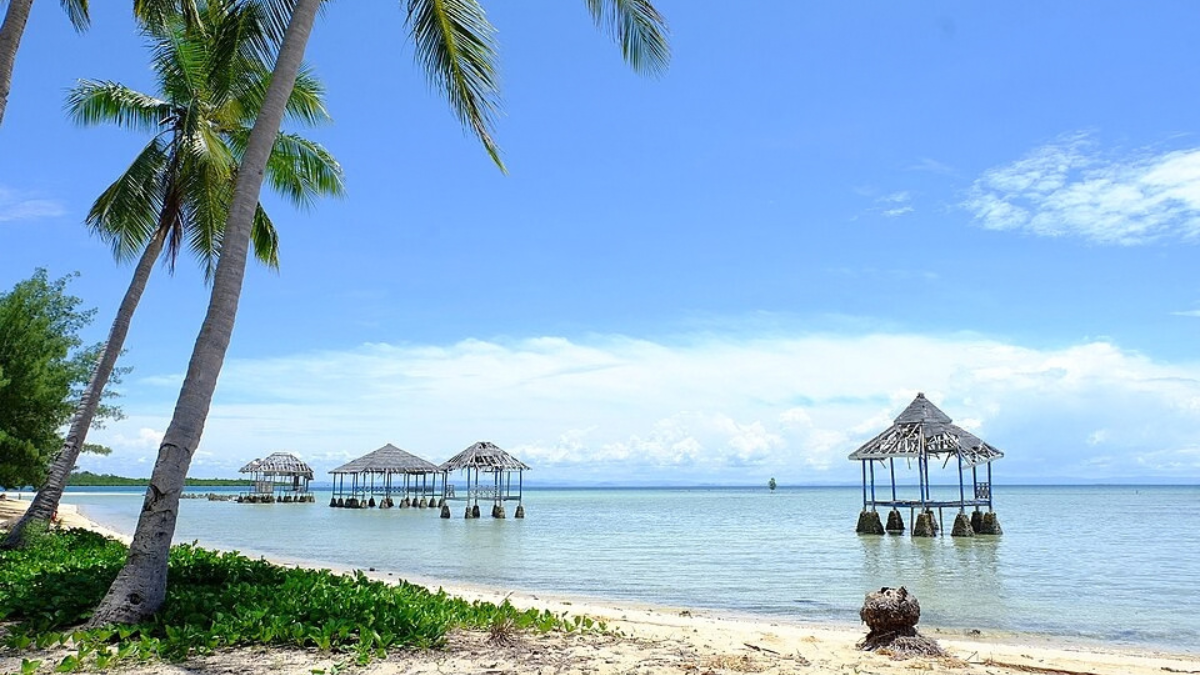
Muna Island is one of the most fascinating but still relatively overlooked destinations in Southeast Sulawesi, Indonesia. Instead of large resorts and crowded tourist streets, the island is known for turquoise saltwater lakes, limestone landscapes, quiet beaches, traditional communities and an extraordinary collection of prehistoric cave art.
The island’s main travel base is Raha, but many of Muna’s most interesting attractions are found farther south around Lohia District. Here you can visit Napabale Lake, explore the clear-water landscape around Meleura, see prehistoric caves at Liangkabori and stand close to rock art that has radically changed what archaeologists know about early human creativity.
This complete Muna Island Sulawesi travel guide explains how to get there, how to get around, where to base yourself, the best things to see, the remarkable Liang Metanduno discovery, suggested itineraries, transport connections with Kendari and Baubau, weather, practical travel tips and how many days you should spend on the island.


Muna Island At A Glance
| Detail | Information |
|---|---|
| Province | Southeast Sulawesi, Indonesia |
| Main base | Raha |
| Best known for | Caves, rock art, blue lakes, karst scenery & quiet coast |
| Major attractions | Napabale, Meleura, Liangkabori & Liang Metanduno |
| Best trip length | 3–4 days |
| Best transportation | Car with local driver or motorbike for experienced riders |
| Main sea connections | Baubau, Kendari and mainland Southeast Sulawesi |
| International significance | Liang Metanduno hand stencil dated to at least 67,800 years ago |
Where Is Muna Island?
Muna is an island in Southeast Sulawesi Province, southeast of the main body of Sulawesi and close to Buton.
The island is divided administratively, with areas belonging to Muna Regency and West Muna Regency.
For most travelers interested in Napabale, Meleura and the prehistoric caves, Raha is the most useful base.
Raha is the capital of Muna Regency and provides accommodation, restaurants, shops, fuel, port connections and access to drivers.
Map Of Muna Island Sulawesi
The attractions around Lohia are close enough to combine into full-day trips from Raha, but you should still allow generous travel time because rural access roads and local conditions can change.
How To Get To Muna Island
Muna can be reached by sea from both the Sulawesi mainland and neighboring Buton.
Flight and ferry availability changes more frequently here than at major Indonesian tourism hubs, so confirm your exact connection shortly before traveling.
Kendari To Raha
Kendari is one of the most useful gateways if you are already traveling in Southeast Sulawesi.
Passenger services connect Kendari with Raha, and PELNI continues to include Kendari–Raha–Baubau within its wider regional network.
Fast passenger boats may provide a more direct option on operating days.
Schedules can change because of weather, maintenance and seasonal demand, so confirm locally or through the relevant operator rather than planning around an old timetable.
Baubau To Muna
Baubau on neighboring Buton Island is another excellent gateway.
ASDP lists the Baubau–Waara crossing as part of its commercial route network, making it possible to move between Buton and Muna with passengers and vehicles.
PELNI also operates regional services involving Baubau and Raha.
This makes a Buton–Muna combination particularly practical.
If you enjoy exploring lesser-visited Indonesian islands, Aoqira’s Ternate Island Travel Guide covers another fascinating Indonesian island shaped by volcanoes, history and maritime culture.
How To Get Around Muna
Public transportation is not the easiest way to build a sightseeing itinerary across Muna.
For most international travelers, the simplest arrangement is to hire a local driver with a car.
This allows you to combine several sites during the same day and avoids having to negotiate separate transport every time you leave a rural attraction.
Motorbikes can work for experienced riders, but remember that:
- weather can change quickly;
- some attractions are away from major roads;
- mobile signal may be inconsistent;
- road conditions can vary;
- night riding should be avoided where possible.
For caves and remote natural attractions, arranging a local contact or guide is often more useful than relying only on online maps.
Best Things To Do On Muna Island
1. Napabale Lake
Napabale is one of Muna’s best-known natural attractions.
It lies in Lohia District and is part of a coastal karst landscape where clear water, limestone and dense tropical vegetation come together.
The lake is unusual because of its connection with the sea through the surrounding limestone environment.
Traditional boats can be used to explore the water, and the clear turquoise-green color makes Napabale especially attractive for photography.
Conditions can look very different depending on weather, tide and sunlight, so do not expect every visit to reproduce heavily edited social-media photographs.
The Muna regional government’s tourism planning documents identify Danau Napabale as one of the area’s priority tourism destinations.
2. Meleura
Meleura is another major attraction in Lohia District, located in Lakarinta Village.
Indonesia’s official tourism-village platform places it approximately 15 km from Raha.
The landscape includes:
- clear seawater;
- white sand;
- karst rock formations;
- small offshore formations;
- boat-accessible areas;
- nearby lakes and natural attractions.
The tourism-village listing also identifies parking, public bathrooms, food, souvenir facilities and visitor photo areas.
Meleura is a good place to slow down after spending time inside the prehistoric cave area.
Travelers who enjoy distinctive tropical coastlines may also like Aoqira’s Komodo Pink Beaches travel guide for another unusual Indonesian coastal landscape.
3. Liangkabori Prehistoric Cave Area
The Liangkabori area is one of the most important cultural attractions on Muna.
Muna government information identifies several tourism caves in Liangkabori Village, including:
- Gua Liangkabori;
- Gua Metanduno;
- Gua Layang-layang.
The caves contain prehistoric paintings showing different forms, figures and scenes.
Researchers have studied the wider Liangkabori cave region for decades, and the area’s cultural value has become increasingly important to local tourism planning.
In 2026, the Liangkabori Festival was also established as an official Southeast Sulawesi provincial agenda, bringing more attention to Muna’s prehistoric heritage.
4. Liang Metanduno & The 67,800-Year-Old Hand Stencil
This is now the most internationally significant part of Muna’s archaeological story.
A study published in Nature on January 21, 2026 reported uranium-series dating results from a hand stencil at Liang Metanduno.
Calcite that formed over the pigment produced a minimum-age constraint of 67,800 years.
This does not mean scientists know the exact year the stencil was made.
It means the art must be at least that old and could potentially be older.
The research team described the result as exceeding previously published minimum ages for known cave art, including the famous Spanish hand stencil previously associated with Neanderthals.
The discovery is also important for understanding ancient human movement through Wallacea toward Sahul — the prehistoric landmass connecting Australia and New Guinea.

5. Danau Ubur-Ubur
Lohia District tourism information also identifies a jellyfish lake in the Lakarinta area.
This is one of Muna’s more unusual natural attractions.
Access conditions, water level and local visitor arrangements can change, so ask locally before making it a fixed part of your itinerary.
Do not touch, lift or deliberately disturb jellyfish or other aquatic life simply for photographs.
Responsible behavior is especially important in enclosed lake ecosystems because they can be much more sensitive than the open sea.
6. Motonuno Lake
Motonuno is another clear-water lake listed among Lohia’s local attractions.
It can be combined with Meleura and other Lakarinta-area stops rather than treated as a completely separate day trip.
This is one reason a local driver is useful: several small natural attractions can be linked together efficiently during the same day.
7. Tampo & Muna’s Coastal Communities
Tampo in northern Muna offers a different look at island life.
The coastal area includes maritime communities and traditional Bajo houses.
Instead of treating places like this as staged attractions, visit respectfully and remember that you are entering communities where people live and work.
Ask permission before photographing individuals at close range.

8. Masalili Weaving
Muna’s official regional tourism plan also identifies Kampung Tenun Masalili as an established tourism asset.
Traditional textiles provide a useful cultural counterpoint to the island’s beaches, caves and lakes.
If you buy locally produced woven goods, purchase directly from craftspeople or trusted community sellers where possible.
This helps keep more tourism spending within the community.
9. Raha
Raha is not primarily a resort destination, but it is the most practical base for exploring this part of Muna.
Use the town for:
- accommodation;
- restaurants and local food;
- shopping;
- fuel;
- port connections;
- finding drivers;
- withdrawing cash;
- organizing onward transport.
Do not expect the polished tourism infrastructure of Bali or Labuan Bajo.
Muna’s appeal is precisely that tourism is still relatively small-scale.
Where To Stay On Muna Island
For a first visit, Raha is the safest practical choice.
It puts you close to transportation, restaurants and everyday services while still allowing day trips toward Lohia.
You may also find local homestay-style accommodation closer to tourism villages. Indonesia’s official tourism-village listing for Meleura currently includes homestay accommodation among local tourism services.
For a short 3–4 day trip, however, changing hotels is usually unnecessary.
Stay in Raha and use a car or motorbike for sightseeing.
How Many Days Do You Need?
2 Days
Possible, but rushed.
Focus on Napabale, Meleura and the Liangkabori–Metanduno area.
3 Days
A good minimum for a first visit.
You have time for the major Lohia attractions without turning every day into a race.
4 Days
The better choice if you want more lakes, cultural stops, photography and flexibility for weather or transportation delays.
5+ Days
Useful if you want to explore farther parts of Muna or combine the island slowly with Buton.
Suggested 3-Day Muna Island Itinerary
Day 1: Arrive in Raha, check in, organize transport and explore the town or nearby coast.
Day 2: Visit the Liangkabori prehistoric cave area and Liang Metanduno, then continue to Meleura and nearby natural attractions if time allows.
Day 3: Explore Napabale Lake and another lake or coastal area before returning to Raha for your onward ferry or an additional night.
Do not schedule a ferry connection immediately after a packed sightseeing day if missing that boat would disrupt an international flight.
Suggested 4-Day Muna & Buton Trip
Day 1: Arrive in Baubau, Buton.
Day 2: Cross to Muna and continue toward Raha.
Day 3: Full Muna sightseeing day covering prehistoric caves and the Lohia area.
Day 4: Napabale or additional natural attractions before returning toward Buton or continuing to Kendari.
This combination works particularly well because sea routes link the two islands.
If island-hopping around Indonesia is part of a longer trip, Aoqira’s Komodo Pink Beaches guide is useful for planning another very different Indonesian island experience.
Best Time To Visit Muna
Muna can be visited throughout the year, but weather strongly affects boat travel, lake conditions and outdoor sightseeing.
Government climate information for Lohia records particularly high rainfall in December, so wetter periods can make a tightly scheduled outdoor itinerary less predictable.
For most travelers, the relatively drier middle part of the year is easier for:
- boat trips;
- cave access;
- road travel;
- swimming;
- photography.
Rain is still possible at any time in tropical Indonesia.
If you enjoy Indonesian hiking destinations as well as islands, read Aoqira’s Inerie Volcano Hike guide for another lesser-visited adventure in eastern Indonesia.
What To Bring
- lightweight breathable clothing;
- comfortable walking shoes;
- sandals or water shoes;
- sun hat;
- sunscreen;
- insect repellent;
- refillable water bottle;
- dry bag;
- power bank;
- cash;
- offline maps;
- basic rain protection.
If entering caves, bring suitable footwear and follow local guidance rather than touching rock paintings, cave formations or archaeological material.
Mobile Signal, Cash & Practical Planning
Do not assume every rural attraction will have reliable mobile data.
Download:
- offline maps;
- hotel details;
- ferry information;
- important phone numbers;
- copies of booking confirmations.
Carry enough Indonesian rupiah for local transport, boat trips, food and small entrance charges.
Card acceptance is more useful in larger towns than in remote villages.
Responsible Cave Tourism
Muna’s cave art is irreplaceable.
Never:
- touch paintings;
- apply water to improve their visibility;
- lean against painted walls;
- scratch names into cave surfaces;
- remove stones or archaeological material;
- use bright equipment against fragile surfaces without permission;
- leave trash inside caves.
The discovery at Liang Metanduno has made the importance of protecting these sites even clearer.
Future scientific work may reveal that other parts of Southeast Sulawesi contain equally important evidence of prehistoric human activity.
Is Muna Island Worth Visiting?
Yes, especially for travelers who prefer destinations that still feel exploratory.
Muna does not compete with Bali for nightlife, luxury resorts or polished tourism infrastructure.
Its strengths are different:
- rare archaeological heritage;
- quiet tropical landscapes;
- karst scenery;
- clear-water lakes;
- coastal communities;
- local culture;
- very limited mass tourism.
Travelers who enjoy jungle and limestone landscapes may also like Aoqira’s Khao Sok National Park guide, which covers a very different karst environment in southern Thailand.

Frequently Asked Questions
Where is Muna Island?
Muna is in Southeast Sulawesi Province, Indonesia, close to Buton Island and southeast of mainland Sulawesi.
What is the main town on Muna?
Raha is the capital of Muna Regency and the most practical base for travelers exploring Napabale, Meleura and the prehistoric cave areas.
How do you get to Muna?
You can reach the island by sea from Kendari, Baubau and other regional ports. ASDP operates crossings involving Muna terminals, while PELNI includes Raha in parts of its Southeast Sulawesi passenger network.
Can you take a vehicle to Muna?
Yes. ASDP operates vehicle-ferry routes connecting parts of Muna with surrounding islands and mainland Southeast Sulawesi, including Baubau–Waara and Tampo–Torobulu.
How old is the cave art on Muna Island?
A hand stencil at Liang Metanduno has been scientifically dated to a minimum age of 67,800 years. This does not mean every painting in the Muna cave complex is the same age.
Is the Muna hand stencil really the world’s oldest cave art?
The 2026 Nature study reported that its 67,800-year minimum-age constraint exceeded the previously published minimum ages for known cave art. Archaeological discoveries continue, so wording such as “oldest securely dated minimum-age evidence currently reported” is more accurate than treating the record as permanent.
Where is the ancient hand stencil?
The dated stencil is at Liang Metanduno on Muna Island in Southeast Sulawesi.
What are the best things to do on Muna?
Napabale Lake, Meleura, the Liangkabori prehistoric cave area, Liang Metanduno, local lakes around Lohia and cultural attractions such as Masalili weaving are among the most interesting choices.
How many days should I spend on Muna?
Three days is a good minimum. Four days gives you more flexibility and allows a slower visit to the caves, lakes and coastal areas.
Can I combine Muna and Buton?
Yes. This is one of the most practical combinations because vehicle and passenger sea connections link Muna with the Baubau/Buton area.
Is Muna crowded?
Muna receives far less mainstream tourism than destinations such as Bali or Komodo, although popular local attractions can be busier during weekends, holidays and festivals.
Final Thoughts
Muna Island is one of Southeast Sulawesi’s most interesting destinations precisely because it combines several completely different reasons to travel.
You can spend one morning crossing turquoise water at Napabale, another walking through a prehistoric cave landscape and another learning about coastal communities and traditional crafts.
The 2026 dating of the Liang Metanduno hand stencil has added an extraordinary new dimension to the island.
Muna is no longer simply an obscure tropical island with beautiful lakes. It is also part of an archaeological story stretching back at least 67,800 years and potentially connected with some of humanity’s earliest maritime migrations through Wallacea.
Use Raha as your base, hire reliable local transportation, leave flexibility around ferry schedules and weather, and give the cave sites the respect appropriate for irreplaceable cultural heritage.
If you enjoy less-developed islands, archaeology and unusual natural landscapes, Muna is one of the most rewarding places to add to a Southeast Sulawesi itinerary.
Sources
Nature — Rock Art From At Least 67,800 Years Ago In Sulawesi
Peer-reviewed 2026 research documenting the minimum age of the Liang Metanduno hand stencil.
Muna Regency Government — Lohia District
Official information listing Napabale, Meleura, Motonuno, the jellyfish lake and Liangkabori-area caves among local tourism attractions.
Muna Regency Government — Liangkabori Festival 2026
Official 2026 information about the Liangkabori Festival and Muna’s prehistoric heritage.
Indonesia Ministry of Tourism — Meleura Tourism Village
Official tourism-village information covering Meleura’s location, landscape, facilities and local attractions.
Muna Regency Tourism Development Regulation
Official regional tourism plan identifying Liangkabori, Meleura, Napabale, Masalili and other priority destinations.
ASDP Indonesia Ferry — Commercial Route Network
Official route information including Baubau–Waara and Tampo–Torobulu connections involving Muna.
PELNI — Passenger Route Network
Official PELNI information showing Raha within its Southeast Sulawesi passenger network.
Wikimedia Commons — Liang Metanduno Boat Depiction
Original image and CC BY-SA 4.0 licensing information.
Wikimedia Commons — Tampo Coast, Muna
Original photograph by Salmiah La Suma, CC BY-SA 4.0.
Wikimedia Commons — Traditional Bajo Houses In Tampo
Original photograph and CC BY-SA 4.0 licensing information.
Information checked: October 2026. Ferry schedules, local transport, attraction access, accommodation and weather conditions can change. Confirm sea connections with PELNI, ASDP or local operators shortly before traveling.