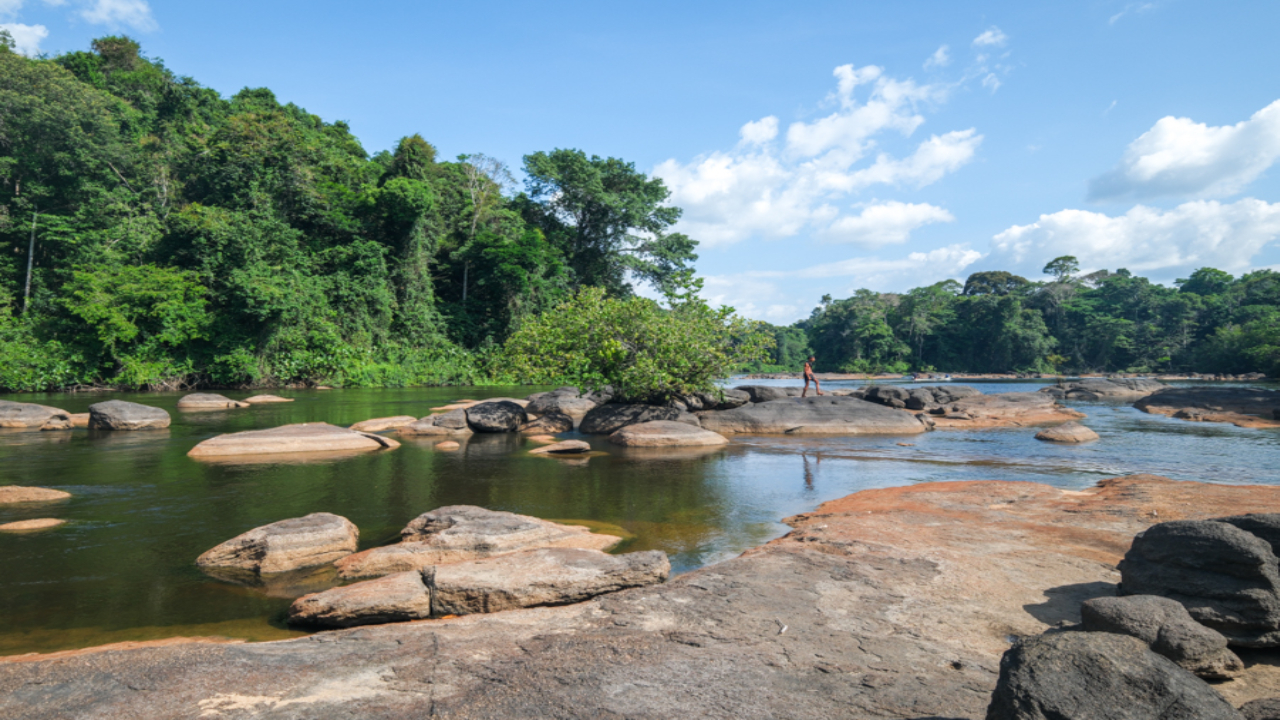
Mount Kasikasima is one of the most extraordinary and remote hiking destinations in South America. Hidden deep in the tropical rainforest of southern Suriname, this striking mountain formation rises above an enormous landscape of untouched-looking forest, winding rivers and isolated rocky peaks. Unlike famous mountain destinations reached by road, Kasikasima requires a genuine rainforest expedition involving a small aircraft, traditional dugout canoes, jungle camps and experienced local guides.
The journey usually begins in Paramaribo, Suriname’s capital, before a flight into the southeastern interior near Palumeu. From there, travelers move along the Tapanahony and Palumeu river systems, passing rainforest communities, rapids and remote forest camps. The final hiking section leads through dense tropical vegetation toward the Kasikasima mountain formation, where an elevated viewpoint offers sweeping views across the surrounding rainforest canopy.
What makes the Mount Kasikasima hike particularly memorable is the entire journey rather than the summit alone. Visitors experience the logistics of traveling through an extremely remote environment, sleep in simple jungle accommodation, learn from Indigenous guides and spend several days far from ordinary roads and city services. However, this is not a trip to improvise. River conditions, flight schedules, physical fitness, cultural permissions, limited communications and the availability of emergency evacuation all require careful planning.
This complete Mount Kasikasima Hike Guide explains where the mountain is located, how to reach it, how difficult the expedition is, what the trekking route involves, published tour packages and prices, where visitors sleep, Indigenous communities, wildlife, seasonal weather, health precautions, a five-day itinerary, an extended eight-day option, packing essentials and practical questions to ask before booking.


Mount Kasikasima at a Glance
| Detail | Information |
|---|---|
| Country | Suriname |
| Region | Sipaliwini District, southern Suriname |
| Mountain | Mount Kasikasima / Kassikassima |
| Recorded elevation | Approximately 718 meters above sea level, according to the geographic record |
| Mountain region | Tumuk Humak region |
| Departure city | Paramaribo |
| Gateway | Palumeu |
| Main transportation | Domestic aircraft, motorized dugout canoe and hiking |
| Expedition duration | Published 5-day and 8-day options |
| Difficulty | Strenuous wilderness expedition |
| Accommodation | Palumeu lodge and remote jungle camps |
| Published 5-day package | €808 per person from one operator |
| Published 8-day package | €950 per person from the same operator |
| Best general travel period | Relatively dry seasons, subject to river-water levels |
| Main highlights | Rainforest summit, canoe journeys, remote camps, wildlife and Indigenous-guided experiences |
Kasikasima consists of a remarkable rocky mountain landscape rather than a conventional hiking peak with a standardized tourist trail. The summit or viewpoint visited, distance walked and amount of climbing may vary by route and expedition operator.
Where Is Mount Kasikasima?
Mount Kasikasima is situated in the remote interior of southern Suriname, within Sipaliwini District, near the Tumuk Humak mountain region.
Unlike the more developed coastal areas around Paramaribo, the southeastern interior contains extensive tropical rainforest, river systems and settlements where boats and small aircraft are important forms of transport.
The Kasikasima landscape is associated with the Palumeu and Tapanahony waterways, which provide expedition access to the remote base camps used by organized groups.
The mountain’s approximate location is 2.98 degrees north latitude and 55.41 degrees west longitude, according to its geographic record.
Palumeu is the primary gateway. Tour operators arrange domestic flights to its airstrip before continuing upriver.
Visitors should not mistake Palumeu for a nearby roadside village. Reaching the mountain from the community still requires substantial additional travel by boat and on foot.
Why Is Kasikasima So Remote?
The southern Suriname rainforest has limited road infrastructure. Navigating its river systems requires experience with water levels, rock formations, currents and rapids.
Commercial expedition routes are therefore built around scheduled flights, local guides, boat crews and camps rather than independent public transportation.
For travelers, this creates an unusual combination of adventure and logistical dependency.
You cannot simply arrive at the mountain, purchase an entrance ticket and start walking.
Flights, local permissions, river transportation, camp equipment and the entire return journey need to be coordinated before departure.
Mount Kasikasima Location Map
The map below shows the general geographic area of Kasikasima in southern Suriname.
Navigation warning: A map pin is not a usable trekking route. Do not attempt to navigate independently from Palumeu to Kasikasima using consumer road directions or an unverified downloaded track.
What Does Mount Kasikasima Actually Look Like?
Kasikasima is known for its striking rocky formations rising above the rainforest canopy.
From suitable viewpoints, the mountain landscape appears as a series of pronounced rocky elevations surrounded by a continuous sea of tropical forest.
The setting is very different from volcanic peaks or high-altitude alpine mountains. The surrounding forest creates a dramatic contrast between the exposed rock and seemingly endless green canopy.
Because modern freely reusable photographs of the actual summit are limited, some historic photographs are particularly valuable for documenting the mountain’s appearance.
The photographs below were taken by Gerard Martinus Versteeg during an expedition in September 1904. They are historical records of the actual Kasikasima formation, not images of its current trekking infrastructure.


How Difficult Is the Mount Kasikasima Hike?
The Kasikasima expedition should be considered strenuous because it combines remote travel, prolonged rainforest exposure, uneven jungle trails, boat transfers and a steep mountain ascent.
Its difficulty cannot be expressed meaningfully using only the mountain’s elevation.
Although Kasikasima’s recorded elevation is approximately 718 meters, the challenges of reaching it are considerable.
Hikers may spend hours moving through humid forest before reaching the steeper rocky sections.
The trail can include exposed roots, wet stones, muddy slopes, fallen vegetation and uneven footing.
At higher elevations, the terrain can become steeper and more physically demanding.
Is Kasikasima Suitable for Beginners?
It is not a suitable first wilderness expedition for someone who has never completed long hikes or traveled in remote environments.
Good candidates are travelers who are comfortable spending several consecutive days outdoors, walking on muddy terrain, sleeping in simple camps and handling physically demanding excursions.
Previous tropical trekking experience is especially useful.
Visitors with limited fitness, significant mobility problems or medical conditions that could become serious far from healthcare should carefully assess whether the expedition is appropriate.
How Long Is the Actual Mountain Hike?
There is no reliable single public trail distance that applies to every Kasikasima expedition.
Different packages may approach the mountain from different camps and visit different viewpoints.
In published expedition itineraries, the summit ascent occupies a major part of the trekking day, often following hours of rainforest walking.
Before booking, ask for the expected walking distance, total elevation gain, approximate number of hiking hours and whether ropes or assisted scrambling are needed on the selected route.
An operator should be able to describe the physical challenge without relying solely on words such as adventurous or moderate.
How to Get to Mount Kasikasima
The standard organized route begins in Paramaribo, followed by a domestic flight to Palumeu and river transportation toward the mountain.
Step 1: Travel to Paramaribo
Most international visitors enter Suriname through Johan Adolf Pengel International Airport, which is located outside Paramaribo.
Allow a separate transfer to the capital and consider staying overnight before your expedition.
International flight delays can make same-day domestic connections unreliable.
Travelers should also verify Suriname’s current entry requirements, including any applicable entry fee, visa or travel authorization for their nationality.
Step 2: Fly from Zorg en Hoop to Palumeu
Organized expeditions commonly depart from Zorg en Hoop Airport in Paramaribo.
One published Kasikasima program lists an 11:00 AM departure and approximately 110 minutes of flight time, while other operators describe a shorter journey under different arrangements.
This is a small-aircraft flight into the rainforest interior rather than a standard large-airline service.
Aircraft type, departure times, luggage limits and weather procedures should be confirmed directly with the expedition operator.
Carry critical medication, documents and essential equipment according to the operator’s cabin-baggage rules.
Step 3: Arrive at Palumeu
Palumeu is a village in southern Suriname associated with Indigenous Trio and Wayana communities.
Travelers may spend their first night at the Palumeu Jungle Lodge or another accommodation specified by the expedition.
This provides time for orientation, equipment checks and preparation for the river journey.
The visit should be understood as entering a living community’s homeland, not arriving at an uninhabited tourism resort.
Step 4: Travel by Dugout Canoe
The next stage involves travel by motorized dugout canoe, often locally called a korjaal.
These narrow boats are used to navigate rainforest waterways and transport passengers, food and camping equipment.
The river journey is a major part of the expedition experience.
Depending on water levels, boat crews may need to approach rapids carefully, unload equipment, follow alternative channels or temporarily stop.
Passengers must follow the boat crew’s instructions and wear appropriate flotation equipment.
Step 5: Reach the Jungle Base Camp
Operators use remote camps to support trekking near Kasikasima.
Accommodation is generally simple, and guests may sleep in hammocks under shelter.
There are no conventional hotel facilities at the mountain itself.
After settling in, travelers prepare for the main hiking day under the direction of local guides.

Mount Kasikasima Hiking Route: What to Expect
Stage 1: Leaving the Base Camp
Most guided ascent days begin relatively early.
Hikers leave the base camp with a guide, drinking water and a daypack containing essential equipment.
The route initially passes through tropical rainforest where the canopy can block direct sunlight.
Although the forest may appear flat from a distance, the ground can contain slopes, exposed roots, muddy areas and fallen trees.
Humidity adds to the physical effort, particularly when the group needs to climb or scramble.
Stage 2: Walking Through Dense Rainforest
Much of the journey is spent beneath tall tropical vegetation.
The local guide determines the safest route and helps identify obstacles.
Rainforest walking is physically demanding in a different way from alpine hiking.
The main challenge may not be gaining elevation quickly but moving efficiently through heat, humidity and uneven terrain.
Carry enough water for the planned walk and keep snacks accessible.
Use insect repellent and avoid brushing against unfamiliar plants.
Stage 3: Approaching the Rocky Mountain
As the route approaches Kasikasima, the terrain becomes steeper and rockier.
Hikers may need to climb natural steps, move across roots or use hands for balance on selected sections.
Rock can be slippery after rain, particularly where algae, moss or loose vegetation cover the surface.
Do not attempt exposed scrambling unless your guide confirms that the route is appropriate for your experience and the current weather.
Stage 4: The Rainforest Viewpoint
The highest point reached during a guided itinerary offers a remarkable perspective over the surrounding forest.
Instead of seeing individual trees, visitors look across a vast canopy that stretches toward the horizon.
The landscape is especially impressive because of its remoteness.
However, visibility depends on weather, and clouds or rain can hide distant mountains.
Kasikasima is a group of distinctive rocky formations, so the precise lookout reached may differ between tour routes.
The physical achievement should be considered secondary to safe navigation and weather conditions.
Stage 5: Descending to Camp
The descent requires concentration.
Wet roots, loose soil, rocks and fatigue increase the risk of slipping.
Stay behind the guide, keep adequate spacing between hikers and avoid unnecessary shortcuts.
After returning to camp, dinner and rest become important parts of recovery.
Depending on the itinerary, the next day may involve additional rainforest walks, a waterfall excursion or the return river journey.

Five-Day vs Eight-Day Kasikasima Expedition
Two of the published commercial options are a five-day adventure and a longer eight-day expedition.
| Feature | 5-day trip | 8-day trip |
|---|---|---|
| Published example price | €808 per person | €950 per person |
| Main objective | Focused Kasikasima adventure | Kasikasima plus more rainforest exploration |
| Transport | Aircraft and dugout canoe | Aircraft and dugout canoe |
| Accommodation | Palumeu and remote camp | Palumeu and several jungle-camp stages |
| Main summit day | Day 3 in published itinerary | Day 4 in published itinerary |
| Additional activities | River travel and Palumeu visit | Waterfall, river and wildlife excursions |
| Recommended for | Fit travelers with limited time | Travelers comfortable with extended wilderness stays |
These are published package examples from All Suriname Tours. Prices and daily programs are subject to change, so request a written quotation for your departure date.
View the five-day expedition and view the eight-day expedition.
Suggested Five-Day Mount Kasikasima Itinerary
The itinerary below follows the broad structure published by All Suriname Tours. It is an example of one operator’s expedition, not an independent route to attempt without support.
Day 1: Fly to Palumeu
Depart Paramaribo’s local airport for Palumeu.
Meet the local expedition team and travel to the assigned accommodation.
Depending on the program and conditions, the afternoon may include a visit to Palawa Island and a short boat excursion.
Prepare equipment for the river journey and confirm what to carry into the jungle camps.
Day 2: Travel by Canoe to Base Camp
Board the dugout canoe and continue through the Palumeu river system.
Travel time depends on the water level, river conditions and the selected camp.
The operator’s itinerary includes a section near Trombaka rapids and an arrival at a remote jungle base camp.
Learn the camp’s safety rules and sleeping arrangements before nightfall.
Day 3: Hike Mount Kasikasima
Begin the guided ascent through dense rainforest.
The day’s objective is to reach the mountain viewpoint if conditions are appropriate.
The ascent involves sustained walking and potentially steep rocky sections.
After enjoying the permitted viewpoint, descend carefully and return to the jungle camp.
Rest, eat and prepare for the following day’s river journey.
Day 4: Return Toward Palumeu
Travel back along the river, with stops determined by the boat crew and weather.
Return to the Palumeu area and enjoy a quieter evening after the mountain and camp sections.
Day 5: Palumeu Village and Flight to Paramaribo
Depending on the operator’s arrangements and community permission, spend time learning about local crafts and village life.
Return by aircraft to Paramaribo.
Because weather can disrupt flights from remote airstrips, avoid arranging a tightly timed international connection immediately afterward.
What Makes the Eight-Day Expedition Different?
The longer itinerary allows more time for the surrounding rainforest and river landscape.
In the published eight-day program, travelers move between Palumeu, Kamakabari camp and Kasikasima base camp.
Additional activities may include a guided visit to Kodebaku waterfalls, wildlife observation, river excursions and encounters with local communities arranged with appropriate permission.
The extra time can make the trip feel less focused on a single mountain objective and more like a complete rainforest journey.
However, an eight-day trip also involves more nights in simple accommodation, greater exposure to heat and insects, and a longer period away from communications and healthcare.
Choose the longer expedition because you are genuinely comfortable with wilderness travel, not simply because it includes more activities.

Where to Stay During a Kasikasima Expedition
Accommodation is unusual because the expedition moves between a rainforest lodge, temporary or semi-permanent camps and the city of Paramaribo.
It is important not to confuse a jungle base camp with a conventional hotel.
1. Palumeu Jungle Lodge — The Rainforest Gateway
Location: Palumeu, Upper Tapanahony region, Suriname.
Palumeu Jungle Lodge is a genuine accommodation operation associated with rainforest tourism and Indigenous-guided experiences in southern Suriname.
METS Travel & Tours operates lodge programs in the region.
The lodge provides a base for excursions and is used as a starting or finishing point for longer Kasikasima itineraries.
Accommodation is comparatively more organized than the remote hammock camps, but it should not be assumed to provide the same facilities as an urban hotel.
Visitors should confirm bathroom arrangements, mosquito protection, electricity availability, meals and communications before booking.
Best for: Travelers joining guided rainforest excursions and Kasikasima expeditions.
Published alternative stay: Palumeu Jungle Lodge packages are advertised from approximately €665 for four or five days by some operators. A Palumeu-only stay does not necessarily include the Kasikasima mountain ascent.
Actual lodge photographs and package information: All Suriname Tours — Palumeu Jungle Lodge Packages.
2. Kasikasima Base Camp — Best for the Summit Expedition
Location: Remote rainforest near the Kasikasima Mountains.
The Kasikasima base camp is not a normal commercial hotel that independent guests can book by room.
It forms part of an organized expedition and is reached by canoe and hiking.
Sleeping arrangements commonly involve hammocks and shelter rather than traditional guestrooms.
Facilities are basic, and ordinary expectations such as air conditioning, continuous electricity and reliable mobile coverage do not apply.
Food, water treatment, cooking equipment and sleeping arrangements are normally organized by the expedition team.
Best for: Fit travelers prepared for basic rainforest camping.
Booking: Normally included as part of a multi-day Kasikasima expedition.
Actual camp imagery: View the operator’s Kasikasima expedition photographs and accommodation description.
3. Kamakabari Jungle Camp — An Extended River-Expedition Stop
Location: Along the remote river-expedition route toward Kasikasima.
Kamakabari appears in published longer Kasikasima expedition itineraries as an overnight or staging camp.
Its value is logistical: it allows travelers and guides to break a demanding journey into manageable stages.
The camp should be understood as rustic expedition accommodation, with the specific sleeping layout determined by the operator.
Do not assume private rooms, flush toilets or hotel-style food service without confirmation.
Best for: Travelers participating in the extended eight-day expedition.
Accommodation information: Official published eight-day program.
4. Hotel Palacio — A Practical Stay Before or After the Expedition
Address: Heerenstraat 9, Paramaribo, Suriname.
Hotel Palacio is a boutique hotel in Paramaribo’s historic center.
Its official website describes 22 rooms with private bathrooms, air conditioning and Wi-Fi.
The property offers breakfast, a 24-hour front desk and arrangements for taxi or airport transfers.
Staying in Paramaribo before the expedition is practical because travelers can organize paperwork, repack luggage and confirm departure instructions before flying inland.
It also provides a more comfortable night after several days in remote camps.
However, the hotel is not at Zorg en Hoop Airport, and guests must arrange the appropriate transfer.
Best for: Travelers needing a city-based hotel before and after the fly-in expedition.
Actual hotel and room photographs: Hotel Palacio Official Website and Gallery.
Indigenous Communities and Responsible Travel
The Kasikasima and Palumeu region is associated with Indigenous Trio and Wayana communities.
These communities are central to the expedition’s local knowledge, navigation and cultural context.
However, Indigenous villages should never be presented as open-air museums or attractions without residents’ consent.
Visitors should approach community experiences through appropriate local arrangements.
Ask permission before photographing residents or homes, respect restrictions on sacred or private spaces and avoid interrupting everyday activities.
Local guides may share information about forest use, wildlife, traditional knowledge and cultural connections to the landscape.
Any stories, beliefs or traditions should be attributed to the people who share them rather than presented as universally held beliefs across all communities.
Choosing an operator that employs and fairly compensates local boat crews, guides and camp workers can help direct tourism income toward the people who make the expedition possible.
Wildlife Around Mount Kasikasima
Southern Suriname is part of the Guiana Shield rainforest region, an extensive tropical landscape with diverse plants and animals.
Wildlife possibilities mentioned in expedition programs include howler monkeys, giant river otters, caimans and numerous forest birds.
However, wildlife sightings are never guaranteed.
Dense vegetation, changing weather and animal behavior make rainforest wildlife more difficult to observe than animals in a zoo or open safari landscape.
Many creatures are heard rather than seen.
Visitors may notice insects, frogs, bird calls and other sounds throughout the day and night.
Experienced local guides can interpret signs of wildlife and explain which species are realistically observable in the area.
Do not attempt to lure animals with food or approach them closely for photographs.

Best Time to Visit Mount Kasikasima
Suriname has a tropical climate with two relatively dry periods and two rainier periods.
However, inland rainforest travel is influenced not only by rainfall but also by river levels.
Long Dry Season: Approximately Mid-August to Early December
This is often an attractive period for outdoor travel because rainfall tends to be lower.
Rainforest trails may be less muddy than during the wettest months.
However, low water can make river travel difficult in shallow sections or near rapids.
Do not assume that the driest possible month always provides the easiest canoe journey.
Short Dry Season: Approximately February to April
This can also be a useful period for trekking.
Conditions still vary, and the expedition operator should assess river navigability as well as walking conditions.
Rainier Periods: Approximately December–January and April–August
Heavy rainfall can make trails muddy and increase river flow.
Higher water may help certain shallow-water sections while making rapids and currents more dangerous.
Small-aircraft flights can also be affected by poor weather and visibility.
The safest travel period is the one during which a reputable local operator confirms that current river, flight and trail conditions are appropriate.
Climate reference: Suriname Hospitality and Tourism Association — Seasons.
Mount Kasikasima Expedition Safety Guide
Kasikasima is a serious wilderness journey.
The main risks come from remoteness, river conditions, tropical illness, falls, dehydration, difficult communications and delayed access to emergency medical care.
1. Do Not Attempt the Expedition Independently
There is no practical public hiking route from Paramaribo to the summit.
Independent travel through unfamiliar rainforest without reliable navigation, local permission and river support can be extremely dangerous.
The Government of Canada’s Suriname travel guidance specifically recommends using experienced guides and avoiding solo jungle trekking.
2. River Rapids Require Experienced Boat Crews
Dugout canoes may travel through narrow channels, shallow sections and rapids.
Water conditions can change quickly after rainfall.
Wear a properly fitted personal flotation device when instructed and remain seated when the crew directs.
Do not stand in an unstable canoe or attempt to cross a rapid independently.
If the boat crew asks passengers to disembark for a difficult section, follow their instructions carefully.
3. Medical Evacuation Can Be Difficult
The mountain and river camps are far from major medical facilities.
An injury or illness may require a complicated transfer by boat and aircraft.
Ordinary insurance policies may exclude certain expedition activities or have limits on evacuation coverage.
Before booking, obtain travel insurance that explicitly covers the planned trekking activities and remote medical evacuation, including helicopter evacuation where available and appropriate.
Ask how the operator communicates with emergency services when mobile networks do not work.
4. Mosquito-Borne Illnesses
Mosquito protection is particularly important in tropical rainforest environments.
The CDC’s Suriname travel information discusses yellow fever, dengue, chikungunya and malaria history.
The CDC’s latest listed malaria information indicates no indigenous malaria cases since 2021 and currently emphasizes mosquito avoidance rather than routine chemoprophylaxis for Suriname. Recommendations can change, and an individual travel-medicine consultation is important for a remote expedition.
Use an effective insect repellent, wear suitable long sleeves and trousers, and confirm mosquito-net arrangements at each camp.
Seek medical evaluation if you develop fever during or after your trip.
5. Yellow Fever and Vaccination Requirements
Yellow fever vaccination is recommended for many travelers visiting Suriname.
Country entry rules may also require proof of vaccination for travelers arriving from certain other countries or after qualifying transit stops.
Discuss vaccination timing, eligibility and any medical contraindications with a qualified travel-health professional before departure.
For remote rainforest trips, it is sensible to consult a travel clinic several weeks in advance.
CDC — Suriname Health Recommendations.
6. Heat, Humidity and Dehydration
Rainforest humidity can make hiking feel difficult even when the air temperature is not exceptionally high.
Drink regularly and communicate any symptoms of dizziness, weakness or overheating to your guide.
Ask whether the team supplies treated drinking water and what personal water capacity you should carry during the summit day.
Do not drink untreated river water.
7. Slippery Trails and Falls
Wet roots, muddy slopes and rocks can become dangerously slippery.
Use hiking footwear with good traction and avoid rushing.
On steep sections, maintain safe spacing between hikers so that a slip or falling object does not affect another person.
8. Wildlife and Plants
Rainforests contain animals and plants that visitors may be unfamiliar with.
Do not touch unknown animals, insects, fungi or plants.
Check your footwear and camping equipment before using them.
Keep food stored according to your guide’s instructions and avoid feeding wildlife.
9. Communications and Emergency Planning
Some published itineraries describe remote camps without mobile-phone coverage or radio communication.
Before departure, ask whether the current expedition carries a satellite phone, emergency locator or other reliable communication equipment.
Do not assume that the presence of a guide automatically guarantees rapid external contact.
Leave your route and expected return date with someone outside the expedition.
10. Respect Weather-Related Changes
Flights, boat departures and trekking routes may be delayed or altered due to weather.
Never insist on continuing a route when the guide or boat crew considers it unsafe.
Maintain flexibility for a postponed domestic return flight.
What to Pack for a Kasikasima Jungle Expedition
The most useful equipment is lightweight, durable and suited to humidity.
- Comfortable hiking boots or trail shoes with reliable grip.
- Lightweight quick-drying shirts and trousers.
- Long-sleeved clothing for mosquito protection.
- Waterproof rain jacket.
- Sun hat and sunglasses.
- Effective insect repellent.
- Headlamp with spare batteries.
- Waterproof dry bags.
- Reusable water bottles or hydration reservoir.
- Water treatment backup if recommended by the operator.
- Personal medication and basic first-aid supplies.
- Blister care and suitable spare socks.
- Power bank and charging equipment.
- Small towel and personal toiletries.
- Swimwear if relevant to permitted activities.
- Lightweight sandals for camp use.
- Passport and copies of essential documents.
- Insurance details covering remote evacuation.
- Cash for personal expenses or community purchases.
- Small waterproof pouch for important items.
Ask the operator about maximum aircraft baggage weight before packing.
Do not assume that large suitcases can be taken on small domestic aircraft or transported comfortably through canoe and camp sections.
Pack a smaller expedition bag and leave unnecessary city clothing at an approved storage location if the operator offers that service.
Common Mistakes to Avoid
Treating Kasikasima as a day hike: Reaching the mountain requires several stages of transport and accommodation.
Ignoring flight baggage restrictions: Small-aircraft capacity can be limited.
Booking a tight international connection: Weather-related domestic flight delays may disrupt your return.
Assuming camps have hotel facilities: Hammock sleeping and basic sanitation are part of some itineraries.
Comparing prices without inclusions: Confirm flights, meals, guides, camping equipment, community payments and insurance exclusions.
Overlooking medical preparation: Mosquito-borne illnesses and remote healthcare are relevant considerations.
Expecting guaranteed wildlife sightings: Rainforest animals can be difficult to observe.
Entering rivers without permission: Hidden currents, rapids and underwater hazards can make apparently calm water dangerous.
Photographing Indigenous residents without consent: Respect local privacy and cultural rules.
Is the Mount Kasikasima Expedition Worth It?
For experienced travelers who enjoy remote wilderness journeys, Mount Kasikasima offers a rare combination of rainforest trekking, river navigation, Indigenous-guided travel and extraordinary mountain scenery.
The appeal is not simply the elevation or the summit photograph.
It is the experience of spending several days in southern Suriname, moving through waterways and forests that are difficult to reach without local knowledge.
However, this is not an appropriate destination for every traveler.
If you prefer reliable mobile reception, private hotel rooms, easy medical access or flexible independent sightseeing, a different Suriname rainforest destination may be more comfortable.
Kasikasima is most rewarding for travelers who accept its logistical complexity and understand the importance of local guides and environmental conditions.
Frequently Asked Questions About Mount Kasikasima
Where is Mount Kasikasima located?
Mount Kasikasima is located in Sipaliwini District in southern Suriname, near the Tumuk Humak region and the river systems associated with Palumeu.
How high is Mount Kasikasima?
Its geographic record lists an elevation of approximately 718 meters above sea level. Individual rocky summits and tour viewpoints may differ.
Can you reach Kasikasima by road?
No conventional road-trip route serves the mountain. Organized expeditions commonly use a flight to Palumeu followed by dugout-canoe travel and hiking.
How many days do you need?
Commercial itineraries include five-day and eight-day options. The shorter trip focuses on reaching Kasikasima, while the longer program includes additional rainforest and river excursions.
How much does the Kasikasima expedition cost?
One operator currently advertises a five-day package at €808 per person and an eight-day package at €950 per person. Obtain a written live quotation for your specific departure and group.
Is Mount Kasikasima difficult to hike?
Yes. The complete expedition is strenuous because it combines remote travel, rainforest hiking, uneven trails, river journeys and potentially steep rocky sections.
Can beginners hike Kasikasima?
It is not recommended as a first wilderness hike. Travelers should have good fitness and be comfortable with long trekking days and basic camps.
Do you need a guide?
Experienced local guides are essential for practical access, navigation and safe movement through the river and forest environment. Visitors should arrange the journey through a reputable expedition operator.
Where do you sleep during the expedition?
Accommodation typically includes a Palumeu lodge and basic jungle camps. Remote camp arrangements may involve hammocks rather than hotel beds.
Is there mobile phone reception?
Reliable mobile service should not be expected in the remote expedition area. Ask the operator what emergency communication equipment it carries.
What is the best time of year to visit?
Relatively dry periods are often preferred for trekking, but river levels can affect canoe navigation. A local operator should confirm current conditions before departure.
Is Kasikasima safe?
It involves meaningful wilderness risks, including river currents, slippery terrain, tropical illnesses and delayed medical assistance. Experienced guides, appropriate insurance and emergency planning are essential.
What animals might you see?
Wildlife possibilities include forest birds, howler monkeys, caimans and giant river otters, but sightings are not guaranteed.
Can you swim in the rivers?
Only where the local guide specifically confirms suitable conditions. Tropical rivers may contain strong currents, rapids and hidden underwater hazards.
Should you choose five or eight days?
Five days may suit fit travelers with limited time. Eight days is better for those who want additional rainforest experiences and are comfortable spending longer in basic camps.
Final Thoughts
The Mount Kasikasima expedition is among Suriname’s most distinctive wilderness adventures.
Its extraordinary setting, remote river routes and challenging rainforest trekking create an experience far removed from ordinary sightseeing.
To appreciate it properly, travelers need realistic expectations about the journey and the amount of preparation involved.
Arrange flights, river transport, guides and accommodation through a dependable expedition operator. Confirm health precautions, insurance coverage and communications before leaving Paramaribo.
Respect the Indigenous communities whose knowledge and services make travel in this region possible, and treat the rainforest as an environment that deserves caution.
For travelers who are prepared for the physical and logistical demands, Kasikasima offers an exceptional opportunity to experience the forest landscapes of southern Suriname.
Sources and Further Reading
This guide uses published expedition programs, recognized travel-health and safety authorities, accommodation websites and documented photograph licenses. Exact departure schedules, prices and operating conditions should be reconfirmed before travel.
- All Suriname Tours — Five-Day Kasikasima Expedition. Published itinerary, price, river journey, accommodation and activity inclusions.
- All Suriname Tours — Eight-Day Kasikasima Expedition. Extended itinerary, camps, guide services and rainforest excursions.
- Orange Travel Suriname — Adventure Tours. Alternative operator information and Kasikasima expedition offerings.
- Suriname Hospitality and Tourism Association — Seasons. Climate and wet/dry periods.
- Government of Canada — Suriname Travel Advice. Remote trekking safety, guides and evacuation insurance.
- CDC — Suriname Traveler Health. Vaccination recommendations, mosquito-borne diseases and remote travel health precautions.
- UK Government — Suriname Health Advice. Medical care and travel health information.
- Hotel Palacio — Official Website. Paramaribo accommodation, facilities and property photographs.
- Wikimedia Commons — Kasikasima Photograph Collection. Historic mountain documentation and image rights.
- Wikimedia Commons — Tapanahony River. Modern regional river photograph and license.
Photography and Copyright Information
Modern rainforest and river photographs are credited individually to their photographers and carry Creative Commons licenses identified in their captions. Historical Kasikasima images are explicitly dated and sourced from public-domain archive material. Photographs of hotel and jungle-camp facilities are linked to the relevant providers rather than copied without independently established republication rights.
When uploading reusable images to WordPress, preserve the photographer, source and license links. If photographs are cropped or otherwise modified, include the notices required by the applicable license.